




Revving Engines Unite Sarasota Residents and Businesses in City Sound Debate

Image: Damon Powers
If anyone still doubted that Sarasota leans older, Monday’s City Commission meeting offered supporting evidence—much of it at considerable volume.
Sarasota County has the highest median age among the nation’s counties, with at least 250,000 residents aged 57.8, and nearly 39 percent of its population is 65 or older. The city’s new sound survey tilted older still: Of the survey respondents, nearly 60 percent were at least 65, and 90.2 percent were 45 or older.
Complaints ranged from booming music and school loudspeakers to construction equipment and mechanical systems. But one source of noise united residents and businesses more than any other: vehicles.
More than 1,000 of the survey’s 1,456 respondents identified engine revving as a major concern. Roughly 77 percent of participating businesses mentioned loud motorcycles, revving engines, modified exhaust systems or vehicle stereos—an unusually clear point of agreement in a debate otherwise divided over nightlife, amplified music and just how quiet a growing city should be.
After nearly three hours of presentations, testimony and debate, commissioners unanimously approved two additional phases of study, directed staff to change the way sound is measured at special events and, in a 3-2 vote, ordered the creation of a cross-department sound-enforcement team.
That team will explore how to enforce existing city rules and Florida laws governing vehicle noise, including engine revving, exhaust and music from cars. Commissioners also directed staff to begin discussions with the Sarasota County School District about excessive sound from some schools.
The decisions followed the presentation of the first phase of a citywide study by Siebein Acoustic with the University of Florida School of Architecture. The consultants installed eight long-term sound meters, conducted “sound walks” through several parts of the city, accompanied Sarasota police into the early morning hours and collected survey responses representing about 2.5 percent of the city’s population.
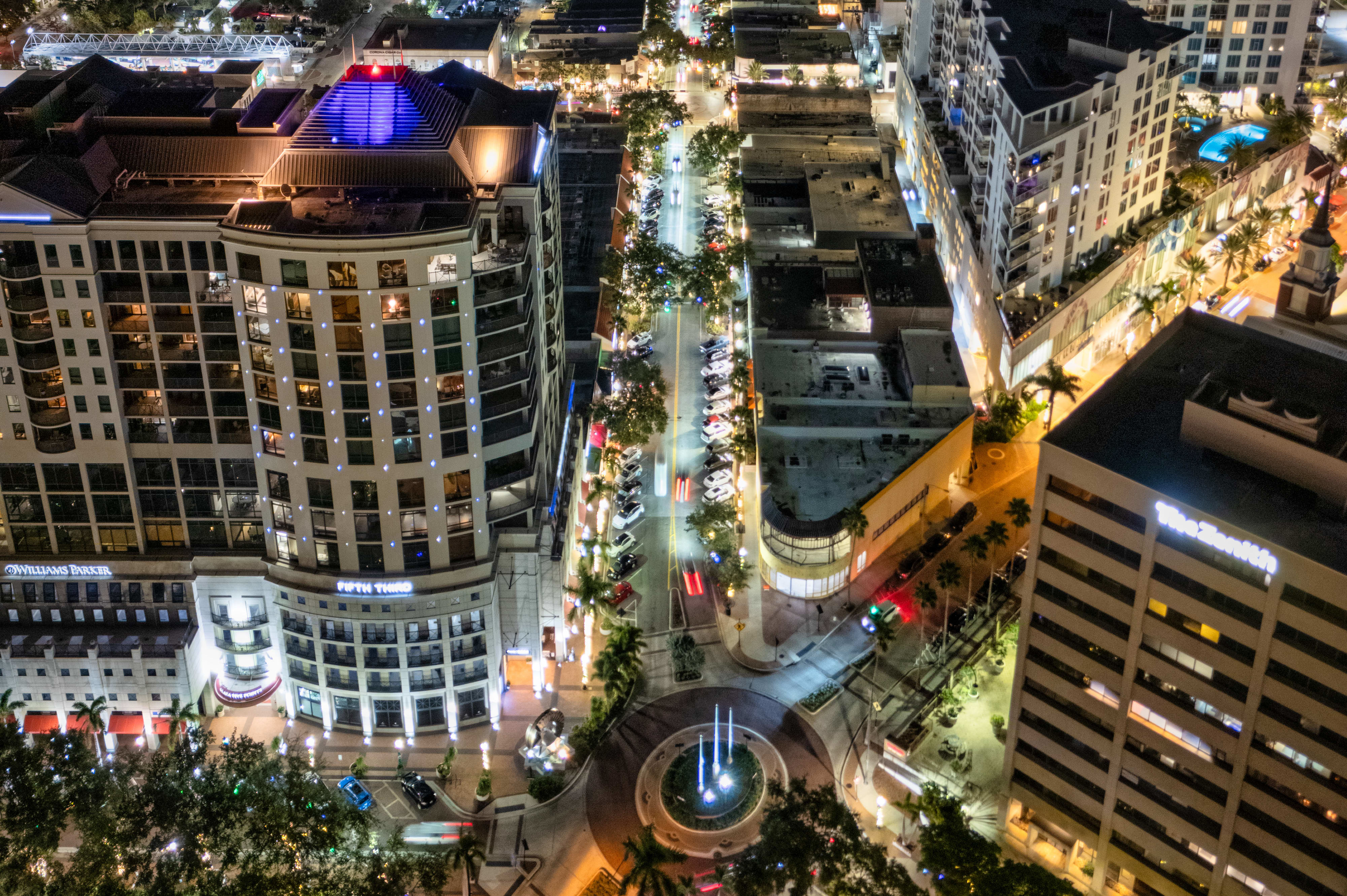
The study examined downtown, Newtown, St. Armands Circle, Ted Sperling Park, the area around Sarasota High School and suburban residential neighborhoods. It found that Sarasota doesn’t have one soundscape, but many—complicating any attempt to impose a single citywide standard.
“What is in downtown with these 60, 70 decibel [dB] levels is not what is out in the suburban areas away from the major arterials,” Gary Siebein, the firm’s senior principal, said.

The city’s ordinance is similarly complicated. Different rules can apply depending on whether a sound is amplified or continuous, produced indoors or outdoors, intermittent or sustained, and heard during the day or at night. Police currently try to record five-minute readings, a period long enough for passing cars, conversations and other sounds to interfere with the measurement—or for someone inside a club to turn down the volume.
“You can take measurements for 15 or 30 seconds and get a pretty reasonable reading,” Siebein said.
City Attorney Joseph Polzak said the current ordinance is “widely regarded as a mess.” The study is intended to produce clearer standards that can be consistently enforced and legally defended.
The city’s existing limits at residential receiving properties are 75 A-weighted decibels (dBA) and 80 C-weighted decibels (dBC) during the day, and 65 dBA and 70 dBC at night. The A-weighted scale generally reflects the frequencies most readily heard by the human ear, while the C-weighted scale captures more low-frequency sound, including the bass residents say they can feel inside their homes.
For a rough comparison, normal conversation is about 60 dBA, while a household vacuum or electric pencil sharpener is generally around 70 dBA. That places the city’s nighttime A-weighted limit slightly above ordinary conversation and its daytime limit around the range of those household appliances—but measured where the sound reaches the residential property, not beside its source. The comparison is less useful for dBC readings, which retain much more low-frequency sound. A bass-heavy source can therefore produce a higher dBC reading than dBA reading, reflecting the thumping or vibration residents may experience even when the sound does not seem exceptionally loud.
Consultants cautioned against changing those limits before collecting data during Sarasota’s busier winter season, when ambient sound levels are expected to rise. A threshold set too close to ordinary background sound could effectively turn the sounds of everyday city life into violations.
That didn’t satisfy everyone who has been waiting years for relief.
John Bordeaux, a full-time downtown resident, objected to a passage in the report saying most stakeholders understood downtown to be a "vibrant entertainment district" and considered that desirable. Downtown residents, he said, support "the restaurants, the shops, the businesses, the arts, the farmers markets" and "pay exorbitant taxes."
“If it wasn’t for the downtown residents, there would be no downtown,” Bordeaux said.
The consultants later called “entertainment district” an unfortunate choice of words and agreed that downtown is a mixed-use district.
David Lowe, a board member of the Downtown Sarasota Condominium Association, questioned how much more study the city needed.
“How many commission meetings and hundreds of thousands of dollars will it take to screw in a light bulb?” he asked. “Well, on sound, I think we may be finding out now.”
Lowe urged the city to take at least incremental action, particularly on vehicle noise and enforcement, while continuing the study.
Business owner and city resident Chris Voelker argued for completing the process before adopting broader regulations that could substantially affect downtown businesses.
“We have an opportunity here to get this right,” Voelker said. “We have to get the complete data, the full public impact and the benefit of the entire process.”
The study found that about 92 percent of participating businesses described downtown’s sound environment positively. Live music, special events and outdoor dining were viewed as contributors to its vitality. Businesses nonetheless shared residents’ frustration with vehicle noise, which the report said discourages some diners from sitting outside.
Another public speaker also asked the city to reconsider construction hours, saying she has been unable to enjoy a quiet Sunday afternoon in her backyard for more than six years.
Noise from Sarasota High School produced another line of complaints.
Steve Martinucci said amplified sound from the school’s stadium, batting cages and mechanical equipment affects nearby homes, but school activities are broadly exempt from the city ordinance. He asked commissioners to create some form of oversight without regulating ordinary school life, such as cheering crowds, band music or children playing.
The next phase of the city study will include measurements around Sarasota and Booker high schools while they’re in session. The consultants conducted their initial fieldwork in July, when the schools were largely inactive. Regulating school activity could prove legally difficult because of exemptions in the existing ordinance, so commissioners directed staff to begin discussions with the school district instead.
The commission unanimously accepted the first-phase report and authorized Siebein Acoustic and the city attorney to proceed with phases two and three. That work will include additional stakeholder meetings, measurements during season, testing of possible standards and development of a proposed ordinance.
In a 3-2 vote, with Mayor Debbie Trice and Commissioner Liz Alpert opposed, commissioners approved Vice Mayor Kathy Kelley Ohlrich’s motion to establish a sound-enforcement team made up of the Sarasota Police Department, code enforcement and special-events staff.
The motion also directed the city to begin enforcement of laws addressing engine revving and music from motor vehicles, to the extent permitted under the current ordinance and Florida law. Before the team can operate fully, however, the city must work through questions involving training, staffing, equipment, departmental authority and the practical difficulty of catching a noisy vehicle before it disappears down the street.
Alpert said she supported exploring a sound team but worried that establishing one before those details were settled would create unrealistic expectations.
“I think it’s going to create false expectations,” she said. “I think we should wait and get the information, the evaluation, so it can be crystal clear who’s doing what.”
The sound team will not be able to enforce the consultants’ recommendations unless they are incorporated into a future ordinance. Police may enforce applicable state vehicle laws, code officers may address violations within their authority and special-events staff may require events to comply with their permits.
Commissioners also unanimously approved two immediate changes to special-event permits. Sound will be measured 100 feet from the main loudspeakers, and the permit language will use “or” between its dBA and dBC limits, meaning either measurement may establish that the limit has been exceeded.
A comprehensive rewrite of the ordinance will return to the commission after more measurements, testing and public discussion.
For now, Sarasota has not turned down the city. It has ordered more readings, begun assembling a team and put revving engines first in line for attention—assuming they remain in one place long enough to catch.


