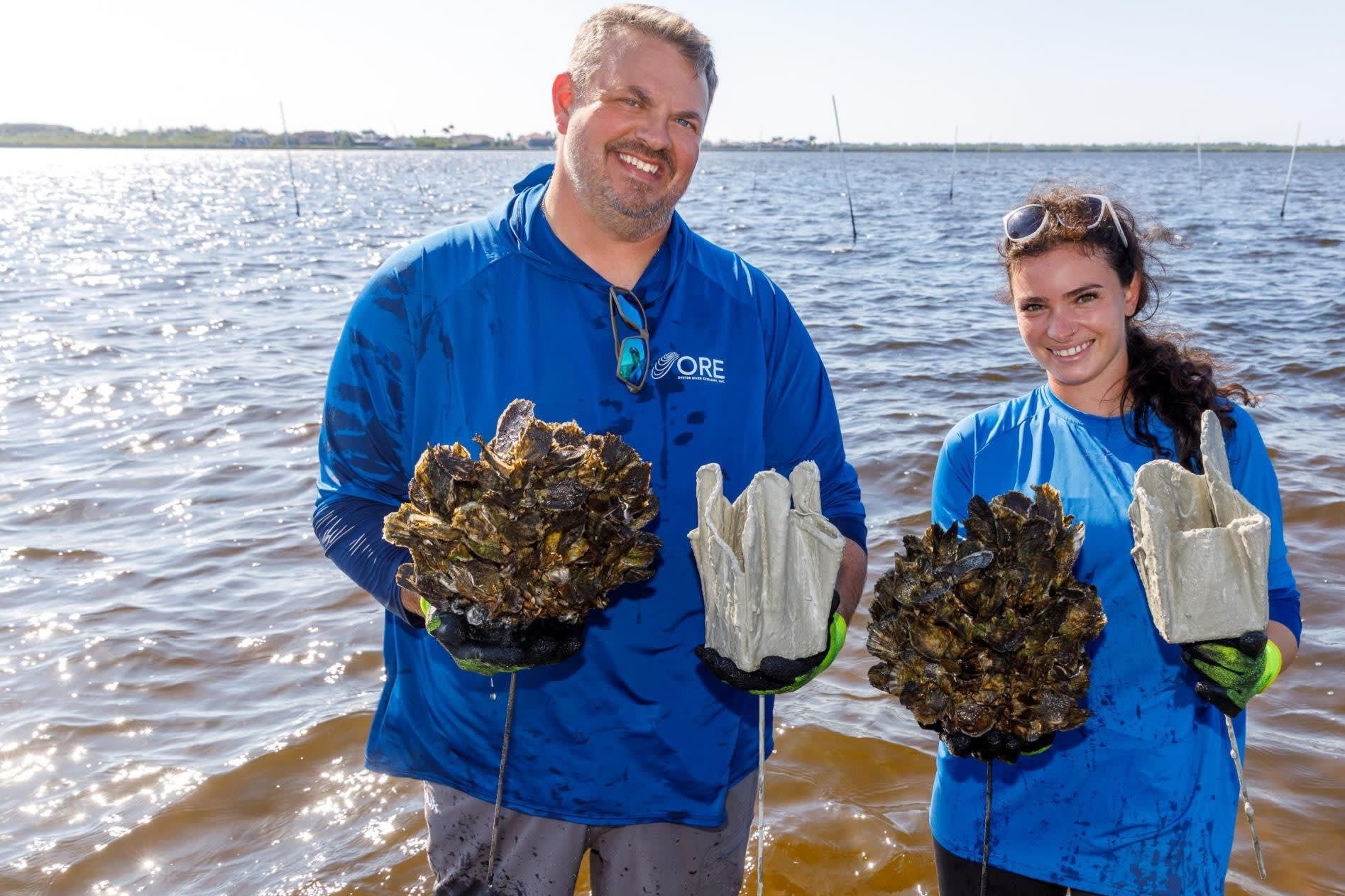


Bringing Oysters Back to the Manatee River

Image: Shutterstock/RASantos-Afan
On a quiet stretch of the Manatee River, just east of the U.S. 41 Green Bridge, hundreds of dome-shaped concrete structures sit on the riverbed, slowly disappearing beneath a growing layer of marine life. Within months of being installed, the hollow reef balls began attracting oysters, barnacles and crabs—the first signs that a long-lost ecosystem may be returning to the river.
The structures are part of a five-year experiment led by the City of Palmetto to restore oyster habitat and improve water quality in the Manatee River. If the Palmetto Bay Oyster Restoration Project succeeds, the oysters growing on those reef balls could eventually filter thousands of gallons of river water each day while also rebuilding a natural habitat that once covered large sections of Florida’s Gulf Coast estuaries.
In February 2024, the artificial reef structures were installed in a grid along the north side of the river between the Green Bridge and the nearby railroad bridge. The installation consists of 76 clusters of reef balls placed across the riverbed to provide surfaces on which oysters and other marine organisms can attach and grow.
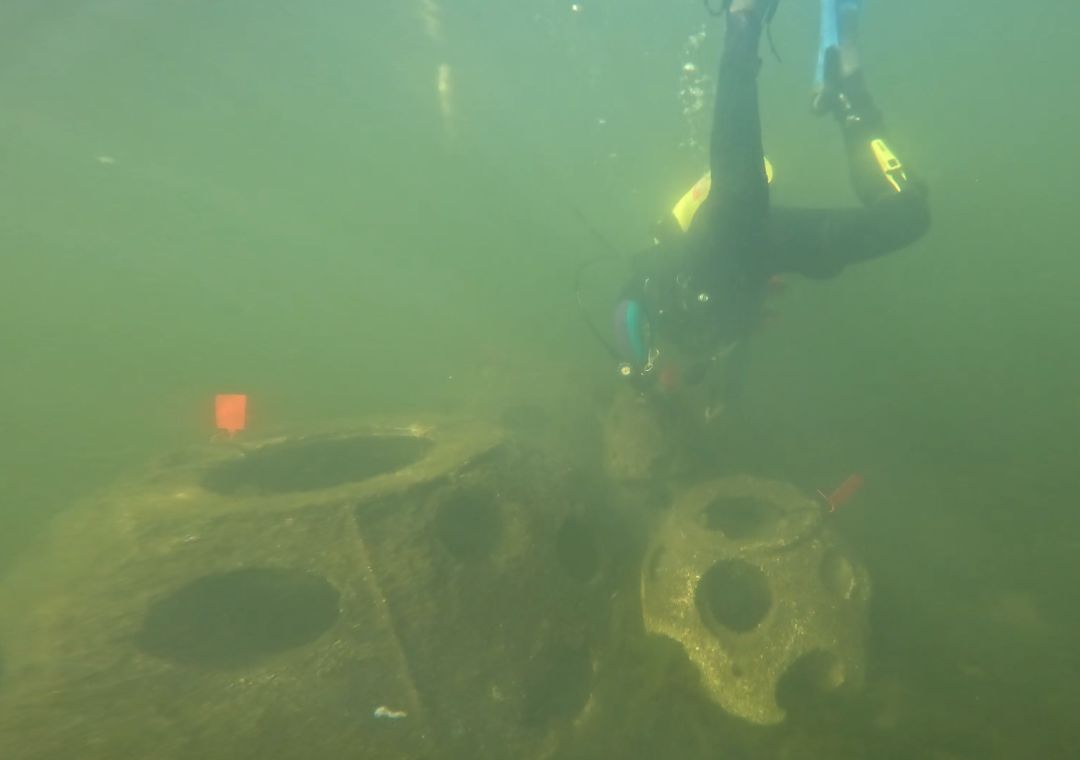
Image: Courtesy Photo
“There are 380 reef balls that have been placed in clusters of five,” says Dr. Ernesto Lasso de la Vega, the marine biologist studying the project’s ecological development. “That grid has been created artificially for improving the water quality in that particular spot.”
By arranging the reef structures in a grid, scientists can track how marine life colonizes the site and measure changes in water quality over time. “Most projects put the reef structures in and walk away and say, of course the oysters will grow. But here we are quantifying everything," Lasso de la Vega says.

Image: Courtesy Photo
For the City of Palmetto, the oyster restoration effort is about more than rebuilding habitat. “We don’t have a sign that says boats can’t anchor here," says Rowena Young, executive director of the Palmetto Community Redevelopment Agency (CRA). She sees it as part of a broader effort to protect the river that shapes the community’s identity and waterfront economy. “The Manatee River is the heart of the community,” says Young. “We’re surrounded by this water, and we want to make sure that the quality of the water and the quality of life surrounding the water is beneficial to the community.”
And while the project may seem unusual for a redevelopment agency, Young says it aligns directly with the CRA’s health and welfare mandates.
The Manatee River once supported far more oysters than it does today. Large reefs historically covered sections of the river, but humans overharvested them, depleting them. In fact, more than a century ago, oysters were so common in the Manatee River that the waterway was called Oyster River.
The decline, Lasso de la Vega says, was driven largely by human activity. “The harvesting that fishermen and construction crews were doing was indiscriminate,” he explains. “They used the shells to build roads and construction projects.”
The story of the Manatee River mirrors what happened across much of coastal Florida. Historical surveys of Sarasota Bay and Tampa Bay describe oyster bars lining shallow shorelines and river mouths throughout the region before large-scale harvesting, dredging and coastal development reduced their numbers during the late 19th and 20th centuries. Today, restoring those reefs has become a growing focus of coastal restoration efforts because oysters not only provide habitat for fish and crabs, but also act as natural water filters that improve clarity and nutrient balance in estuaries.
Organizations such as Tampa Bay Watch and other regional conservation groups have spent decades rebuilding oyster reefs using shell recycling and reef structures. The Palmetto project represents one of the larger municipal efforts in the Manatee River itself.
Underwater, the new reef balls began attracting life almost immediately. “At first you have small organisms like sponges and tunicates,” Lasso de la Vega says. “Later come the barnacles, and finally the oysters.”
By November 2024, inspections showed the reef balls already covered with small oyster spat—or juvenile oysters—along with barnacles and other filter feeders. Within the first year, oysters growing on the structures reached between one and two inches in length.
Oysters play a remarkable role in coastal ecosystems because of the way they feed.
“A medium-sized oyster, about two to three inches long, can filter about 12 to 20 gallons of water per day,” Lasso de la Vega says. “Now imagine this: one reef ball can have 500 or maybe even 1,000 oysters attached to it.” Multiply that across dozens of reef clusters and the filtration capacity becomes substantial. As oysters feed, they remove algae and suspended particles from the water column and convert them into nutrients that other species can use.
The restoration effort is also partly a response to the kinds of pollution that reach the river after heavy rains. “We come into situations where sewage is dumped or spills into the waters,” Young explains, pointing to storm events that overwhelm drainage systems and push runoff into the river. Oysters can help buffer those impacts because they filter algae and nutrients that often accompany stormwater and fertilizer runoff. Those runoff events often carry nutrients into the river—particularly nitrogen from fertilizers and urban stormwater—which fuel algae growth in estuaries. That’s where oysters play a role.
“Oysters filter that algae out of the water, process it and then release it as poop pellets that other organisms can use," Lasso de la Vega says.
That biological recycling process supports the larger food web that develops around the reefs. “Crabs and snails and even fish benefit from the community of organisms living from that processed food,” Lasso de la Vega says.
The reef balls themselves also become miniature habitats. “When you look inside the reef balls you see stone crabs, blue crabs and all kinds of little invertebrates living there,” he says. “Fish come there because there’s food.”
As oysters grow and die, their shells fall around the base of the structures, creating new surfaces where additional oysters can attach. Over time, the reef expands beyond the original concrete domes.
While the science unfolds underwater, the project has also exposed a regulatory challenge above the surface.
“One of the major challenges that we find ourselves with is the fact that there is not a mandated signage guideline for what we can put out into the water,” Young says. “We don’t have a sign that says boats can’t anchor here.”
Anchors dropped into the reef grid could damage the structures or drag across the study area. “An anchor can go down and grab onto those reef balls and drag through the entire test area,” she says.
The city is now working with state agencies and lawmakers to establish clearer protections for restoration areas.
“We’re working with our legal team and our lobbyists to bring something to the state so they can recognize that this is really happening,” Young says. “We want to build some kind of statute that protects projects like this.”
The restoration effort has also required the city to move forward without the outside funding it originally expected. “When we started out with the proposal for funding, we were looking at the EPA and the Florida Department of Environmental Protection,” Young says. “But there was a transition where the funding that we had applied for changed, and we actually lost that funding.”
Rather than abandoning the project, Palmetto chose to continue it using redevelopment funds. The initial proposal estimated about $350,000 over a five-year pilot project, and the city says the work has remained within that budget.
Three years into the project, the reef balls are already heavily colonized by oysters and other marine life. For Lasso de la Vega, the experiment’s value extends beyond the Manatee River.
“This is a monster of an experiment,” he says. “And the data we collect here will help future projects.”