



At the Sarasota County History Center, You'll Find Fascinating Historical Objects
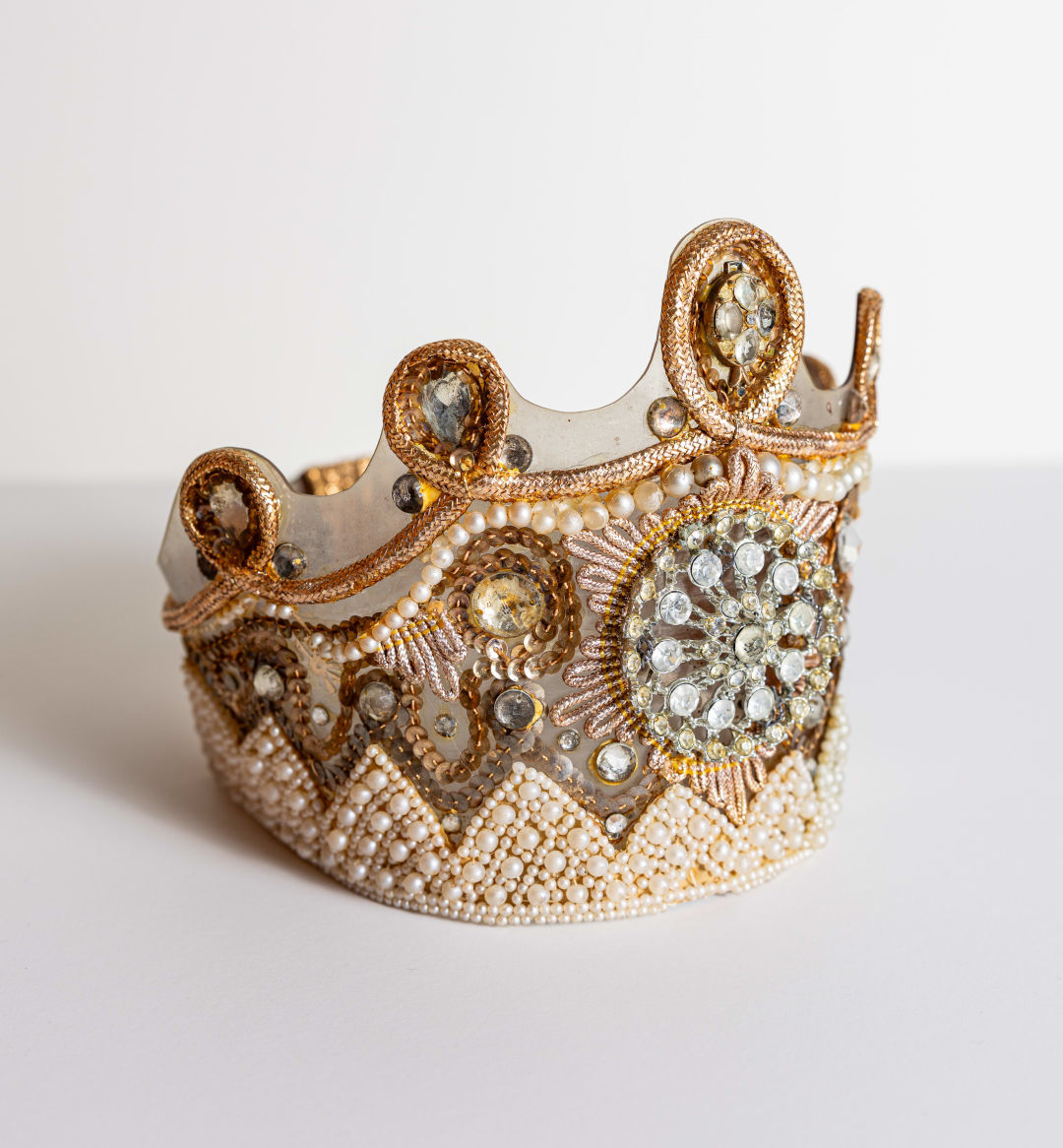
Image: Hannah Trombly
Type into your search engine the words “Sarasota County History Center Archives Catalog,” and you’ll get more than 15,000 results. Among all the items the archives houses are hundreds of documents (letters, diaries, business records, scrapbooks), thousands of digitized photographs, a plethora of maps, newspaper clippings, school yearbooks, and what we term ephemera—posters, handbills, tickets and the like.
Right now, all of those items are stored in boxes and drawers in a secured building downtown, accessible to the public by appointment. By late 2026, a new, 30,000-square-foot history center is slated to open adjacent to a newly expanded Fruitville Library, near the intersection of Fruitville Road and I-75. There, two main exhibit galleries and several smaller spaces will display more of those artifacts than are currently easily viewed.
But until that day comes, we’re happy to take a peek inside the treasure cache that is the center’s collection. Some of what we found, on a recent visit with Joshua Goodman, manager of the Division of Historical Resources (part of the Sarasota County Libraries and Historical Resources system), is straightforward enough. But a few of the items might be looked upon as surprising or even downright odd. Here are some examples.
Golf Clubs

Image: Hannah Trombly
These belonged to the first mayor of Sarasota, the man who helped found the city in the 1880s, J. Hamilton Gillespie. Gillespie, a Scotsman by birth, was famously a golfer, building the first course in the state of Florida here. His woods are actually wood, and date back well over 100 years. Just as interesting: the boomerangs nestled in the drawer below the clubs, souvenirs of time Gillespie spent in Australia before being summoned by his father to Sarasota to work for the Florida Mortgage and Investment Company. And, yes, the story has it that he died on a golf course near his home, in 1923. What a way to go.
A Pen

Image: Hannah Trombly
This was used by Gov. Cary Hardee in 1921 to sign the official document establishing Sarasota County as independent from Manatee. That pen slips into an envelope marked “Sharp” on the outside, because we’re not talking about a Bic felt-tip here—the nib of this historic writing implement is pointed enough to draw blood.
The Voter Registration Rolls From 1920-21

Image: Hannah Trombly
Significant not only because of the above-mentioned independence date for the county, but for marking the first year women were allowed the right to vote following the ratification of the 19th Amendment. Hence, a lot of women’s names appear grouped together, as if they marched en masse to register, which maybe they did. Familiar Sarasota names like Bispham, Browning, Colson and Abbe appear here, and it’s fascinating to learn their details—race, age, occupation, etc.—forming a snapshot of that era.
A Deed to the Ringling Causeway From 1928

Image: Hannah Trombly
Signed by John Ringling, who financed the original causeway bridge, which opened in 1926, to the tune of about $750,000. He wanted, of course, to make the islands of Lido and Longboat Key accessible for the developments he planned there; but ultimately, the bridge continues to benefit us all, long after his big, bold signature was affixed to that historic document.
Medical Supplies

Image: Hannah Trombly
If you’re squeamish, you might not want to view the medical supplies of Dr. Furman C. Whitaker. Whitaker opened his first practice in the area in the 1890s, and taking a look at the forceps used back then to extract whatever needed to be withdrawn from the human body, or the hemostat employed to clamp blood vessels shut during surgery, could cause a swoon.
A Crutch

Image: Hannah Trombly
It belonged to Pulitzer Prize-winning author MacKinlay Kantor, who made Sarasota his home for decades beginning in 1937. Kantor was an acclaimed writer, best known for his nonfiction book Andersonville and for the story that became the film The Best Years of Our Lives. He was also, as they say, something of a character, a conservative type who felt he truly belonged in the 19th century, not the 20th. The crutch reflects that, with all sorts of printed opinions and comments on it. One begins: “MacKinlay has even promised to approve of” among other things, tourists, liberals, abstract art, television, Hubert Humphrey and progress. The crutch also boasts a convenient spot for a beverage and one for a round ashtray as well—all the comforts, right there at hand.
A crown
Pictured at top, this was worn by many Sara De Soto queens over the years. The pageant crowning that queen dates from 1916, when Genevieve Higel was the first to be so honored. The crown shown here, encrusted with many faux jewels, does not date back that far, but it still adorned the heads of many a pageant winner. BTW, in case you didn’t know, the pageant stemmed from a legend woven even earlier, in 1900, about the doomed romance between a Native American man named Chichi and Sara, the daughterof Conquistador Hernando De Soto. Sara never really existed, but why let that get in the way of a celebration?
Sheet Music
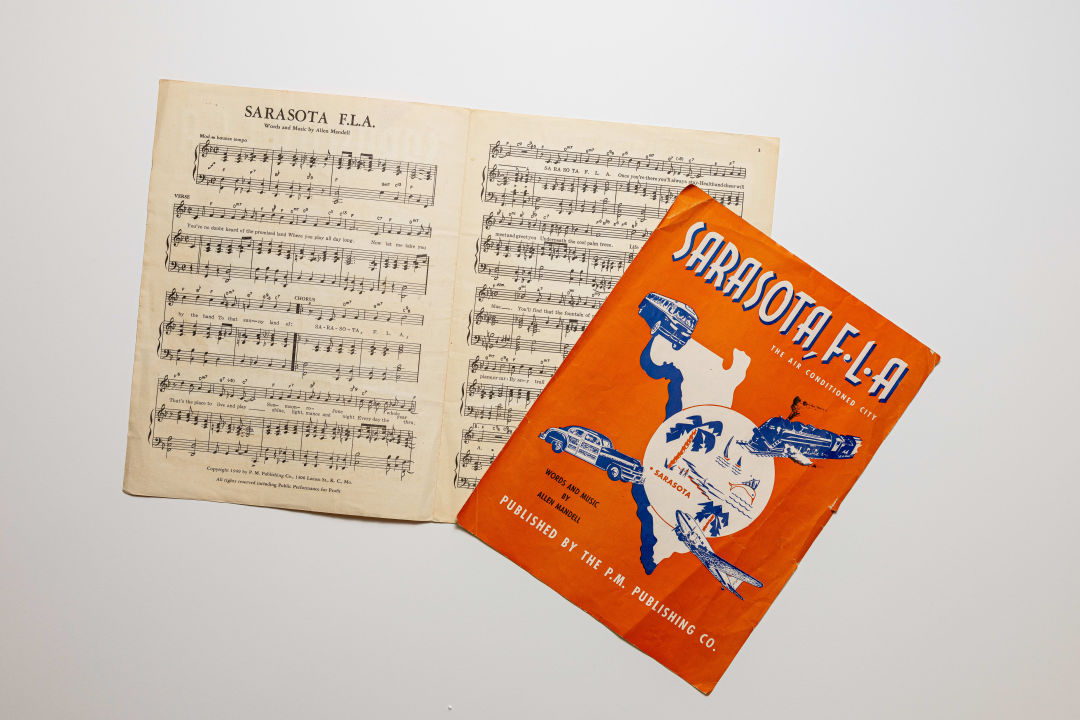
Image: Hannah Trombly
The original sheet music to a ditty titled “Sarasota FLA,” words and music by Allen Mandell, dating from 1949. Who even knew we had our own song?
There’s more—lots more, like the terra cotta cups used to collect pine sap for
turpentine production; an original map of 1886 Sarasota, laid out to appeal to those early Scottish colonists with road names like “Strawberry” and “Banana”; the original blueprints for the 1920s Mira Mar Hotel on Palm Avenue, now facing development; and the “Sarasota” sign that once hung at the Atlantic Coast Line station to welcome rail travelers. We’ve opened the door for you; soon it will be your turn to walk into a brand-new history center and discover more.