




Peek Inside a 1925 Mediterranean Revival Home in Sapphire Shores
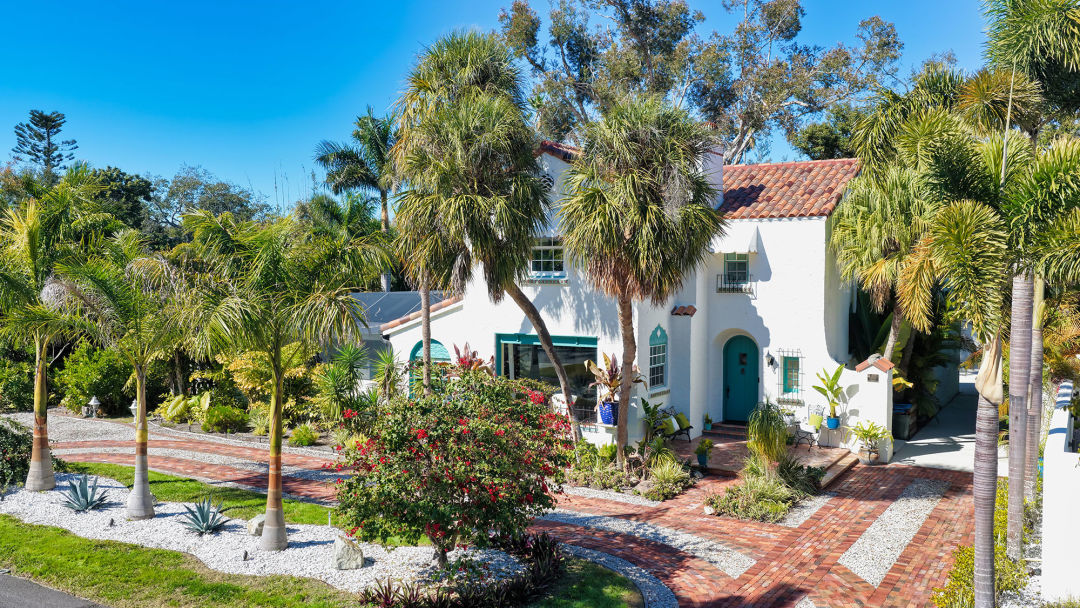
Image: Pix360
In the months since the 2024 hurricanes, a certain kind of house has started to feel even more vulnerable than ever before. Some older homes were battered and flooded. Others have become harder to justify restoring in a market that keeps rewarding bigger replacements. And Mediterranean Revival homes, once one of Florida’s defining architectural languages, are still built every now and then, but rarely with much conviction.

Image: Pix360
This is part of what makes the Brody-Murrell House at 547 N. Shore Drive feel more rare. Built in 1925, the historic Sapphire Shores home—which is on the market for $2.7 million—still carries the elements that made the style persuasive in the first place: thick white stucco walls, a clay-tile roof, arched openings and deeply set windows. It doesn’t feel like a house trying to evoke the past. It feels like one that has survived it.

Image: Pix360
Trish and Greg Vulopas understood that. Before they bought the house, Sarasota had already lodged itself in Trish’s imagination through childhood trips to visit family on the Gulf Coast. Her grandparents had a place on Indian Rocks Beach, and family visits meant excursions to the nearby Ringling Museum grounds.
Then a work connection pulled them toward Florida. Greg is a software engineer, whose main client was in Tampa, and his business partner relocated there, too. But when the couple left Michigan, they chose to live in Sarasota instead. “We both liked it better,” Trish says.
They were drawn to Sapphire Shores because the neighborhood still offers an increasingly harder-to-find version of Sarasota: large, ancient trees and a mix of architecture spanning a hundred years. “It’s an eclectic neighborhood,” Greg says.
And then there was the house itself. Trish says she “fell in love with the outside” first. The front façade has a simple, slightly theatrical grace: white stucco, a turret-like arched entry, a vivid turquoise front door and a garden that softens the edges without obscuring the form.

Image: Pix360
For all the care the house has received, it still retains much of what gives it character: the working brick fireplace; wooden ceiling beams in the main living area; original plaster walls and ceilings; original solid wood panel doors with glass and solid brass hardware; handcrafted wide base molding; recessed nooks; a pecky cypress accent wall in the living room; an original pecky cypress ceiling in the sunroom. Running up the stairs are three original arched crank windows. The front door is original, as are the staircase’s handrail and newel posts, though the Vulopases later added wrought-iron spindles and imported Mexican tile on the risers.

Image: Pix360
The biggest transformation began with something straightforward enough: the family wanted a pool. But like all renovations, one desire revealed three others. If there was going to be a pool, they would need a lanai. If there was going to be a lanai, they would need a kitchen that opened to it. And if the kitchen was going to become part of a larger indoor-outdoor composition, it needed to be rethought from the ground up.
“We basically completely gutted the kitchen,” Greg says. “Then we built a laundry room, a whole covered lanai, whole pool decks.” In all, they added about 2,000 square feet of outdoor space.

Image: Pix360
“We really tried to take great care to kind of speak to the Mediterranean architecture and the era of the home,” Trish says.
Greg says that after the big renovation they spent “almost every day” out in the lanai. Trish says the outdoor space changed everything. Before there had been only an uncovered slab of concrete and all the usual Florida nuisances: bugs, debris and too much exposure. “Now it’s all mostly screened in,” she says.
The kitchen, though rebuilt, maintains exposed brick piers and clay-toned floor tile that hold the room in conversation with the older parts of the house. Heavy wood beams cross the ceiling while a broad copper farmhouse sink and a custom hood sit beside more modern cabinetry.

Image: Pix360
Much of that came from the Vulopases’ own temperament. Greg may be a software engineer by profession, but Trish describes him as “an engineer to his very core.” That seems to explain a lot. He is the sort of owner historic houses need: methodical, curious, hands-on and not intimidated by hidden systems or structural quirks.

Image: Pix360
Trish, a physical therapist, brings a different attention to detail. “We’re both very hands-on,” Trish says. “We’ve put a lot of our heart and soul into renovating.” For example, Greg built pieces in the kitchen. Trish worked with a local artist on custom tile details. They reused cabinets removed from the old kitchen in the laundry and workshop. Brick found scattered around the property became the driveway.
“We don’t like to see things go to waste,” Greg says. “Especially old things.”

Image: Pix360
While stripping wallpaper, the couple uncovered original clay block and brick. Rather than hide it again, they chose to leave portions exposed in the powder room, kitchen and one of the baths. Trish was delighted by what the walls revealed. “You can actually see in some of the mortar the seashells that they used to mix into,” she says. “So they’re 100-year-old seashells.”
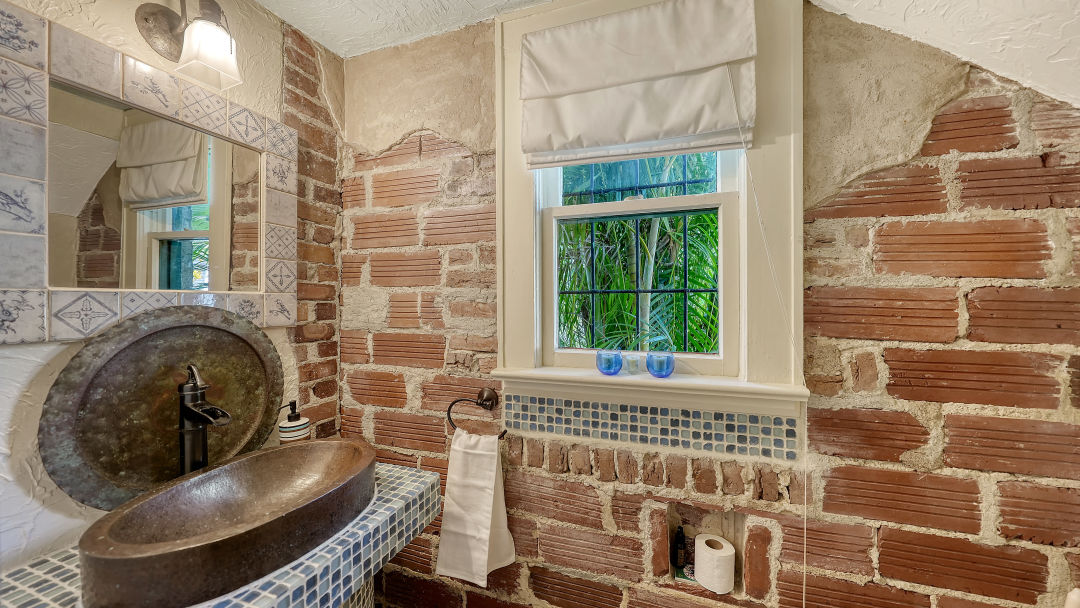
Image: Pix360
It's the kind of detail that explains why old houses continue to exert power over otherwise rational adults. Nobody commissions a new house because they hope to uncover century-old seashells in the mortar. The house’s materials offer receipts of where they came from.
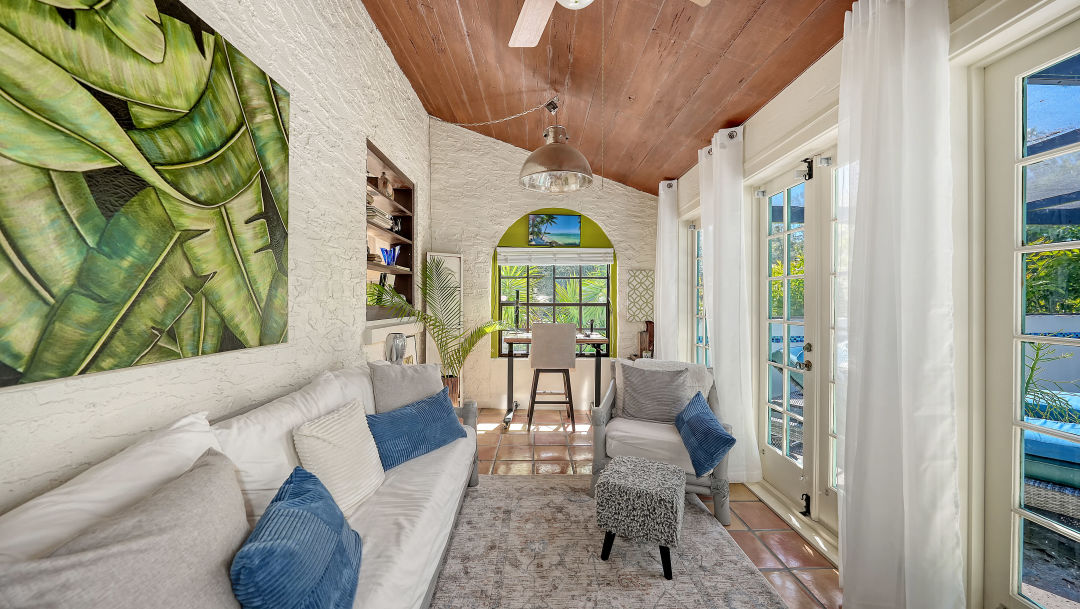
Image: Pix360
“We also worked very closely with the historic preservation board and made sure everything we were doing was in line with what the historic character of the house was,” Greg says. Trish adds that the board offered “really good ideas.”
The result bears that out.

Image: Pix360
Upstairs, the bedrooms are softer and more private, with windows that look into palms and courtyard greenery. One bedroom opens to a small balcony.

Image: Pix360
The couple is equally proud of what can’t be seen at first glance. Trish says the house has been modernized “behind the scenes,” with plumbing, electrical and other infrastructure updated so that “there’s nothing left to redo—or fall apart.” The Vulopases wanted to preserve the atmosphere without leaving the next owners a century’s worth of deferred maintenance.

Image: Pix360
The previous owners, the Martins, who bought the house in 1969, had a son who was a contractor, and the Vulopases say that mattered. Even before the Vulopases began their own work, they sensed the house had been well cared for. Greg, who by all accounts has investigated the place from beneath as well as within, was reassured by what he found. The bones were genuinely sound.
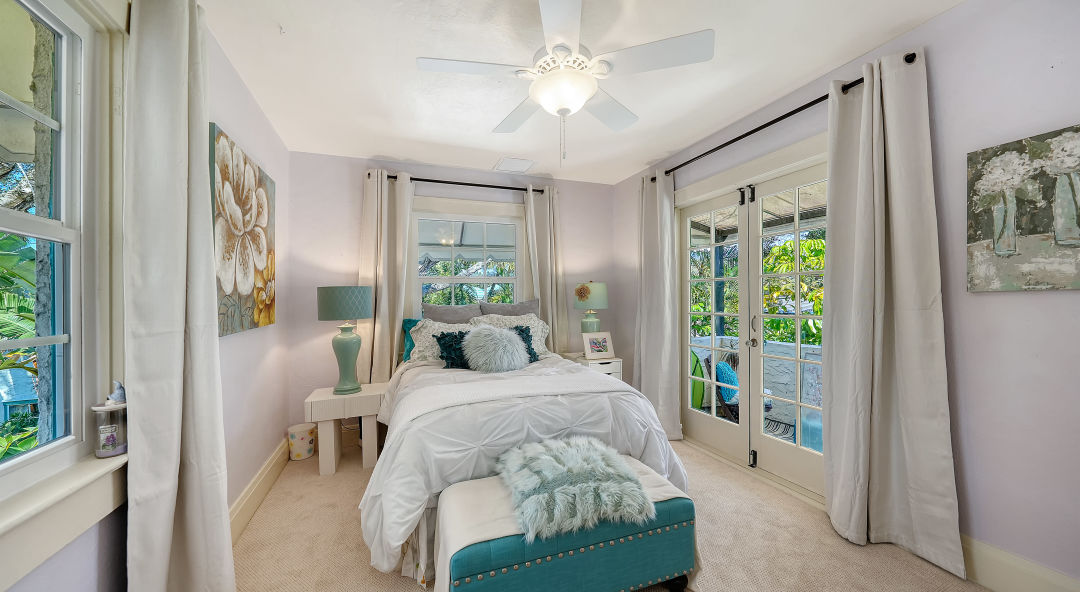
Image: Pix360
Today, the house is historically designated and can't be easily knocked down for a replacement. Its house’s formal name, the Brody-Murrell House, comes from its first two owners. It was designed by Clas, Shepherd and Clas, which has a place in Sarasota’s early development of Sapphire Shores. The firm also had a hand in the development of Sarasota that Charles Ringling (John Ringling's brother) was helping to shepherd. In 1924, Ringling hired the firm to design the mansion he shared with his wife, Edith, on their north Sarasota estate. By then, Ringling had already become one of the city’s central forces, investing in real estate, banking and development during the boom years that helped reshape Sarasota.

Image: Pix360
The Vulopases selling for the reason many beloved houses eventually come to market: their family has changed size. Their son is out on his own. Their daughter is close to finishing graduate school. The house now feels too large for two people heading toward retirement. “It’s sort of bittersweet and heartbreaking,” Trish says. But they're keeping a foothold nearby and planning to split time between North Carolina and Sarasota, without severing their relationship with the area entirely.

Image: Pix360
That may be the final argument for their home. Historic houses survive because a chain of owners decides that character is worth the trouble. In an era when so much residential architecture aims for maximum square footage, or sugar-cube conformity, the Brody-Murrell House isn’t just one of the houses still standing—it’s still speaking.
Interested? Call Bev Murray of Berkshire Hathaway Home Services at (941) 724-4995.