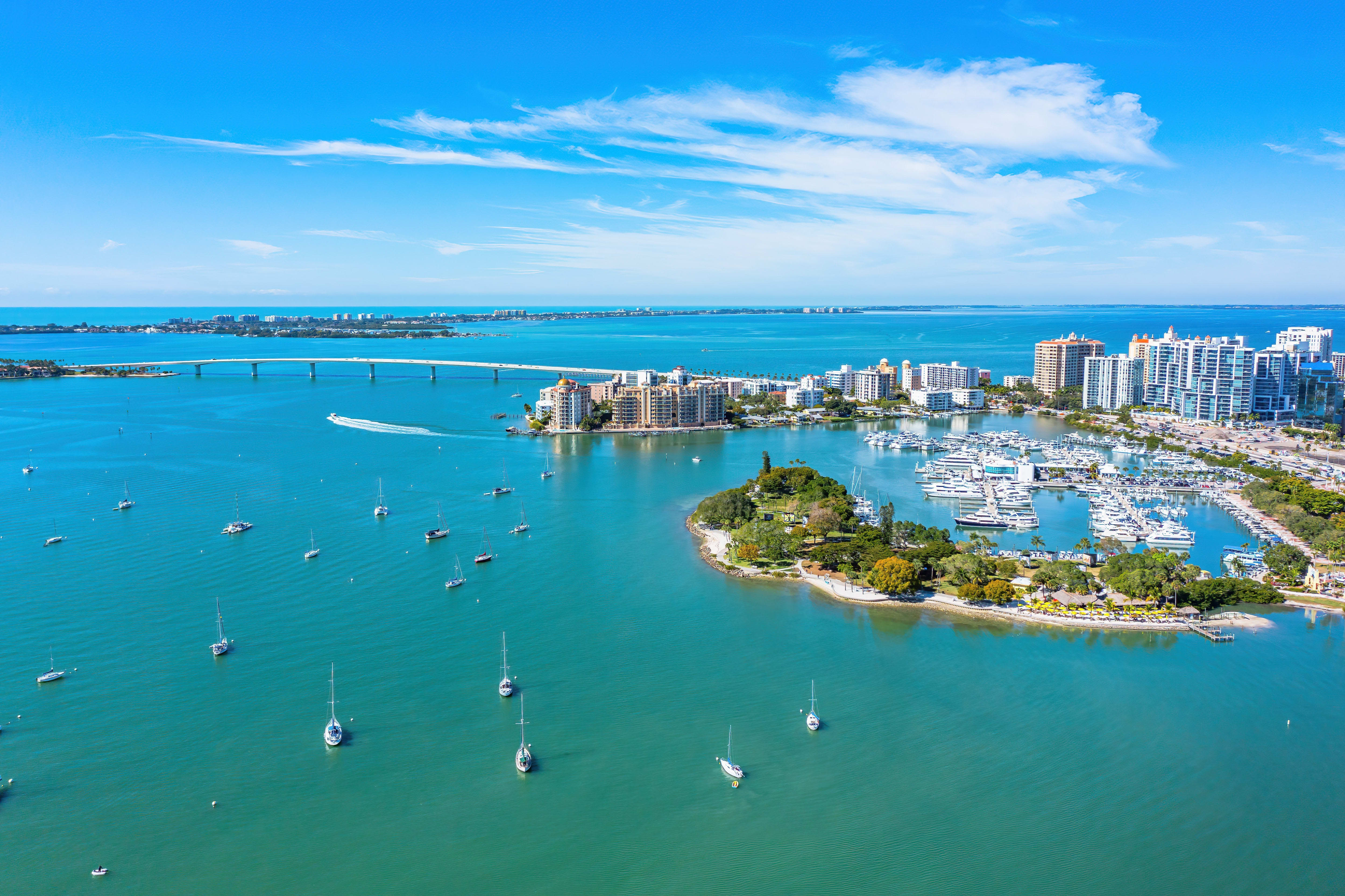




Sarasota Area Ranks No. 4 for Job Market Momentum and No. 2 for Office Investment

Image: SeventyFour/Shutterstock
People often move to Sarasota to escape the cold light of an office and the sad geometry of a cubicle, preferring palms, beaches and the freedom to call a Tuesday afternoon outdoors “lunch.” Yet the region now appears to be developing an unlikely side hustle: becoming a place to work. The North Port-Bradenton-Sarasota metro ranks No. 4 on LinkedIn’s 2026 list of rising job markets, while the City of Sarasota places No. 2 among 50 markets studied for office investment by LoopNet, an online marketplace for commercial properties for sale and lease.
Taken together, they point to economic growth. LinkedIn found increased hiring activity, job postings and member migration across the broader metropolitan area, while LoopNet found comparatively rapid growth in Sarasota’s office-using employment.
This is the first year the Sarasota metropolitan area has appeared on LinkedIn’s Cities on the Rise list. LinkedIn identifies real estate, hospitals and health care, and technology and internet companies as the area’s leading hiring industries. Sarasota Memorial Health Care System, Sarasota County Schools and Sarasota County Government hired the largest shares of LinkedIn members in the metro from Feb. 1, 2024, through Feb. 1, 2026.
LinkedIn reports a median household income of $84,050, drawn from the Census Bureau’s 2020-2024 American Community Survey five-year estimates. It also reports an average home listing price of $978,680, based on Realtor.com data. According to Realtor Association of Sarasota and Manatee June data, the median sale price of a single family home in Sarasota County was $492,450.
LinkedIn created its ranking by examining year-over-year changes in hiring, job postings and migration. Hiring was based on members who added new positions to their profiles. Job market activity also incorporated changes in the number of postings, adjusted for the average number of LinkedIn members in each metro.
Migration was measured through the year-over-year change in the ratio of LinkedIn members entering an area to those leaving it, based on the locations shown on their profiles. To qualify, a metro’s growth rates for hiring, job postings and migration had to rank in at least the top half of all U.S. metros. It also had to record positive net migration during the previous year.
The analysis used anonymized and aggregated data from millions of LinkedIn profiles and job postings from March 1, 2024, through Feb. 1, 2026. Metros with more than 2.5 million LinkedIn members were excluded.
LinkedIn’s findings reflect the portion of the labor market visible through its platform. Still, they overlap with one of the strongest components of Sarasota’s LoopNet ranking: employment growth.
LoopNet says office-using employment grew faster in Sarasota than in all but two of the 50 markets studied. Professional and business services led the growth. That was one of three employment sectors LoopNet treated as indicators of potential office demand, along with information and financial activities.
Sarasota also stood out for the composition of its listed office properties, recording the fourth-lowest share of Class C assets. Its average asking rent was $37.46 per square foot, among the highest in the study.
The market’s limitation was its size. LoopNet found fewer listings in Sarasota than in many of the other markets it examined, leaving prospective buyers with a tighter selection. The company found that Sarasota’s employment growth and relatively small share of lower-grade listed properties helped offset that limitation. LoopNet based its findings on more than 5,000 office listings active across 50 markets as of March 2026. It supplemented those listings with employment figures from the U.S. Bureau of Labor Statistics and population estimates from the U.S. Census Bureau.
LoopNet based its ranking on asking rents relative to sale prices, the number of available listings, office-sector employment trends and the quality of listed buildings. The analysis reflects properties advertised on LoopNet and is intended as a starting point for investors—not a prediction of actual returns.
The rankings don’t necessarily mean Sarasota has the country’s second-most-profitable office market or fourth-strongest job market. Instead, they offer two different snapshots of the local economy: one showing momentum in hiring, job postings and the number of LinkedIn members moving to the area, and the other showing growth in office-based jobs and a strong selection of higher-quality office properties.
For a region long viewed primarily as a place to retire or vacation, that overlap may be more telling than either ranking on its own.