

Sarasota Bradenton International Airport’s New Chief Paul Hoback Has Big Plans for the Future

Image: Gene Pollux
Paul Hoback laughs when he talks about what made him fall in love with flight. “Top Gun in the ’80s,” he says. “As soon as I saw that movie, I wanted to be a fighter pilot.”
He came close after being recruited to play football for the Air Force Academy, but a variety of circumstances intervened to make him change course. He got his mechanical engineering degree and worked different jobs after graduation—including at a window and door company and a diaper factory—but his passion for aviation remained. “I didn’t know if I’d ever be in aviation again,” he says.
Then he saw an advertisement for a mechanical engineering position at Pittsburgh International Airport (PIT). “I got the job, and it was one of the best moments of my life,” Hoback says.
That was in 2000. Hoback, 50, stayed at PIT for the next 25 years, climbing the ladder and ultimately becoming executive vice president and chief development officer, and helping shepherd the airport through the construction of a brand-new, $1.7 billion terminal, which opened last November. A Western Pennsylvania native, it wasn’t until his son went off to college in Arizona that he and his wife began to think about relocating.
Enter SRQ. Last August, the airport’s longtime president and CEO, Rick
Piccolo, announced his retirement after 30 years leading its operations. Hoback—a Pittsburgh Pirates fan who attended spring training games in Bradenton and has family in the area—had just interviewed for a leadership role at Cincinnati/Northern Kentucky International Airport, a facility similar in size and scale to PIT. After a five-month interview process, he was one of two final candidates, but ultimately didn’t get selected.
“I thought, ‘I’m done. I had the opportunity to leave and didn’t get it, but that’s OK,’” Hoback recalls. “Then a headhunter approached me about the job with Sarasota Manatee Airport Authority and SRQ. As soon as I started to read about it, I knew it was the perfect match. I wanted [to work at] a specific type of airport—one that’s run by an airport authority so you can run it like a business instead of a bureaucratic organization.”
He has big plans for SRQ. “Parking is a problem here,” he says matter-of-factly. “There are significant issues during peak season and holidays. We have to look for short-term solutions while advancing the construction of a parking garage. This airport has a small-town feel, but it’s grown so significantly that we’ve got to bring up the facility to keep that feel.”
Rental car inventory is another pain point. “In February and March, some rental car [services] are turning people away,” he says. “Part of the parking garage project will be a first floor for rental car partners.”
The proposed garage will also be used to expand and modernize baggage claim services, not only to allow more bags on the carousel, but also to allow more airlines to unload cargo simultaneously. “Only three airlines at a time can use the airport’s baggage claim carousels, but during peak season, there’s up to six [in line],” Hoback says.
Technology will play a big part in all of it. “Aviation is going to change some in the next five to 10 years,” Hoback says. “How do we maintain that boutique feel but still grow? For example, traffic is an issue, so where do we position a vertiport [a specialized area for aircraft like drones and electric flying vehicles] here? How do we put vertiports in key locations like Longboat Key and possibly up in Lakewood Ranch and help get cars off the roadway systems while bringing passengers right to the front door of the terminal?”
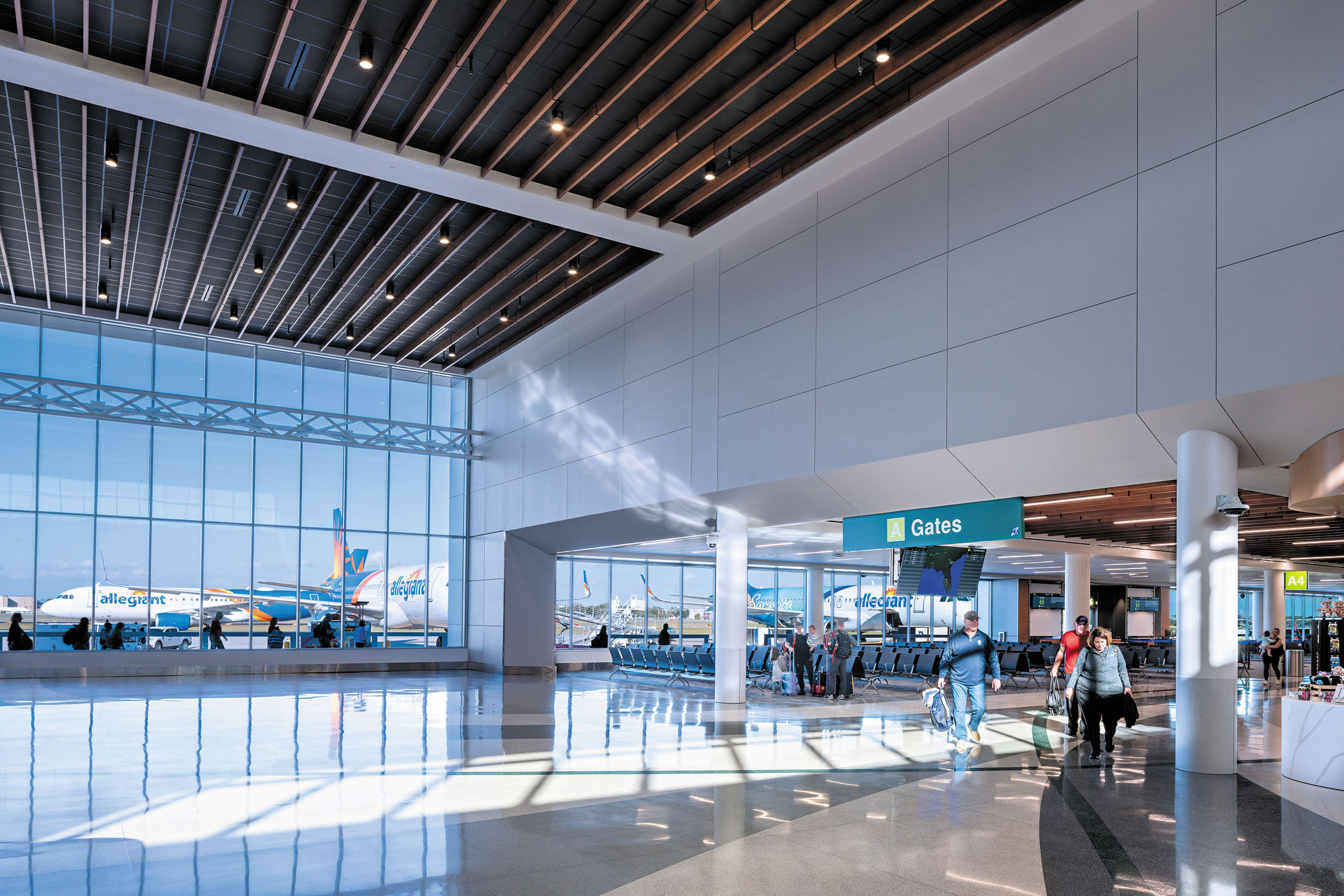
He’s quick to point out that an airport’s personality is important, too. “When I walk through the terminal here, I love the fish tank, the manatee and the waterfall,” he says. “So what else can we do to give a resort feel and make people feel like they’re extending their vacations?” His ideas include bringing in performance art, more concessions and elements that enhance the feeling of being in Florida instead of making passengers feel like getting through the airport is an obstacle to their time here. In PIT’s new terminal, which Hoback worked on for the last 12 years, similar upgrades and installations include constellation-like lighting that also acts as a wayfinder to the landside terminal; glass-walled outdoor areas that incorporate a parklike feel; and a bar in baggage claim.
Then there’s the emotional component of travel—a throughline that resonates deeply with Hoback. After he and his wife got married, they traveled to Disney World in 2002 with his in-laws. “We flew from Pittsburgh to Orlando, checked into our hotel and went to the first park—what was then MGM Studios,” Hoback says. “My father-in-law had been feeling a little sick, and as we were leaving the Indiana Jones Stunt Spectacular, he fell back into my arms and died of a massive heart attack. It was the worst thing we’ve ever experienced.
“When we got to the airport, we were treated like gold by an airport ambassador and by the airline team,” he continues. “That’s the way every business should be. [Air travel] is not just about happy times—it’s also about very sad times. The airport and the airline stood out on that vacation because they took care of us. If you do it right, it changes the game.”
Airports, Hoback believes, are both economic engines and relationship builders. “It’s the pursuit of world peace and prosperity,” he says. “That’s what we get to do for a living.”