





What Does the Future Hold for St. Armands Circle?
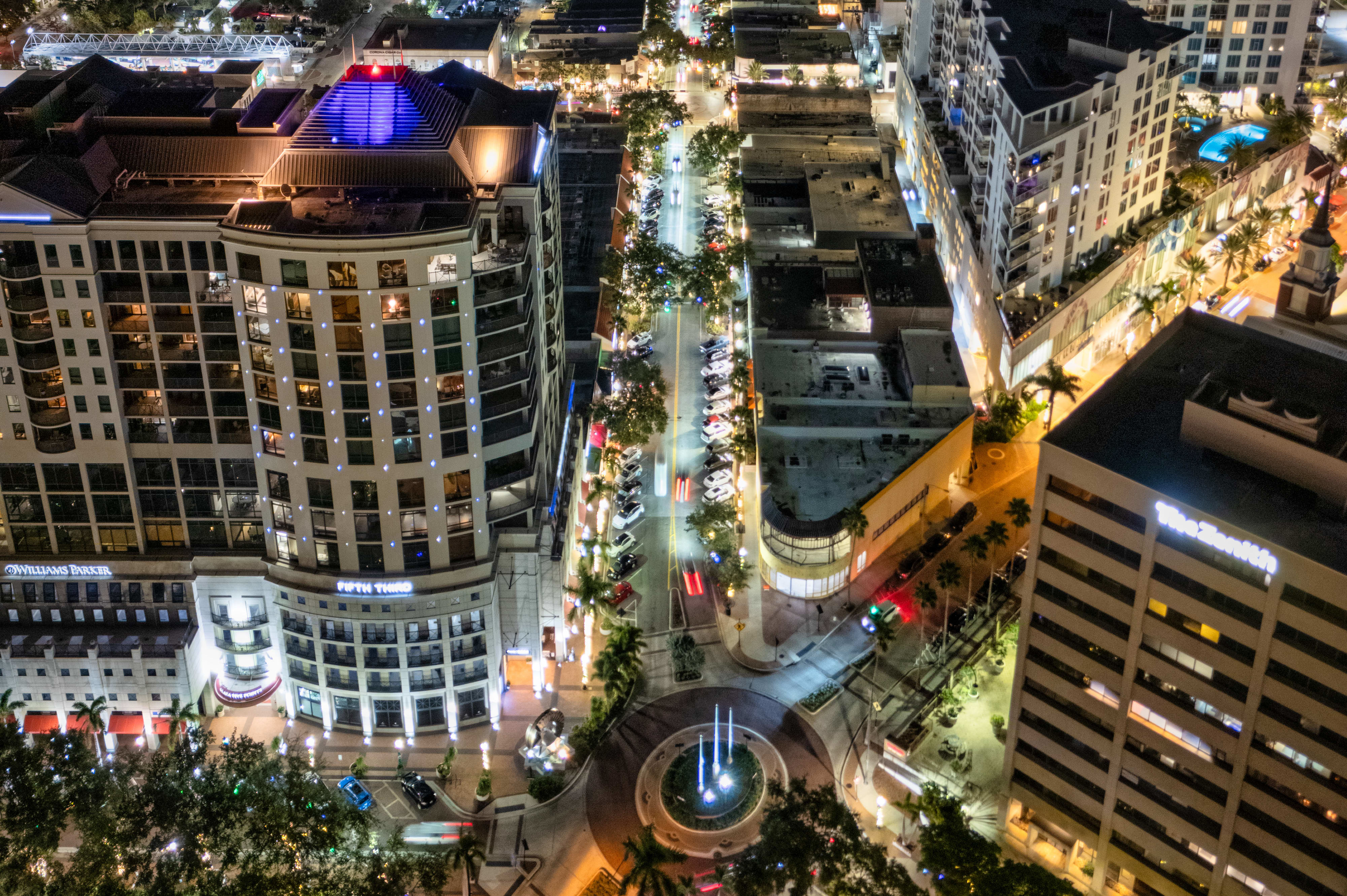
John Ringling stood on the Gulf’s edge in 1923 and saw not just sand and mangroves, but a stage. The circus magnate, who had built a fortune on spectacle, envisioned a European-style shopping district on a manmade island connected to Sarasota by a causeway. He platted the key in a circle, with radiating streets and a central park. Statues arrived from Italy and France—gods and muses to lend grandeur to what had previously been little more than oyster shell and pine scrub.

Locals soon began calling it “the Circle.” Ringling gave it the feel of a stage set that evoked elegance and expectation. When the bridge—later named for Ringling—was completed in 1926, visitors could drive from downtown Sarasota straight into this new fantasy. Benches and facades hinted at Paris while Lido Beach was steps away. It was part illusion, part infrastructure.
After the collapse of the Florida land boom in the late 1920s, the Circle languished for more than 25 years. In the 1950s, investors bought in, and by the end of the decade, St. Armands Circle was being called the Worth Avenue of Florida’s West Coast. Fine-dining restaurants sat beside clothiers, jewelers and curio shops. Window-shopping was theater.

Image: Hannah Trombly
“You’d run into people you knew, but it also felt like traveling somewhere,” says Scott MacDonald, who washed dishes at his parents’ restaurant, Crab & Fin (formerly Charley’s Crab), when he was 12. Today, he owns and runs the place. In the 1970s and early ’80s, St. Armands counted roughly 150 shops and restaurants. People could dine outside, and tropical landscaping and flowers created the coastal sophistication that tourists still seek out today.
Starting in the ’60s, you could browse for dollhouse trinkets and pet turtles at J.A. Klauck’s Five and Dime, get a James Bond Aston Martin toy car from the Pied Piper Toystore, pick out ball gowns at John Baldwin’s and linger over wine at Le Bistro St. Armand, where duck flamed in Calvados cost $15.50 and linguine Cleopatra ran $12.75. People danced at Ruby Tuesday’s, and The Tail o’ the Pup served bacon-wrapped hot dogs and sauerbraten. Explorer’s Lounge, built in 1961, was still drawing crowds with its midcentury facade and its soundtrack—Omni played live at the Patio by night.
The mix was mostly upscale in those earlier decades. A 1985 brochure lists Capri Jewelry, Dream Weaver, Little Bo-tique, Harold Reason Shoes and more, arranged along the spokes of Boulevard of the Presidents and John Ringling Boulevard. The circle wasn’t just where you shopped. It was where you worked, danced, got your hair cut and signed your name to a dinner bill without thinking about it until the end of the month.

Image: Hannah Trombly
“It wasn’t just shopping—it was an outing,” Rachel Burns recalls. Her parents dressed her up for visits to match the tourists in pressed slacks and summer dresses. Her earliest memories of St. Armands Circle are tied to school breaks, trips to the Sandcastle Hotel, dinner at Charley’s Crab and German apple pancakes with crème fraîche at Café L’Europe. She remembers visits to Jacobson’s, a stylish clothing, jewelry, homewares and furniture store, where she “jumped around on the couches and beds.”
Today, Burns is executive director of the St. Armands Circle Association, which represents almost the same number of merchants as decades ago, about 150. Burns’ husband, Jason, owns one of them, Lynches Pub & Grub, which has been on the Circle for 23 years. Others have been there far longer. Columbia Restaurant, the longest-running restaurant in Sarasota County, has been open since 1959. Another legacy business, William and Aletha Bennington’s cigar shop, opened in 1965. Their son Jack, who now runs Bennington Tobacconist with his brothers, sells to the grandsons of his father’s original customers.
But history masks the Circle’s fragility. Built at sea level on dredged fill, it has always been vulnerable to major storms. “It’s a big bowl,” Sarasota urban planner Philip DiMaria told an audience at a community event this fall.

Image: Sarasota Police Department
Flooding had happened throughout the years, but the Circle’s vulnerability was truly tested in 2024. Two hurricanes—Helene in September and Milton days later—sent water rushing into the Circle with force not seen in living memory. Streets became rivers. Pumps failed. “The water had nowhere to go,” Crab & Fin’s MacDonald says. “It was coming up through the drains. We had a sealed walk-in cooler with 4 feet of water in it.” Chairs were whisked away almost a mile to Plymouth Harbor. Ovens and ice machines sat in saltwater for days, inviting rust, while access to the Circle—and electricity—stalled.
“The water wasn’t draining. Until it did, Florida Power & Light couldn’t come, so you had no air conditioning and mildew grew,” says Chris Goglia, president of the St. Armands Residents Association, who returned a few days after the hurricanes to survey his Lido Key home.
Crab & Fin shut down for three months. “[We had] almost a million [dollars] in damages,” MacDonald says. “But we were still lucky—out of 80 employees, we got 79 back.” He kept 15 on payroll during the early weeks of cleanup and tried to relocate the rest. The first three weeks were debris clearing, remediation and an endless stream of contractors. “It was rough,” he admits.
Inside the restaurant, nothing was spared. “We ripped out the walls,” MacDonald says. “All the pumps shorted out because the electricity was underwater. I’m not sure they were even built for what we got hit with.”
Image: Hannah Trombly
Columbia Restaurant’s owner, Casey Gonzmart, who also owns Cha Cha Coconuts, another restaurant on the Circle, saw similar effects. “We had 4.5 feet of flood. So you’re removing all your electrical from five feet down. “We threw away all our banquets and kitchen equipment,” he says. The financial loss was enormous: “Easily in the millions,” he says, between lost revenue, rebuilding and equipment.
Every business had its own version of MacDonald and Gonzmart’s stories. “We had to take all the merchandise out and put it in my living room and U-Hauls,” says longtime retail owner Cleon Dixon, who owns Ivory Coast, Sahara and Binjara Traders. “The staff was working and cleaning and getting things shored away.”
Insurance proved useless. Most merchants were under-insured or not covered at all. On the Circle, “You can only get minimal flood insurance,” MacDonald says. “I was quoted a policy that was $300,000 to $400,000—not doable.”
Dozens of businesses shuttered and some relocated to the mainland. You could trace the arc of destruction in watermarks, then plywood boards and, finally, ‘For Lease’ signs. Burns and her daughter played a game of “What’s that floating by?” Damaged furniture and merchandise piled up at the curbs for weeks, waiting for pickup. Some dumpsters remain lost to this day. For two months, shop owners cleaned and rebuilt, and in December, the Circle’s 60-foot Christmas tree went up, visitors gathering at its base for selfies. Still, the 2024 holiday season, usually bustling, felt muted.
As for putting a price tag on the total losses, “We don’t have a general number,” Burns says. “But take each business’s losses and multiply them by at least 130. Even at a minimum of $100,000 each, losses would total $13 million. We know it’s much more.”
And it wasn’t just the infrastructure and the businesses. “The mail in the mailbox was papier mâché,” says Goglia. “Your heart drops. I still have PTSD.”
“Everyone was so overwhelmed,” says Gonzmart. “Contractors were swamped, so if you needed help, you had hiccups—like finding one and waiting on permits.” Gonzmart opened Columbia Restaurant in 31 days, one of the first on the Circle to do so. But “you don’t just unlock the door and get business after two hurricanes,” he says.
There was no grace period on rent. “It was business as usual when it came to owing rent,” says Burns, who adds that FEMA aid covered only residential properties. “No one’s making you whole.”
Commercial tenants pay “triple net leases, meaning all repairs and taxes are your responsibility,” Burns says. Some tenants pay $55 per square foot on the lower side; others closer to $120 before taxes. Restaurants pay more to support the shared parking garage. “It’s more expensive than downtown Sarasota,” Burns says. “Even a smaller unit, less than 1,000 square feet, is $15,000 a year. They’re some of the highest leases along the West Coast of Florida.”
For Dixon, between rent, payroll, utilities and insurance, it’s about $150,000 a month for her three shops. “That’s just for the basics, and then on top of that, there’s the cost of your merchandise,” she says. “You have to earn $100,000 a month to break even in one store.”
The City of Sarasota has known for a long time that St. Armands Circle streets flood and drain slowly—even at low tide. After Hurricane Helene, the city and Sarasota County replaced and elevated control panels at flooded pump stations, cleaned and video-inspected the storm drain system, and restored lighting and landscaping.
Still, many retailers say, help has been slow to come, and they have to deal with a bureaucratic maze. The city owns the stormwater management system at St. Armands, but it’s maintained by Sarasota County. “The county can’t handle the pump systems, and they want to hand them over to the city,” MacDonald says.
“It’s a massive undertaking to redo that. A year later, and we’re no better off.”
Nikesh Patel, public works director for the City of Sarasota, has studied the Circle’s drainage issues for years. His latest plan—submitted in 2025—calls for corrosion-resistant pumps; backflow prevention at stormwater outfalls where pipes discharge water into a receiving body, like a canal or open water; and improved weirs that help control the elevation or flow of water, regulating how much flows downstream or into storage.
To address the overdue checklist, the federal government has approved $210 million in disaster recovery funds for Sarasota County through HUD’s Resilient SRQ program, and the county formally executed the grant agreement in June 2025. Of that amount, the city has requested $10 million for the St. Armands resiliency and flood-mitigation project—$478,000 of it a City of Sarasota contribution—to fund the upgrades, which also include new pump stations, permeable pavement and more. The money has not yet been disbursed for construction—the project remains in the application and planning phase—and Sarasota County has not announced a specific timeline for when work will begin.
But, no matter what, any new system will confront geography. The Circle relies on storm drains that empty directly into Sarasota Bay. When tides rise—or when hurricane surge forces water back into the outfalls—the system can reverse, sending water into the streets rather than away from them. The 2025 application represented the city’s clearest acknowledgment yet that resilience would have to be built–and it will be expensive.
Even cosmetic fixes were delayed. “It was earlier this summer that the city stepped in to fix the landscaping, but the entire winter, there was nothing,” Goglia says. “This is the only way to get to Lido Key, to the city beach—not to mention it’s supposed to be the jewel of Sarasota.”
“It’s out of sight, out of mind,” Burns says. “We could be forgotten as far as resources, even on the state and federal level.”

Image: Jenny Acheson
There are solutions—albeit controversial ones.
In 2021, the St. Armands Business Improvement District (BID)—which represents commercial property owners—proposed raising the height limit on the circle from 35 feet to 45 feet, allowing hotel and residential uses on upper floors, and redeveloping the city-owned Fillmore parking lot southeast of the shops. The aim was to give property owners more vertical flexibility, but the Sarasota City Commission ultimately rejected the zoning changes, citing concerns over traffic, density, parking and the threat to the area’s unique character. The BID sunsetted in 2023 after failing to win renewal support.
Meanwhile, speculation is swirling that Benderson Development, the huge Manatee-based commercial developer, may have big plans for the circle. Benderson has developed 1,000 commercial properties in 40 states, including huge shopping districts like University Town Center. Since 2019, the company has acquired roughly 15 percent of the Circle’s commercial real estate, totaling about $30 million, including the Crab & Fin building, Café on St. Armands (formerly Café L’Europe), Starbucks and more, according to local reports. This is more than any other single entity. (The Benderson family did not respond to inquiries for this story.)
“When you hear Benderson is coming, you think it’s going to become a mall,” Burns says. “But they’ve done a great job. They lease to mom-and-pop shops, vet their tenants and care for their properties. It’s been tough with so many small owners. We need investment.”
MacDonald, who is among Benderson’s tenants, says, “They helped with remediation and had crews out here fast, and they helped with rent. They’re businesspeople, but they want to keep their tenants, too.”
By fall of 2025, uncertainty about Benderson and other larger property owners on the Circle remained, especially when a by-invitation-only email thread on the future of St. Armands surfaced. In a July email, longtime commercial property owner Dr. Mark Kauffman floated the idea of adding a “boutique hotel” on the Circle.
Kauffman owns 24 and 28 N. Boulevard of the Presidents—two commercial buildings across from Speaks Clam Bar that once housed Chase Bank and Garden Argosy, among others. Following 2024’s hurricanes and the damage they brought, Kauffman’s buildings’ lower levels are now all vacant.
“I’m aware why residents would abhor a major hotel,” Kauffman wrote in the email thread, “but a few boutique rooms should not be a problem.” He proposed gathering “activist landowners” to privately discuss the idea with city planners, including City of Sarasota planning director Steve Cover and deputy city manager Pat Robinson.
The meeting was set for Sept. 8. Kauffman’s invitee list had some of the circle’s biggest owners and local players: Tom Leonard, co-owner of Shore; Gavin and/or John Meshad, who have developed commercial real estate across Sarasota and unsuccessfully pushed for a hotel on the circle in 2021; the Columbia’s Casey Gonzmart; Matt Rosinsky, one of the shopping district’s biggest landlords; a Benderson representative (or Randy Benderson or his son); and Geoffrey Michel, who owns The Met Fashion House, Salon & Day Spa.
In the emails, Kauffman also added that he had read through the latest St. Armands Residents Association survey, which showed overwhelming pushback against increased density or height on the Circle, and wanted to meet with Goglia, who spearheaded the survey. When Burns and Goglia caught wind of the private, invite-only meeting weighing the future of the Circle, they asked questions about the meeting’s openness, legality and invitation list.
Cover wrote that the intent was to discuss post-hurricane resilience and regulatory hurdles with large property owners, with later meetings planned for merchants, residents and tourism groups. But following the questions on transparency, Robinson canceled the private session, promising instead a public “community conversation kickoff” followed by open charrettes in the future. At press time, no date had been announced for public discussion.
“The problem isn’t people having conversations. The problem is when those conversations are had behind closed doors,” says Sarasota City Commissioner Jen Ahearn-Koch, who saw the emails. “If a hotel on St. Armands is on the table, the public needs to be in the room.”
Ahearn-Koch says any conversation about increased density must begin with the realities of infrastructure and safety. “The Circle sits at sea level, and the infrastructure is nearly 100 years old,” she says. “If we’re going to talk about increased density or new hotels, we need to start with a conversation about evacuation, stormwater and sustainability.”
She pointed to the City of Sarasota’s Comprehensive Plan, which outlines height limits and use compatibility on barrier islands. “One of our core planning documents includes a chapter on environmental protection and coastal islands,” she says. “It talks about maximum height limits and the kinds of uses that might be allowed. Bed and breakfasts are mentioned. Boutique hotels are not.”
Ahearn-Koch also emphasizes the effect on neighbors. “People often forget that Longboat Key has no direct access to the mainland,” she says. “To get off the island [and into downtown Sarasota], residents must pass through Lido or St. Armands. That means their safety is in the hands of other jurisdictions.”
In the meantime, Kauffman says he’s been planning a major renovation on his buildings. He also says it’s time to have hard conversations about how to bring the Circle back. “If you’re going to rebuild, you have to recoup the expenses,” he says. “The city also needs to bring things up to snuff.”
He believes the current parking code stands in the way of recovery. “If you’re flooded and have to rebuild, you’re held to parking codes that are just too rigid,” he says. “That has to change. If you want St. Armands to regain the prominence it once had, you’re going to have to relax some of the rules. This may be the right time to do that.”
Others, like Carl Shoffstall—president of the Lido Key Residents Association, which is different from the association that represents St. Armands residents—say the issues aren’t new, but they’re worsening. “There are a lot of businesses that aren’t going to return,” Shoffstall says. “It’s slowly starting to come back, but it needs something. What that is exactly, I don’t know.”
On the topic of a hotel, Shoffstall was blunt. “You’re trying to cram 10 lbs. of crap in a 5-lb. bag. The south end of Longboat Key is one way in and out. Same with Lido. I don’t know how much more the infrastructure can handle. I’m in construction, so I’m about development—but it has to be right.”
Ahearn-Koch says she’s open to dialogue. “You have to be profitable to survive on the Circle. But it also has to be compatible,” she says. “The Circle isn’t just a place; it’s a story. When I was a little girl, I’d go to Talk of the Town, order a root beer float and a hot dog, and feel like a queen. That’s what we’re trying to protect.”
Goglia agrees. “Developers say they can’t renovate without going taller. But you don’t need that for the Circle to move forward.” The city needs to fix the infrastructure, in his opinion.

Image: Courtesy Columbia Restaurant
The tension is unresolved. Will St. Armands Circle evolve into a chain store-studded mall or retain its charming local and historical flavor?
“These aren’t nameless corporations,” Burns says. “I know most of the merchants personally. Their devotion drives me to want to continue working for them.”
As Gonzmart puts it, “This is still the Circle. People will always come back.”
MacDonald, faced with the more prudent choice of leaving after the hurricanes, admits paddleboarding right after work at the nearby beach is priceless. Plus, he says, the Circle “is who we are.”
That may be what John Ringling understood: that the Circle was never just a commercial district but a ritual—a place for shared experiences in a beautiful setting. What’s less certain now is whether Sarasota will keep investing in the illusion, because storms are no longer rare. They are inevitable.