



The 2025 'Six to Save' List Sounds the Alarm for Sarasota's Vulnerable Historic Buildings

Image: Courtesy Photo
Sarasota’s buildings have always told their story long after the people who built them are gone. Some mark the city’s earliest attempts at settlement; others its midcentury experiments in climate and form; and others still the improvisations of a young county trying to connect its islands and shape its identity. Each year, the Sarasota Alliance for Historic Preservation’s (SAHP) Six to Save program examines these layers and identifies the places most at risk of demolition.
Now the SAHP has released its 2025 Six to Save list, naming six sites that reveal how quickly Sarasota’s historic fabric is thinning under the pace of today's redevelopment. Launched in 2020, the program highlights six vulnerable historic resources—structures or landscapes that lack sufficient protection, face redevelopment pressure, or risk erasure through infrastructure changes or neglect. The list doesn’t function as a legal shield. Instead, it serves as a public alarm, drawing attention to endangered sites.
"The Six to Save 2025 list represents the range of historic resources, nominated by the community, that will become the strategic focus of our advocacy in the coming year. This is only the tip of the iceberg, though," says Erin DiFazio, SAHP's program director. "With the challenging legislation coming out of the state effectively crippling local government's ability to safeguard historic places, the escalating costs of insurance, rising taxes and maintenance costs, and a national example of the swift revision of history, we have our work cut out for us.
"The Six to Save provides a framework for members of the community to get involved: envisioning and carving out a path to preservation for those places that matter to us," she continues.
This year’s selections span more than half a century. They include a 1912 block house that predates the city’s boom years, a pioneering automobile building adapted for new uses, a 1920s swing bridge tied to Sarasota County’s earliest roads, a once-elegant civic park and two midcentury structures tied to the architects who shaped Sarasota’s modern identity. Together, they form a map of the city’s past and a reminder of how swiftly the landscape around them is changing.
J.B. Turner House (1912)

Image: Courtesy Photo
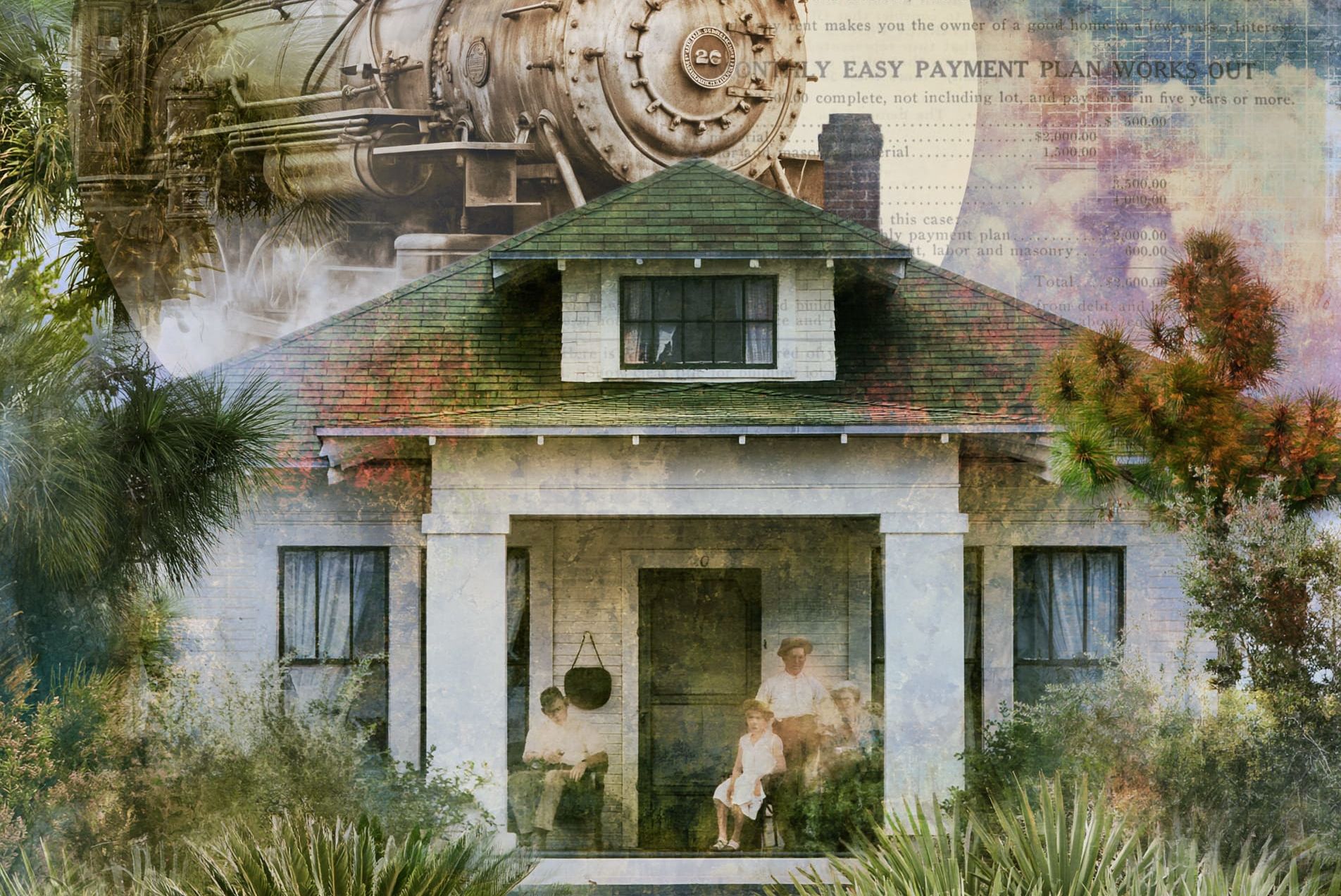
The Turner House is one of the oldest buildings still standing downtown and one of the few surviving examples of rusticated block construction in Sarasota. Built in 1912 by mason George W. Barker, it was purchased by James B. Turner, a Main Street merchant who helped guide the early city through its first municipal framework as one of its first aldermen. During this period, Fruitville Road was a modest residential street lined with turn-of-the-century homes and small neighborhood businesses. Only two of those original residences remain: the Turner House and the 1924 Battle House across the street. The Turner House, now owned by a developer, sits isolated among modern structures—its humble scale and materials a stark reminder of Sarasota’s pre–land boom fabric. The lack of an approved plan does not diminish its vulnerability; redevelopment crowding it has been consistent and swift.
U.S. Garage Building (1924/1984)

Image: Courtesy Photo
Completed in 1924, the U.S. Garage was Sarasota’s first commercial garage during a moment when automobile ownership symbolized progress and status. Its architect, J. Herbert Johnson, designed broad plate-glass windows for vehicle display and incorporated a second-floor car elevator—an uncommon feature that signaled Sarasota’s confidence during the height of the land boom. The building later anchored a Ford dealership’s service department for decades, contributing to the evolution of the Pineapple Avenue commercial corridor.
In 1984, architect Frank Folsom Smith—who had an office in the building—adapted it into retail and professional spaces while preserving its industrial character—a form of adaptive reuse uncommon in Sarasota at the time. That renovation became a local touchstone for the idea that historic commercial buildings could be updated without being erased. Today, the building sits within a multi-parcel assemblage assembled for Adagio, a proposed 18-story condominium development by The Lutgert Companies. The plan submitted to the city includes the demolition of the U.S. Garage building. With an ideal location near the water and downtown, the structure stands as one of the last intact commercial survivors of the Florida land boom in the Palm Avenue-Burns Court district. (Fun fact: the building was also Sarasota Magazine's offices for years.)
Blackburn Point Swing Bridge (1925)
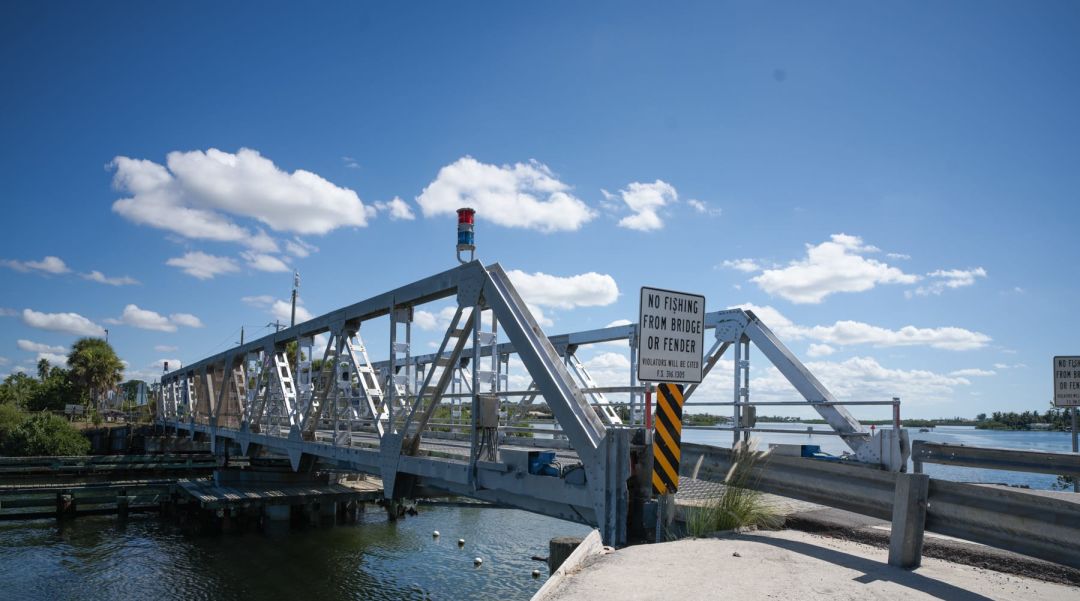
Image: Courtesy Photo
Built in 1925, the Blackburn Point Swing Bridge is one of the most historically intact pieces of early Sarasota County infrastructure. The Warren pony truss swing-span design was a common engineering solution in the 1910s and 1920s, but is now exceedingly rare statewide. The bridge originally required a hand crank to pivot open, carrying boats through a narrow channel between the Gulf and the Intracoastal. Its listing on both the National Register of Historic Places and the Sarasota County Local Register reflects its importance not just as a transportation link but as a physical record of how the county connected its barrier islands before modern causeways and high-rise spans. In 2001, the county faced a similar crossroads and chose rehabilitation over replacement, extending the bridge’s life by an estimated quarter-century. With that period now closing, county staff have initiated a new engineering review examining whether a second rehabilitation is feasible or whether a full replacement is preferred. That decision will determine whether one of the last working swing bridges on Florida’s Gulf Coast continues to turn—or becomes another chapter in the county’s early infrastructure history.
Luke Wood Park & The Mable Ringling Fountain (1931/1936)

Image: Courtesy Photo
Luke Wood Park was envisioned as a verdant civic sanctuary when Luke and Ann Wood donated the land in 1931. At that time, it sat at the gently sloping southern entrance to the city, and the park’s lagoon, pathways and shaded canopies gave Sarasota a formal garden space uncommon for cities of its size. In 1936, the Sarasota Garden Club added the Mable Ringling Memorial Fountain to honor Ringling as its founding president. The design featured a sculptural central basin flanked by marble lions donated by John Ringling—an early collaboration between civic groups and the city that tied together philanthropy, landscape design and public art. Over time, Mound Street expansions divided the park into fragments, altering circulation and diminishing its original layout. The fountain was filled in, its lions removed, and later the city constructed key wastewater infrastructure on the site. A restoration push began in 2011 but halted without a maintenance agreement. Today, nearly all of the original park’s defining features are either hidden, altered or deteriorating. A community group, Miracle on Mound, is working to revive both the fountain and the park’s role as a ceremonial gateway into the city.
Warriner Residence (1961)

Image: Courtesy Photo
Designed by Joan and Ken Warriner for their own family, the house is a distilled expression of Sarasota School of Architecture principles—clean lines, climate-driven design and thoughtful engagement with the outdoors. The 1961 “Record House” designation by Architectural Record reinforced its national significance at a time when Sarasota School architecture was gaining wider attention. The house remains largely as the Warriners built it, with shaded outdoor rooms, cypress cladding, original fenestration patterns and a modest footprint that emphasizes proportion over scale. It sits in a neighborhood that has undergone substantial transformation in recent years, as midcentury homes are routinely demolished for larger builds. The property is now listed for sale, and without local designation, it faces the same pressures that have erased many midcentury houses in nearby Arlington Park, Southside Village and Alta Vista.
Lawyers Professional Building (1961)

Image: Courtesy Photo
Sarasota School architect Frank Folsom Smith’s first independent project, the Lawyers Professional Building, is an example of Sarasota School commercial architecture integrated into the civic fabric of East Main Street. Its courtyard-centered layout, deep overhangs and single-story profile reflect Smith’s early exploration of scale, shade and internal circulation. For decades, it served attorneys seeking proximity to the courthouse across the street, anchoring a professional cluster that shaped the area’s identity. The parcel, however, lies within a Downtown Core zone that permits significant height, and the building’s one-story footprint has put it at the center of multiple redevelopment discussions. The property has changed hands several times as interest in Main Street intensifies and as nearby parcels move toward mixed-use development. Without a protective designation, the building remains highly vulnerable.
To check out last year's Six to Save list, click here. To learn more about SAHP and ways you can help, click here.