





Award-Winning Wildlife Photographer Carlton Ward Jr. Returns to the Gulf
Photographer Carlton Ward Jr. is too humble to say he’s a big deal.
Fortunately, there are others to do it on his behalf.
In January 2026, Ward was introduced to hundreds of attendees of the Great Florida Cattle Drive by former agricultural commissioner Adam Putnam as “among the greatest Floridians ever to make a mark in conservation from one corner of the state to another.” A month later, Ward won the Eliza Scidmore Award for Outstanding Storytelling from National Geographic.
The award, which began in 2018, is named after writer and photographer Eliza Scidmore, the first woman elected to the National Geographic board in 1892. It recognizes people who use “immersive storytelling to make complex ideas, issues and information relevant and accessible.”

Image: Carlton Ward Jr.
Ward, 50, an eighth-generation Floridian, received the award for his decades of immersive storytelling in the Florida wilderness. His documentation of Florida’s panthers, flowers and cowboys, combined with his environmental conservation advocacy, made him an easy choice for National Geographic. Ward’s Emmy-winning Path of the Panther photographic project directly influenced the passage of the Florida Wildlife Corridor Act in 2021, which allocated more than $2 billion dollars toward creating a contiguous wildlife corridor that extends from the southern tip of the peninsula all the way out to the panhandle of the Gulf. The act has saved more than 500,000 acres of wild Florida so far.

Image: Carlton Ward Jr.

Image: Carlton Ward Jr.
Now, Ward is turning his sights back to where he grew up—the Gulf. “A lot of people think I’m just a panther person,” Ward says. “But I grew up on the waters of the Gulf coast in Clearwater.” He says that half his heritage is the ranch, but the other half is on the coast.
“This is a return to my first connections to nature,” he says. “This is where the wildlife corridor and the Gulf meet.”
This next project, which he is calling the “Wilderness Coast Project,” focuses on the coastline north of Tampa all the way to Tallahassee.
“The reason this part of the coast is still healthy, the reason it still exists as the largest seagrass bed in the entire Gulf, is because the land upstream is part of the Florida Wildlife Corridor and isn’t developed yet,” he says. “The hope is that by emphasizing the importance of conservation of inland habitats like pine forests, hardwood hammocks and scrubs to the health of Gulf seagrasses and estuaries, [we will] motivate more conservation efforts. We're looking at the migratory species in the Gulf that tell a story of wildlife corridors at sea, so I'm looking at making short films about whale sharks, manatees and sea turtles.”

Image: Carlton Ward Jr.
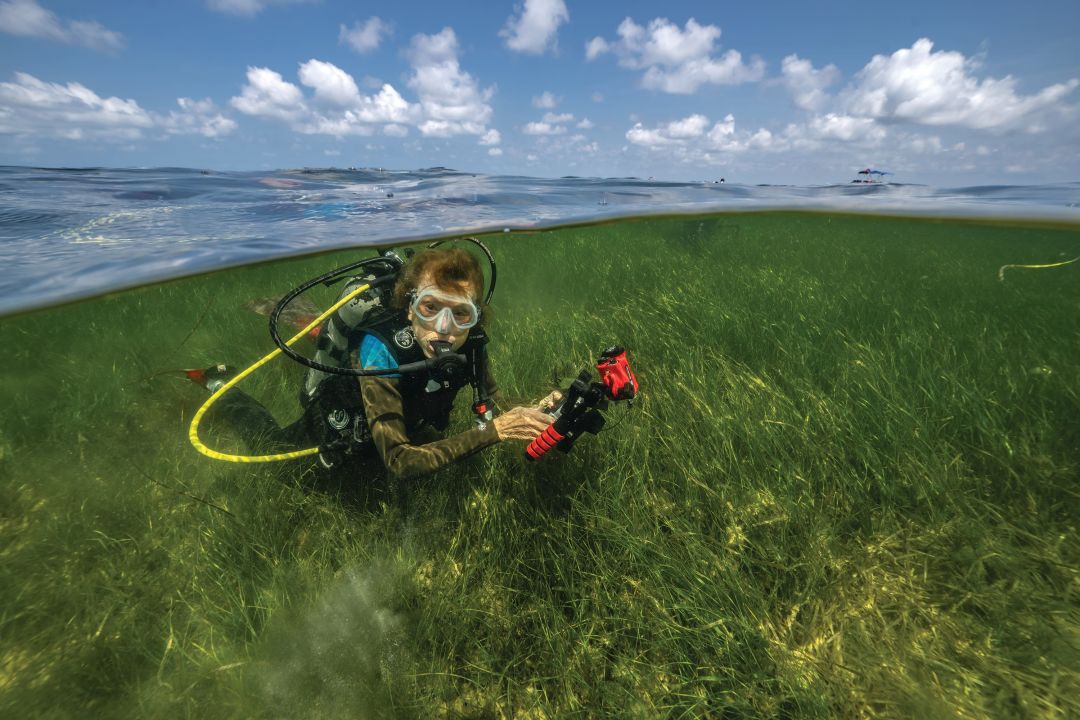
Image: Carlton Ward Jr.
There’s also a plan to make a feature-length documentary about Sylvia Earle, a marine biologist, oceanographer and explorer who is still scuba diving at 90 years old.
How different is capturing the interior of Florida from its coast? Ward says there are similarities. “In both places, it’s about the sky and light and the drama that’s going on in the foreground.”
But he says there is something special about the Gulf.
“It’s driven by the light for me,” he says. “Living on the west coast of Florida, there’s no more beautiful or powerful light than in the summertime when the sun is going down. There’ll be a thunderstorm marching in off the peninsula and you get this collision of warm sun and heavy clouds above the horizon.”

Image: Carlton Ward Jr.

Image: Carlton Ward Jr.
For Ward, it’s also not any easier to find animals in the water than it is
on land.
“Panthers are elusive, but so are whale sharks,” he says. “I thought I’d had a frustrating, challenging project on the panther for five or six years, and I didn't make it any easier for myself when I started trying to look at migratory species that don't show up for long.”
Whale sharks can swim to the bottom of the Gulf and spend lots of time in Mexico. For two straight summers, Ward spent weeks at a time using daily spotter planes to locate the sharks—and still wouldn’t see a single one. Fortunately, they began showing up off the mouth of Tampa Bay in late May and early June last year. Now, Ward and his organization, Wildpath, are partnering with the National Oceanic and Atmospheric Administration (NOAA) to try and satellite tag the whale sharks, which head as far north as the Hudson River and all the way down to Bermuda and back.
“It's really interesting to see the way they travel,” Ward says. “We have evidence that many of the sharks that were tagged off the mouth of Tampa Bay were foraging off the Dry Tortugas a few weeks later, which means the way they're moving is showing us the importance of the corridor to the health of the Gulf.”

Image: Carlton Ward Jr.
This migration and the marine wildlife corridors tell scientists, and maybe more importantly, elected officials, where we should be protecting marine areas and reducing human activities like shipping. For Ward, seeing marine life like whale sharks inspires him to think of marine creatures as “charismatic wild animals, deserving of admiration and respect, rather than being anonymous seafood.”
What happens next? It is unlikely Ward will ever move on from his work in Florida.
“There's so many stories here,” Ward says. “I can spend the rest of my career just focusing on the wildlife corridor and the Gulf, and I'll have no shortage of content.”