



Deb Kabinoff Strengthens Community Through Technology
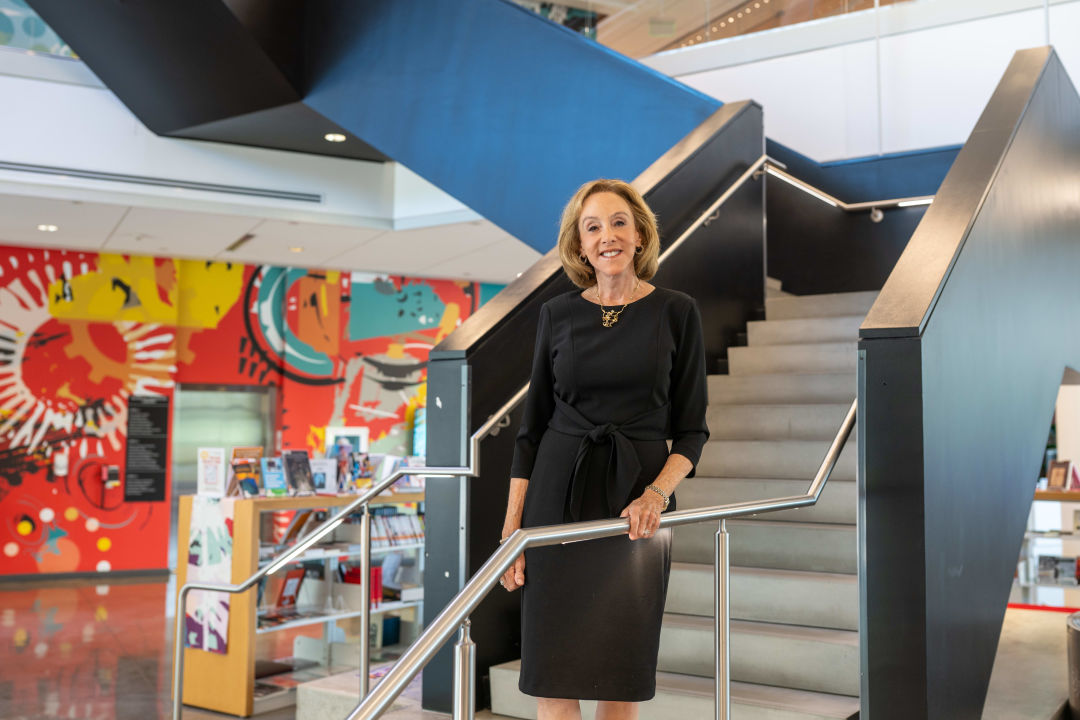
Image: Allan Mestel
Picture this. It’s 1978, and the country is on the brink of a technology revolution. The year before, the “1977 trinity”—the Apple II, Commodore Pet 2001 and TRS-80 Model I computers—had come to market, revolutionizing the industry with their small size and powerful processing capabilities. Suddenly, companies didn’t need million-dollar computer systems, massive structures that took up whole rooms, for data analysis.
At Cornell University, a young MBA student named Deb Kabinoff was paying close attention. “Having the ability to do complicated, large-scale statistical database analysis was so amazing to me at the time,” she says. “Now, of course, you can do it on your watch. But back then, it was unattainable for most people—and most companies—because it was so expensive.”
Kabinoff leapt at the opportunity to learn more. “At the time, there were very few women in business school, and none in operations research or computer science,” she says. “It was a groundbreaking time when women were first getting exposed to [this technology] and the opportunity to take advantage of it.”
She founded her first company, Corporate Health Strategies, at 28 years old, selling it to MetLife just two years later. After waiting out her two-year non-compete clause working at Ernst & Young as a consultant, she started a second company that she ran for 10 years before selling it to another conglomerate. That sale allowed her to retire to Sarasota at just 42 years old. But while some retirees might be content to spend their days golfing, at the beach or lunching with friends, Kabinoff has immersed herself in the community, founding GulfStar
Homes, a builder of affordable housing, with her late husband Larry Kabinoff; volunteering for area nonprofits; serving on boards like Sarasota Memorial Healthcare Foundation and Gulf Coast Community Foundation; and helping improve the lives of residents through her knowledge about and passion
for technology.
Or, as she puts it, “My mission is to help every sector of our community benefit from the capabilities of technology.”
Her projects span the gamut. In 2023, working with the Sarasota Police Department, Kabinoff provided 100 iPads to students living in Sarasota’s North Orange Mobile Home Park, historically a learning desert during the summer months, to allow them to access educational tools at home. That same year, 40 Booker High School students participating in the school’s Law Academy also received iPads—funded by Kabinoff—after a field trip to the police station to learn about the police department’s role in the community. At Marie Selby Botanical Gardens, Sarasota Memorial Hospital, the Jewish Federation of Sarasota-Manatee and Asolo Repertory Theatre, she’s provided hundreds of thousands of dollars for multimedia studios that allow those organizations to upgrade existing systems or create new ones, making it easier to share important news, updates and breakthroughs with the community. And this year alone, she’s personally underwritten the $100,000 cost of the Sarasota Police Department’s new mobile Learning Center—a 28-foot trailer complete with iPads, a 3-D printer, satellite internet and what Kabinoff calls a “jewel box of learning tools for kids”— and funded a trial at Sarasota Memorial Hospital studying how robotic companion pets can help older adults with dementia in hospital settings.
“No one would fund the project because it came from a nurse who had an idea about how to give better care to her patients, not a doctor or researcher,” Kabinoff says. “It was a double-blind study. Half of the patients did not get a robotic pet; the other half did. The people who got the robotic pet didn't use as much pain medication, didn't stay in the hospital as long, and when they left the hospital, they went home instead of going to another institution. The outcomes were dramatic.” The study made international news; Kabinoff says she was tickled to see her name in German press clippings.
Currently, she’s in the midst of a years-long project with Ringling College of Art + Design to help bring the college’s various institutions—from its main campus to its Osher Lifelong Learning Institute to Sarasota Art Museum and beyond—into one unified computer system.
“We’re just at the point where they have designed a system and are about to implement it,” she says. “It's not as glamorous as AI, but it's so essential to managing, communicating and optimizing the programs that [Ringling College] is offering. It’s been very rewarding.
“I think technology can help us pull the community together,” she continues, “and we need to keep finding opportunities to do that.”
Join us on Thursday, Oct. 15, 2026, for a fabulous luncheon celebrating unity and community at Sarasota Magazine’s Unity Awards! Get tickets here.