


Meet the Innovators and Professionals Shaping Our AI Ecosystem
Could Sarasota become home to a tech sector fueled by artificial intelligence entrepreneurs and startups? We’re still terabytes away from the density of AI talent in San Francisco, New York, Boston, or Seattle, but a diverse and steadily growing group of innovators—from architecture and education to law and venture building—are already here, immersed in the region’s emerging AI world. And no matter how confused or uneasy many of us feel about AI’s power and its risks—and every person we spoke with raised warnings about its unreliability and the fast-moving, barely governed frontier—we’re also watching something unmistakable: the future of how humans will live and work has arrived, and these people are seizing its possibilities.
Sam Bobo Worked on IBM's Revolutionary Watson Project. Now He’s Advancing the Language Capabilities of Artificial Intelligence Models.

By the fourth grade, while most kids his age were just discovering the Internet, Sam Bobo was already deep into Microsoft Encarta, scrolling through the digital encyclopedia to teach himself foreign languages. The early fascination with how information moves and multiplies never left him.
Years later, at Emory University in Atlanta, he earned degrees in business administration with a focus on information systems and mathematics.
After graduation, he received Emory’s Goizueta Business School Emerging Technologist Award and landed at IBM in New York City, where he joined the famed Watson AI project. It was 2014—just three years after Watson made headlines for beating “Jeopardy!” legends Brad Rutter and Ken Jennings.
Nearly a decade later, in 2023, Bobo moved to Microsoft, where the 34-year-old is now a senior product manager developing the large language models (LLMs) behind today’s AI agents. He works remotely from Sarasota, where his wife, Laurabeth, grew up, and he’s become an advocate for the city’s emerging tech community.
In January 2025, he took the stage at the inaugural Sarasota Tech conference for a panel aptly titled “The Good, Bad, and Ugly of AI.”
“There are a lot of false expectations of what AI can do,” he says. Too many organizations, he adds, “try to shove AI into a use case that doesn’t make sense because there was so much hype and promise. So many people believe that AI is this magical capability that’s going to solve all the world’s problems.”
Still, Bobo notes, AI’s ability to process and access vast amounts of data has no rival.
“Where AI thrives, in my opinion, is solving highly specific tasks at scale,” he says. One example: Dragon Medical One, a Microsoft product that serves as a digital scribe during doctor–patient conversations. “It’s taking detailed notes, transcribing everything, finding knowledge articles, and taking all that information and throwing it against a list of clinical trials to maybe get a head start on a diagnosis.”
The technology, called Scribe, is designed to focus only on the medical portion of a conversation—it ignores personal chatter or gossip that might surface between doctor and patient. The result is a kind of invisible assistant that lets physicians focus fully on their patients instead of scribbling on a pad or typing mid-visit. Of course, that new efficiency can be a double-edged sword: the more streamlined the process, the easier it becomes to squeeze even more appointments into an already packed day.
The real value, Bobo says, lies in the data itself.
“You can feed an AI model a million images of X-rays that show a malignant tumor, and a million samples that don’t, so you have this huge wealth of information to identify patterns,” he says. “It’s a highly specific task, but you can do it at scale.”—Brian Hartz
Suncoast Venture Studio’s Will Dolan and Travis Priest Dream up AI Concepts, Then Find the Right People to Carry Them Forward
Opera, beaches and the circus. Sarasota’s cultural résumé is impressive, but could it add “AI hub” to the list?
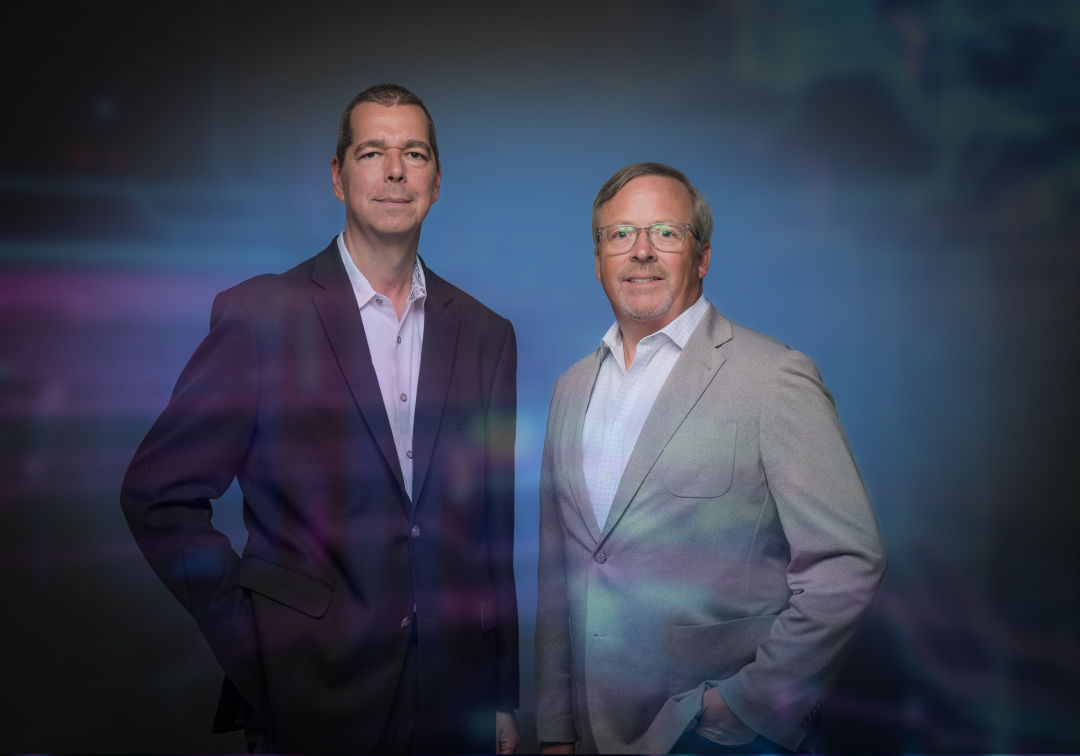
For Will Dolan and Travis Priest, the answer is an easy yes. The two are the driving force behind Suncoast Venture Studio, a business incubator that develops its own ideas, funds and manages the first steps, and then recruits entrepreneurs to run with these new ventures. Dolan, 55, a fintech and financial services veteran, and Priest, 54, a longtime venture capitalist, say thinking big has never been the problem.
“We come up with ideas internally, either things that we have looked at, or people we’ve talked to in industries that have problems that we can solve, or we license technology from a third party, like a university,” Priest says. So far, the studio has seeded a small but growing portfolio of AI-driven startups in fields like insurance, manufacturing and venture automation.
“AI investment is huge right now,” Priest says. “AI is industry agnostic, so we can touch health care, we can touch insurance, we can touch general consumer goods, we can touch manufacturing.”
The Suncoast Venture model, Dolan and Priest say, fits Sarasota’s unique position in the tech landscape. They call it a “tertiary” market—not flush with the startup infrastructure of Miami or even nearby Tampa, but full of residents who’ve built, sold and exited successful companies. Many are now looking for their next challenge. Some may want to run a Suncoast-backed startup; others could mentor and advise new founders.
Because Priest and his partners personally invest in these ventures, providing not just funding but operational support and early infrastructure, experienced, retired businesspeople and entrepreneurs see opportunity. “That’s a compelling picture, even for a successfully exited founder,” Priest says. “With all that infrastructure in place, it’s a huge head start.”
What drives Priest and Dolan is not just the thrill of new technology, but the practicality of solving real problems.
“AI is part of how you solve business problems,” Priest says. “We want to solve for things that can be done better or differently, or new things that can be introduced into a market. We have to make sure we’re solving problems for people and that there’s value in the businesses we’re launching.” —Brian Hartz
Intellectual Property Lawyer Elizabeth Stamoulis Navigates the New Legal World of Generative AI

Image: David Tejada
Guesswork isn’t a term you’d normally associate with the American legal system. Judges and attorneys are creatures of precedent, trained to lean on case law and history. But what happens when there’s no precedent at all—when the law is chasing a technology that’s running at warp speed?
That’s the bind intellectual property attorneys like Elizabeth Stamoulis of Williams Parker now find themselves in. Generative AI can, with a few keyboard strokes, conjure books, songs, videos—even lifelike digital performers—and the courts are scrambling to keep up.
“With AI, we’re on the cutting edge of technology,” Stamoulis says. “And the law doesn’t keep up with it, so you’re having to guess and anticipate what’s going to happen, and then advise clients until we have
better, more final, answers.”
At 39, Stamoulis is well acquainted with reinvention. A New Jersey native, she followed her family to Englewood after high school, earned her law degree from Stanford, and began her career at a New York City firm before moving to Venice in 2015 to be closer to home.
That same year, Stamoulis joined Williams Parker. At the time, intellectual property (IP) wasn’t exactly the firm’s bread and butter, but she helped build its practice from the ground up. Today, IP—and, increasingly, AI—law sit at the center of her work. Her clients run the gamut from small local businesses and nonprofits to software developers, authors and artists trying to protect what they create.
Copyright and trademark law, Stamoulis says, already cover much of the AI landscape. "It's not that we need to create all-new laws,” she says, “although Congress is working on that, too, because of deep fakes.”
Still, the existing framework is being tested. In California, the tech company Anthropic—maker of the AI assistant Claude—was recently sued for using large amounts of copyrighted material to train its models.
“In that case, the court found it was fair use to train the model with other people’s content,” Stamoulis says. “But the issue was that [Anthropic] hadn’t necessarily paid for all the content that they had used.”
As AI shifts from invisible back-end engines—think Netflix’s recommendation algorithms that predict what we’ll watch—to tools that can instantly generate creative work, the stakes have risen.
“It sometimes catches people off guard to learn that with copyright infringement, there’s no intent requirement, so just because you didn’t intend to infringe doesn’t mean that you didn’t,” she says. “If [AI] spits out something that happens to look like somebody else’s work, and you use it, you’re possibly opening yourself up to infringement.”
Her clients, she says, are using AI everywhere. “I don’t know that I’ve talked to a client recently who isn’t using AI in some way,” Stamoulis says.
That ubiquity is both exciting and fraught. AI can help speed up patent and trademark filings—but it can also introduce new errors and liabilities.
ChatGPT, Stamoulis notes, “doesn’t understand distinctions. It’s not necessarily catching all those things that we might be worried about from a legal perspective. It’s not always accurate, and I wouldn’t rely solely on it.”
For now, even the lawyers are learning as they go. —Brian Hartz
Rick Dakan Is Bringing AI into the Classroom at Ringling College of Art and Design

Image: David Tejada
Three years ago, Rick Dakan, a professor at Ringling College of Art and Design, started a course called Fundamentals of AI. He seemed an unlikely—some might have said unwilling—instructor in the world of artificial intelligence. Dakan is a creative writing teacher, fiction writer and video game designer, someone for whom creativity and authenticity are paramount. And yet, AI has now become a major part of his professional life and his main preoccupation.
Always impeccably dressed—his ties and shirts are conversation pieces—upbeat and immediately accessible, Dakan, 53, has been filling his days for the last several years trying to understand what AI will mean for creatives as the technology advances. He is Ringling’s first coordinator of AI and designed its first courses; sits on the steering committee of the Florida AI Learning Consortium, a collaborative of 40 Florida colleges and universities; runs an annual AI symposium at Ringling that brings in national speakers (this year it was a two-day event called “AI and Creative Innovation: Advocating for Artists and Designers”); and is involved in designing a new major for Ringling students called Creative Technologies.
He’ll also be the first to say that AI disrupts. “All of us feel some level of threat,” he says. AI poses huge ethical and existential questions in the arts. How can artists and designers keep the distinctiveness and humanity that are part of human creativity if they use AI and watch it feed on (some say steal) data—everything available online about language, style and composition?
For Dakan, there is no clear answer.
“Nobody knows anything,” he says—at least not yet.
To that end, his courses teach students how to ethically and discerningly approach AI in their work. AI is a powerful thinking partner, he says, good for research, organization and developing ideas. It provides enormous opportunities. Even for faculty and students who are reluctant to explore it, there is an immediate takeaway when asking ChatGPT, Claude or Gemini for help. “People hate AI for doing things they love and love AI for doing things they hate,” Dakan says.
AI is already light years away from when ChatGPT entered the public marketplace in late 2022. For those reluctant to dip a toe into the unsettling new world of artificial intelligence, Dakan says to interact with AI about something you already know and care about. That will give you a sense of the good, the inaccurate and the bad, and how useful and capable AI is. “You won’t know until you push up against its boundaries,” he says. “But the truth is AI is here. We’re not going to be able to put it back in the box. And if we don’t figure out how to use it, [we] are going to be left far behind.” —Susan Burns

Image: David Tejada
Jonathan Rameau, 39, opened his architecture firm, Office J. Rameau, in 2019 and has worked on projects like the Leonard Reid House in Newtown, various commercial projects and residential architectural design.
Rameau is a Sarasota native, so he knows the local landscape, but AI helps him visualize each project’s surrounding environments without having to revisit a site over and over again. “I have software that essentially takes images from a drone video I shoot, extracts the data within those images, and extrapolates all the points to create a 3D model of the site,” he says as he pulls up an image of a property he has begun work on. It looks like a Google Earth image, but Rameau says it's better because it’s the most up-to-date imaging that includes nearby foliage and surrounding buildings that may have changed since the last Google survey.
“This video allows me to walk through the space as though I were there right now,” he explains. “Once we designed the house, the idea would be that I could remove a tree, or an obstacle like an existing house, and [replace it with my design]. Now I don’t have to return to the place to visit constantly, and I don’t have to work based on my memory.”
Rameau stresses that he’s not a huge fan of generative AI, a subset of AI that uses existing human artistry, such as images and writing, to generate new products based on a series of prompts from a user. (Think ChatGPT.) However, he concedes, other AI tools help him with his day-to-day work.
“I would never write a prompt and hit a button to make a rendering,” Rameau says. “Further, when using generative AI, there are too many decisions for it to make. You could get good at talking to AI and force it to make certain decisions, but I think it’s better to learn the existing tools available to make the thing, and use AI to help you understand or streamline those tools.”
There are drawbacks to AI in his field, Rameau says. Its wide availability has made everyone feel like they’re an expert. “A client may ask ChatGPT if something is possible for their home design, and because [the program] is agreeable, it may say yes, even if that thing is not possible within the scope of a project,” he says. “AI is making it more difficult to convince every client of that. It can be deceiving.” —Lauren Jackson
Four Guys Launched a Tech Meet-Up and It Exploded Into a Thriving Community
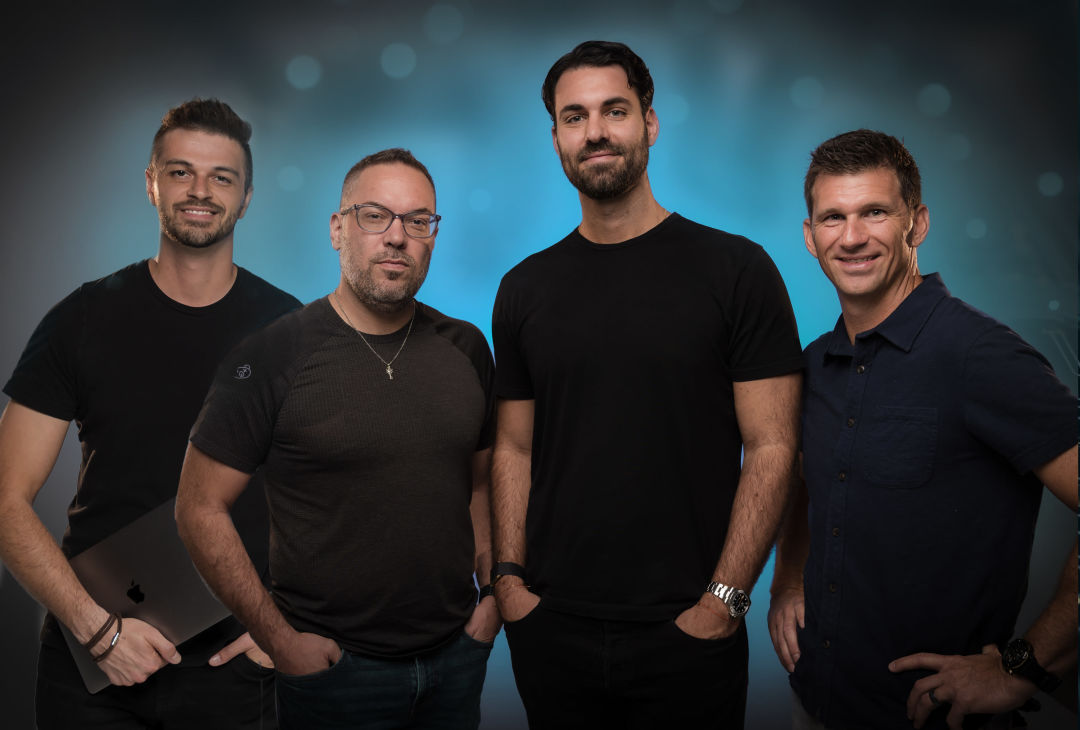
Image: David Tejada
After playing pickleball a few years ago, Raymmar Tirado and Anatoliy Marchuk headed to a local bar for a beer and chicken nuggets. Both worked in the tech industry. “We need more people like us,” Marchuk remembers saying, “Just fellow nerds in the tech industry, all doing our own thing.”
They connected with two other friends, Pete Peterson and Vlad Ljesevic, all of whom knew one another from working at The Lab, a co-working space in downtown Sarasota. As serial entrepreneurs using AI, they knew Sarasota’s tech world and had the credibility to bring people together.
Tirado, 42, describes himself as an entrepreneur, software inventor, digital strategist and community organizer. He assists software startups with digital strategy, builds online communities and helps companies take their products to market.
Marchuk, 35, last year co-founded his latest venture, Xeet.ai (pronounced Zeet), an 11-employee, Sarasota-based crypto company that has found a unique way—using AI—to recruit thousands of influencers to expand a company’s reach and awareness. The influencers are paid in, no surprise, crypto tokens.
Ljesevic, 32, is the co-founder and managing partner of CMPSE (pronounced “compose”), a five-year-old, Sarasota-based tech consultancy of 21 employees that is using artificial intelligence to help business owners and executives grow their companies.
Pete Peterson, 46, sold his first tech company when he was 23, and since then, has been a top executive at Sarasota-based global company S-One Holdings/LexJet, Dealers United and BuyerBridge. He’s part of Bridge Angel Investors; has a consulting company, Pete3; and sits on multiple boards, including Gulf Coast CEO Forum and Gulf Coast Community Foundation.
The four friends initially called the new tech group Drinky Thinky, and it started with six people at a local bar; the next time 10 people sat in a circle at the CMPSE offices at the Rosemary Art & Design District; the following month 30 attendees showed up. The group renamed itself Sarasota Tech, became a nonprofit, and now has 1,500 members. “We hit a nerve,” says Marchuk.
That’s because technology workers have been a growing but hidden and disconnected profession in Sarasota. Many of them moved here during Covid and are still employed by big companies in San Francisco, Chicago and New York City. They work out of their homes and in co-working spaces. Ljesevic, Peterson, Tirado and Marchuk wanted to connect these scattered innovators and startup entrepreneurs. The goal, they say, is to network with Sarasota’s top tech professionals, and, hopefully, turn Sarasota into a “tech town.”
The group hosts free meetups every third Thursday at bars, restaurants and local businesses, and also organizes an annual summit, largely focused on AI. Their second Tech Summit is on Jan. 15, 11 a.m. to 10 p.m. at Mote SEA, and the group expects 500 people.
Could retirement and touristy Sarasota become a tech town? Ljesevic says the community has changed since he arrived seven years ago. “New companies have relocated to Sarasota or are being formed here,” he says. “Those jobs require skill sets unique to the technology industry, and that is changing and reshaping Sarasota.” —Susan Burns