



Parafencing Brings International Competition to Bradenton
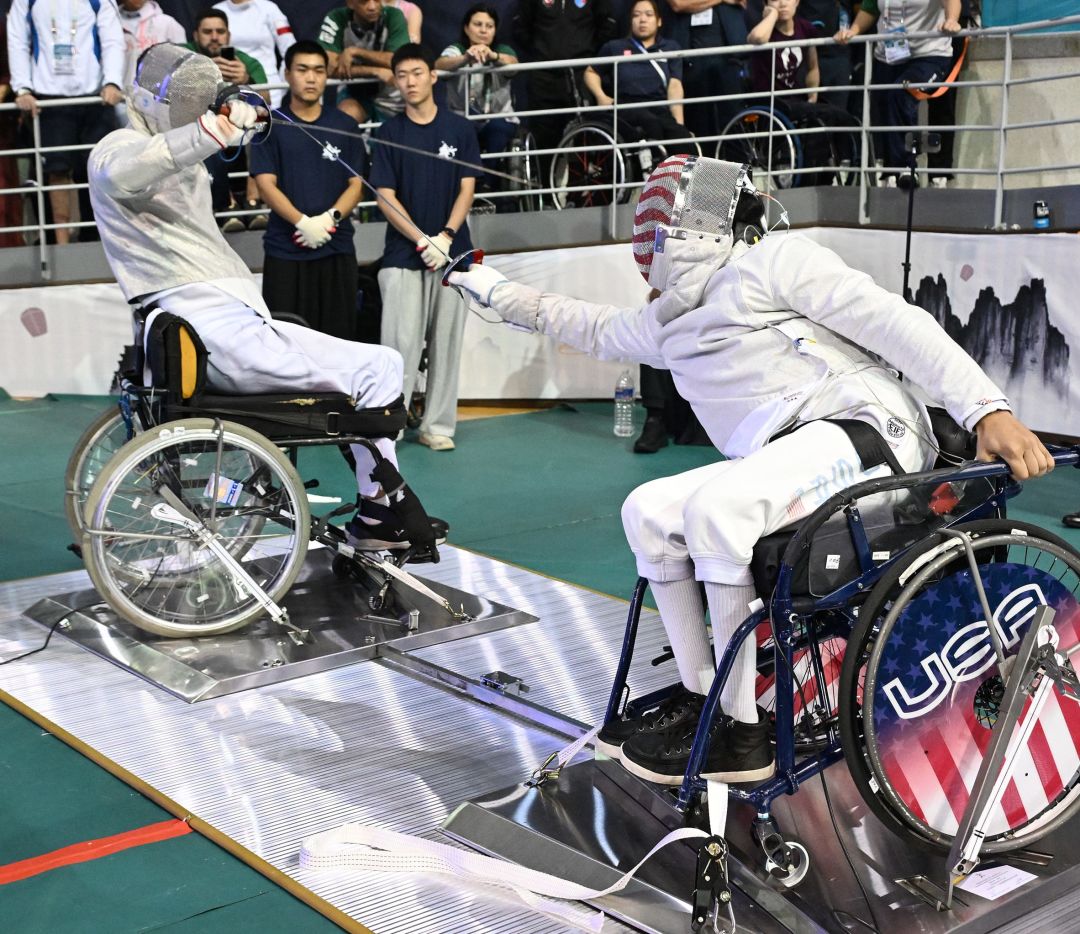
Image: BizziTeam via USA Fencing
A few days before the World Para Fencing World Cup opens in Bradenton, Victoria Isaacson is still in Poughkeepsie, N.Y., finishing a full work week as an occupational therapist and preparing to leave her house at 2 a.m. to catch a flight to Florida.
By the next day, she’ll be in Sarasota for training camp. By Wednesday, she’ll be part of an international field of wheelchair fencers competing at IMG Academy, where 170 athletes from more than 20 countries are expected for one of the sport’s rare appearances on American soil.
The World Para Fencing World Cup runs May 27–30 in Bradenton, marking the first international para fencing competition held in the United States since the 2023 World Cup in Loudoun County, Va. The event brings athletes to Bradenton for world-ranking competition during the long runway toward the LA28 Paralympic Games.

Image: BizziTeam via USA Fencing
For Isaacson, 28, the appeal was never only athletic.
She first tried fencing as a teenager because a friend was taking lessons at a club five minutes from her house. Before then, she says, she hadn’t connected with sports. Fencing was different.
“Something about the problem solving and martial arts—but [that] it’s not full contact—really appealed to me,” she says.
When Isaacson was 17 or 18, she began experiencing health issues that weakened her legs and qualified her for wheelchair fencing. Her coach, Eric Soyka, stayed with her through the transition. Now, years later, he’s the current U.S. Paralympic fencing coach and she’s a member of the Paralympic team.
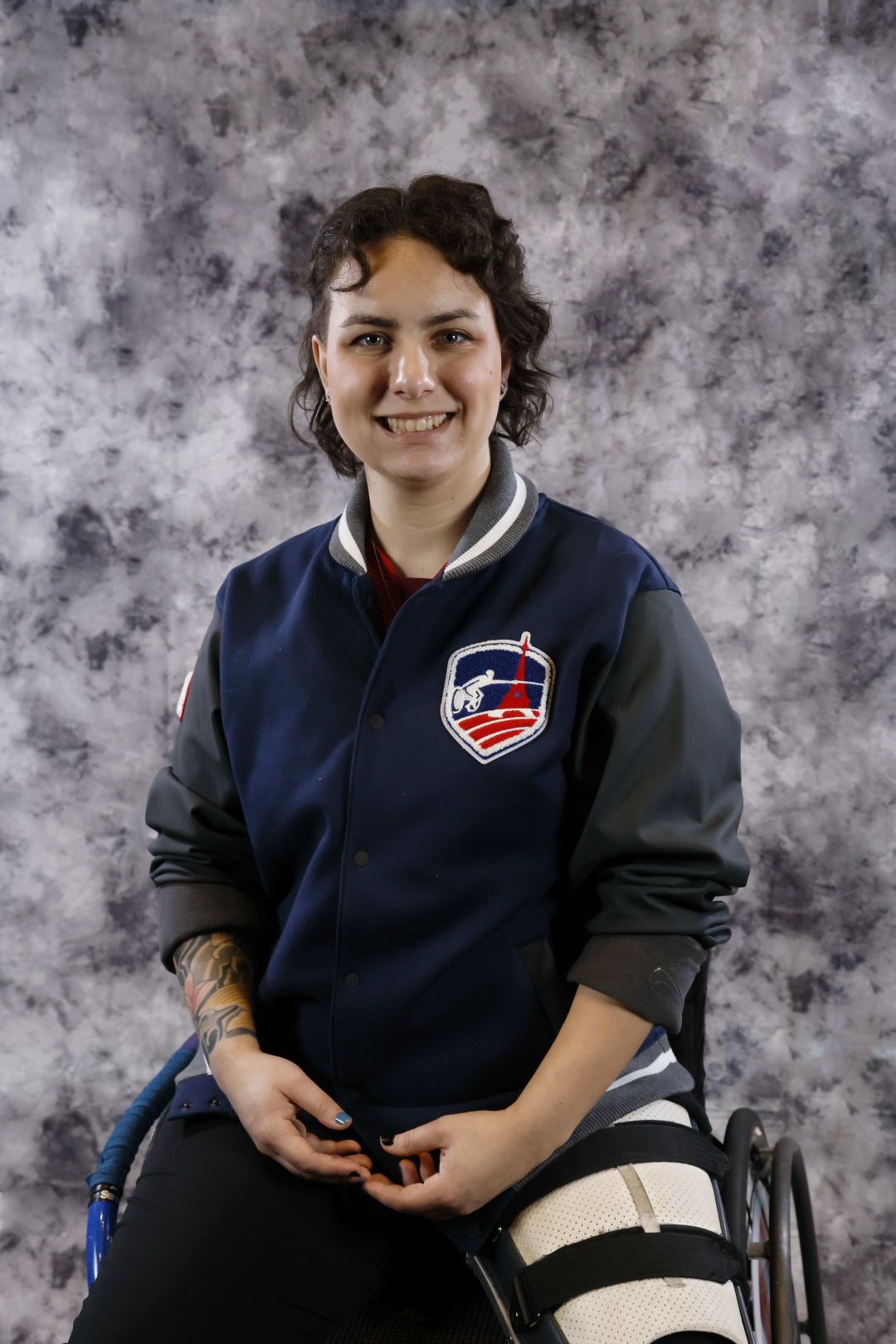
Image: Courtesy Photo
“We’ve been on this little journey together,” Isaacson says.
In para fencing, athletes compete in wheelchairs fixed into metal frames. The distance between fencers is measured before a bout so both athletes can reach each other, a setup that removes the footwork of able-bodied fencing but intensifies almost everything else: hand speed, reaction time, reach, deception, core strength, tactics and nerve.
The sport has been part of the Paralympic program since Rome 1960, and athletes compete in foil, epee and saber. One of the most basic things spectators misunderstand, Isaacson says, is the presence of the wheelchair itself.
“Usually, the biggest misconception people have about wheelchair fencing is that you’re pushing the wheelchairs while trying to hit each other,” she says. “But you’re fit in position away from each other and held together by a big metal frame set at the shorter person’s arms, so you’re always in hitting distance and you lean in and out of the chair.”
That creates an unnerving reality. “You’re never safe,” Isaacson says. “There’s no retreating.”
Noah Hanssen, 25, who lives in Maryland, started para fencing in 2017 after first trying Historic European Martial Arts, a form of historic fencing. At a tournament in Washington, D.C., that included both HEMA and Olympic-style fencing, he met a referee who connected him with a coach to work with him in para fencing.
Since then, the sport has taken him from national competitions in Milwaukee, Kansas City, Charlotte, St. Louis, Los Angeles and Richmond to World Cups and championships in Europe and Asia. His first World Cup was in Amsterdam in 2019. Last year, he competed at the World Championships in Iksan, Korea.
“It’s been an adventure,” Hanssen says.
He’s also watched the sport grow in the United States. Para fencing has a longer and larger presence in parts of Europe, especially Italy and Poland, he says, where fencing has deeper roots and international competitions can have more of a spectator culture. In the U.S., he says, the sport is still small.

Image: Courtesy Photo
“This is a new thing for the U.S.,” Hanssen says. “Our para fencing program has been growing, but it’s not a particularly large sport yet.”
That makes the Bradenton stop matter beyond the competition itself. For athletes, it’s a high-level international event. For local spectators, it’s a rare chance to see international para fencing in person.
Hanssen says fencing rewards focus. It moves so fast that hesitation can decide a bout.
“There’s a lot of very quick decision-making,” he says. “Deception is an important part of it. You’re trying to hit your opponent without getting hit, and there’s a lot of tactics and strategy that goes into that.”
The idea of mental control comes up again and again with both athletes. Isaacson works with a sports psychologist, using one-on-one sessions to manage stress and performance habits. Around that, she fits in fencing three or four times a week, plus swimming, personal training and long shifts as an occupational therapist.
“You have to be physically fit, you have to be mentally fit and you also have to have the skill for fencing,” Isaacson says.
Hanssen describes the mental side as a balance between analysis and overthinking.
“The sport rewards being intentional with how you’re choosing actions to take,” he says. “You’re able to analyze the situation, but you’re not overthinking, because if you’re overthinking, that will slow you down or make you hesitate, and those are things that you just can’t do in fencing.”
Isaacson says much of what happens in a bout isn’t conscious thought at all. Once the action starts, there’s no time to reason through every decision.
“With wheelchair fencing, especially, we’re in a locked distance, so there’s no running away from each other,” she says. “It’s very high pace, constant movement, and our hands have to be very fast. Usually when I’m in a bout, there’s not a lot of thinking. It’s all subconscious.”
The Bradenton World Cup will also give U.S. athletes a chance to test themselves against countries that dominate the top of the sport. Hanssen says China, Great Britain and Italy are among the teams he’ll be watching. Isaacson says the field is familiar in some ways—many of the same top athletes appear at international events—but she’s also interested in seeing newer programs develop, including Kenya, which she says is bringing a team to competition for the first time.
The event also comes early in the long runway toward the 2028 Paralympic Games in Los Angeles. Isaacson says Bradenton itself doesn’t directly count toward LA qualification, though performance can affect world seeding, which can shape future competition paths. The first event that counts toward LA qualification will come in the fall in São Paulo.
Hanssen sees Bradenton as part of the larger qualification picture, but not a moment to overburden.
“It’s definitely present,” he says of the L.A. Paralympic Games. “But it’s a little bit easier to not think about it right now. It doesn’t feel like the competition is a make-or-break moment for me. Even if it was, treating it that way isn’t really helpful for me as a fencer.”
Beyond the rankings, both athletes talk about para fencing as a community. Isaacson says the sport can be maddening—referees, opponents, equipment and one-point losses all add layers of frustration—but it has also given her a community of disabled athletes and a way to stay mentally sharp.
“The people that really like fencing are very passionate about it, so you find a really good community of people,” she says. “Especially as someone with a disability, having a community of other disabled people where we’re all up doing a lot is really beneficial.”
For Hanssen, the beauty is partly that he gets to keep doing something that fascinated him as a child. He grew up playing with lightsabers and sword fighting with siblings and cousins. He was in a car accident when he was 7, and fencing became something that carried forward.
“It’s very cool that it still gets to be a part of my life,” he says, “even in a more professional way.”
He also wants first-time spectators to understand that para fencing isn’t a "lesser" version of fencing. The strategies overlap with able-bodied fencing, but the execution changes because every athlete’s body is different.
“It’s cool to see how every athlete figures out how to make their style work for them and their body,” Hanssen says. “It creates a dynamic situation and problem solving that I do think is unique to para fencing.”
For spectators, the best advice may be simple: watch closely. Some bouts move so quickly that the breaks can take longer than the action itself. Direct elimination matches can include three three-minute periods, Hanssen says, but many end well before that. The scoring can be difficult to follow at first, because the most important move isn’t always the most obvious one. A feint, a parry or a brief hesitation can decide the point.
“It can be a confusing sport at first,” Hanssen says. “But there’s a lot of thought and technique that goes into it.”
The World Para Fencing World Cup runs Wednesday, May 27, through Saturday, May 30, at IMG Academy, 5500 34th Street W., Bradenton. Competition is open to the public and free to attend. Competition is scheduled to begin at 9 a.m. Wednesday, Thursday and Friday. Team events are scheduled to begin at 9 a.m., noon and 3 p.m. Saturday. Click here to learn more. Follow USA Fencing on Facebook and Instagram: @usafencing.