
Evan Nicolaides Makes Award-Winning Heirloom Knives in His Sarasota Studio

Image: Nicole Moriarity
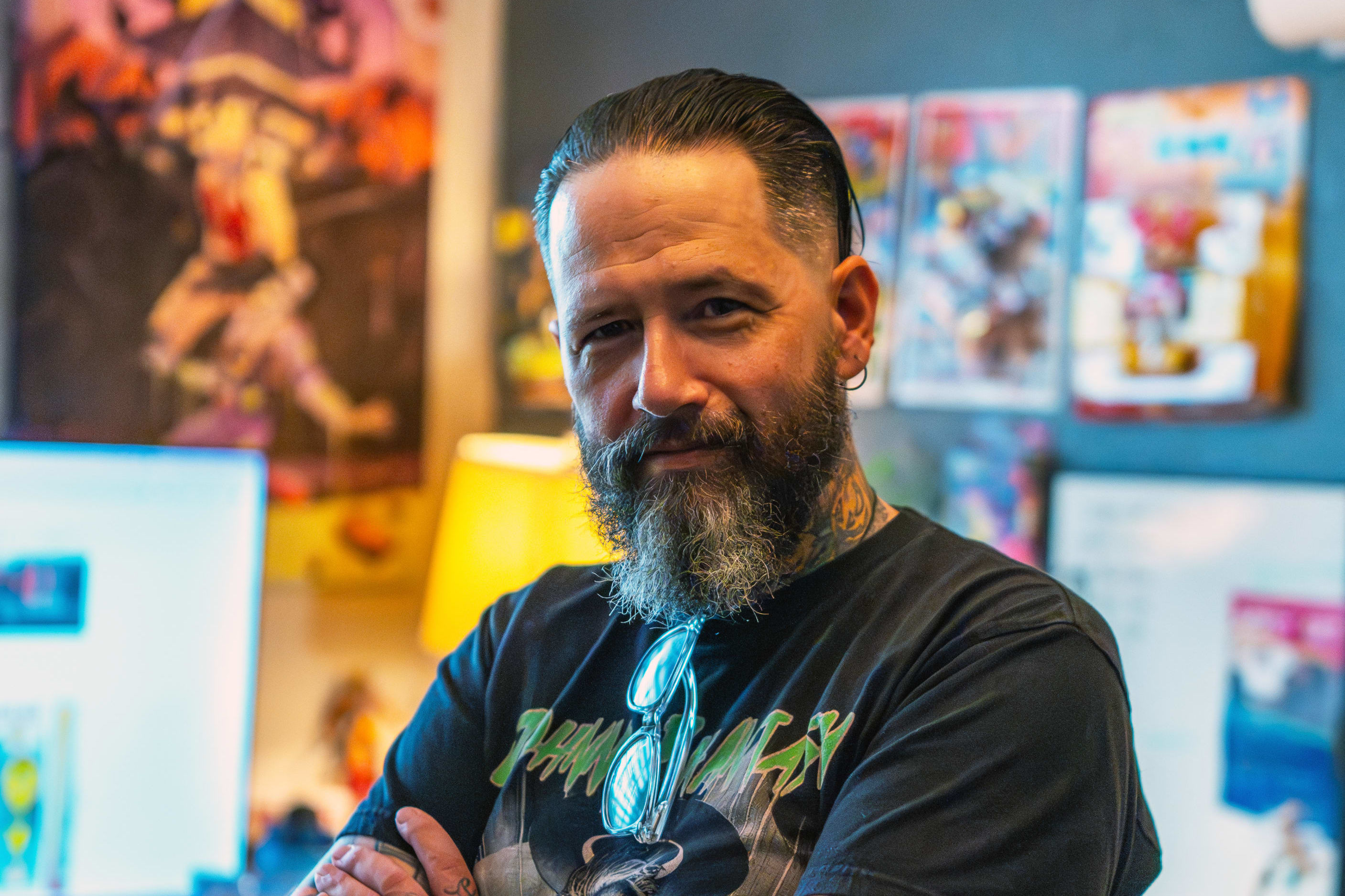
Evan Nicolaides, 37, never planned to get into the knife business. Prior to founding his knife company, Esnyx (a fusion of his name, Evan Stratton Nicolaides), he worked in sales and marketing for a telecommunications company, but “I was always into art and doing sculpture,” he says. Then a friend introduced him to the world of traditional pocket knives, “and I fell in love,” he says. Today, Esnyx is Nicolaides’ full-time job, and as he works toward earning the title of master bladesmith, he spends his days in his Sarasota studio crafting one-of-a-kind creations.

Image: Courtesy Photo
Blade Runner
Each knife begins with a bar of steel that Nicolaides shapes and heat treats—a process called austenitizing, with temperatures reaching 2,000 degrees—to meet exacting hardness and toughness standards and ensure the blade will last. Then he surface-grinds the blade so that it lies flat and parallel and builds the handles. The final step is called “pin together construction,” in which Nicolaides hammers the blade and the handle together with a pin. He also makes multi-bladed knives with different tools on them, like tweezers, corkscrews and scissors.

Image: Nicole Moriarity
The Cutting Edge
The knives Nicolaides makes are called slip joint knives, traditional pocket knives that date back to the 1700s. “There’s a lot of soul to them,” he says. At first, he used bone wood and other traditional materials for the handles, then transitioned to modern synthetics. “Now I just use whatever I think is cool,” he says, including Bakelite, pearl and other vintage materials.
Razor Sharp
Nicolaides caught the knife-making bug more than a decade ago, in 2014, when he ordered a vintage pocket knife online. “I didn’t like the handle on it, so I made my own,” he says. “I posted it in [the online community] Blade Forums, and it got a little traction, so I thought, ‘You know what? Let me try this again.’ It grew from there.”

Image: Courtesy Photo
Knife Bloc
There are only a few hundred master bladesmiths in the world. In the U.S., the title is given by the American Bladesmith Society after years of rigorous testing and evaluation.
Bladesmiths “pour our souls into the knife,” Nicolaides says, and want to get to know their customers and collectors as well as other makers. There’s also a connection to the art world. “There’s a category of knives called art knives that are all about carving and materials,” he says. “People use gold and ruby inlays and [create] intricate engravings; the knives can sell for tens of thousands of dollars. It really is an art form.”

Image: Nicole Moriarity
Price Point
Esnyx knives start at $1,500. One piece that Nicolaides created in collaboration with a master bladesmith from Brazil sold for $8,000 at the Atlanta Blade Show.