






Where to Get Real Gulf Seafood
When the first Spanish conquistadors arrived on our Gulf shores, they nearly starved to death. For all their bloodthirsty ambition and technical know-how, they were ignorant of the bounty just beneath the salty waters. All the protein from the sea surrounded them and yet they ate their horses and stole from Native Americans, never learning of the oysters, redfish, sheepshead, black drum, mullet and scores of other fish that sustained the people who lived along the coast.
Five hundred years later, are we guilty of the same? The menus at most of our seafood restaurants boast of fresh, local fish—mostly grouper or snapper—but the real issue is that the “local” fish we eat is likely not local at all.
Seafood established Sarasota. Our old city seal used to memorialize our fishing industry with a childlike drawing of mullet and oysters. So why aren’t we partaking of nature’s bounty just off our shores? To understand why, I visited A.P. Bell Fish Co., one of the last remaining wholesale seafood dealers in our region.
For more than a century, A.P. Bell Fish Co. has sold freshly caught Gulf seafood at its location in the historic fishing village of Cortez on Sarasota Bay. In the beginning, it was a small fish house that sold its catch to Tampa and Cuba. Today, it harvests millions of pounds of seafood using its fleet of 13 fishing boats. And yet, most of what is brought into A.P. Bell gets sent to other states and even other countries instead of going to local restaurants or our own kitchens.
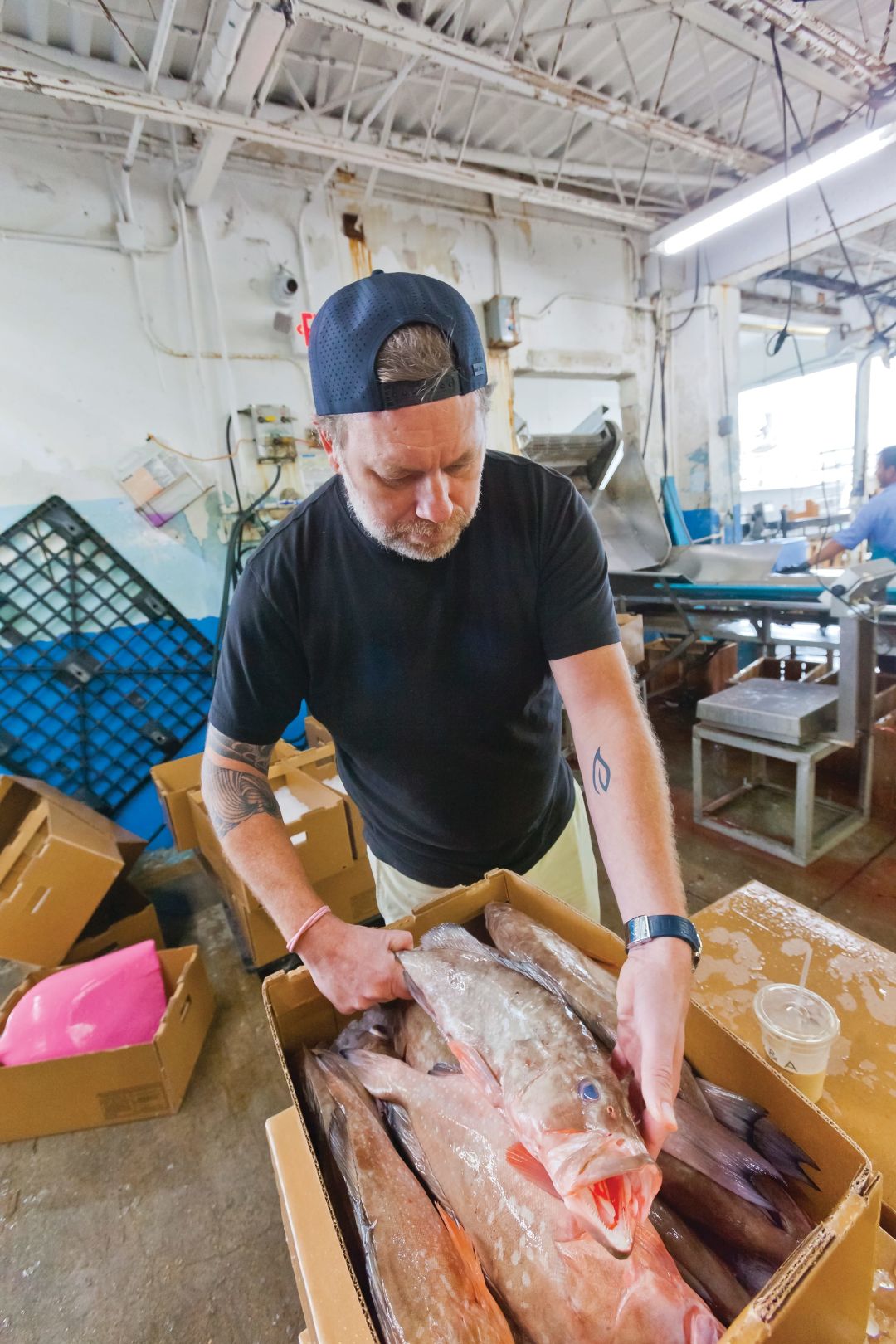
Image: Gene Pollux
A .P. Bell’s headquarters is a big, weather-worn white building. There is a warehouse-sized freezer with a temperature of 30 degrees that can hold 3 million pounds of fish. Semi-truck trailers are backed into its loading docks waiting to be filled with fresh catch. Next door is A.P. Bell’s famous Star Fish Company Seafood Market & Dockside Restaurant, where you can eat some of the fish house’s fresh catches on picnic tables overlooking the water.
I arrived at 10 in the morning, just in time to watch a fishing boat arrive and unload its harvest, and to meet with chef Drew Adams. Adams is the head chef at CW Prime at the St. Regis Longboat Key Resort. For years, he’s made the trek to Cortez to buy fish for his customers. If you’ve ever had the pleasure of eating one of his dishes, especially from Adeline, his previous restaurant, you’ll know Adams knows fish.
He loves A.P. Bell. “There’s no other place in Florida that’s like it,” he says. “There just aren’t enough people that do this anymore.” For Adams, the fish house connects him to his roots in Maryland, where he grew up crabbing in the bays. “I love that grit and that grind,” he says. “I have a lot of respect for what they do here, and it’s sad because it’s an industry that is disappearing and being replaced by commercial fisheries.”
Adams showed me around the place. The inside of the warehouse was busy. Many of the workers knew him and greeted him warmly. Another fishing boat had just arrived and was docked outside, where a couple dozen opportunistic brown pelicans waited for a mistake or generosity. A long conveyor belt rising into the building trafficked red snapper like a luggage carousel and dropped the fish into a large container, where workers grabbed them by the gills and immediately packed them into crushed ice. Diluted fish blood streamed along the concrete floor.
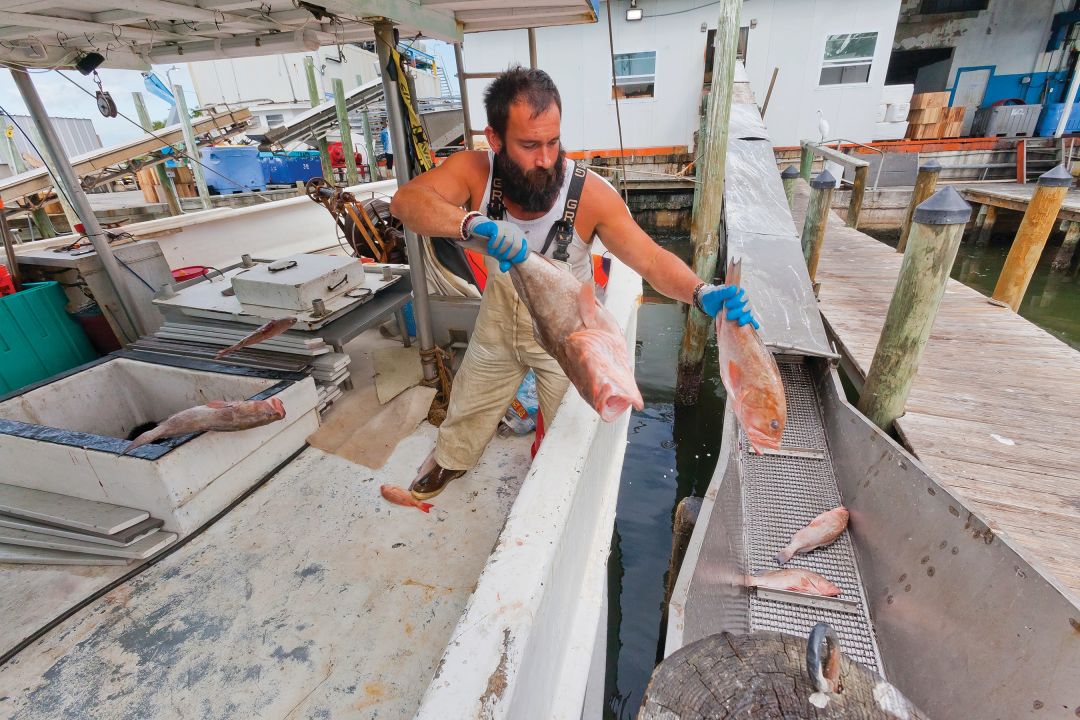
Image: Gene Pollux
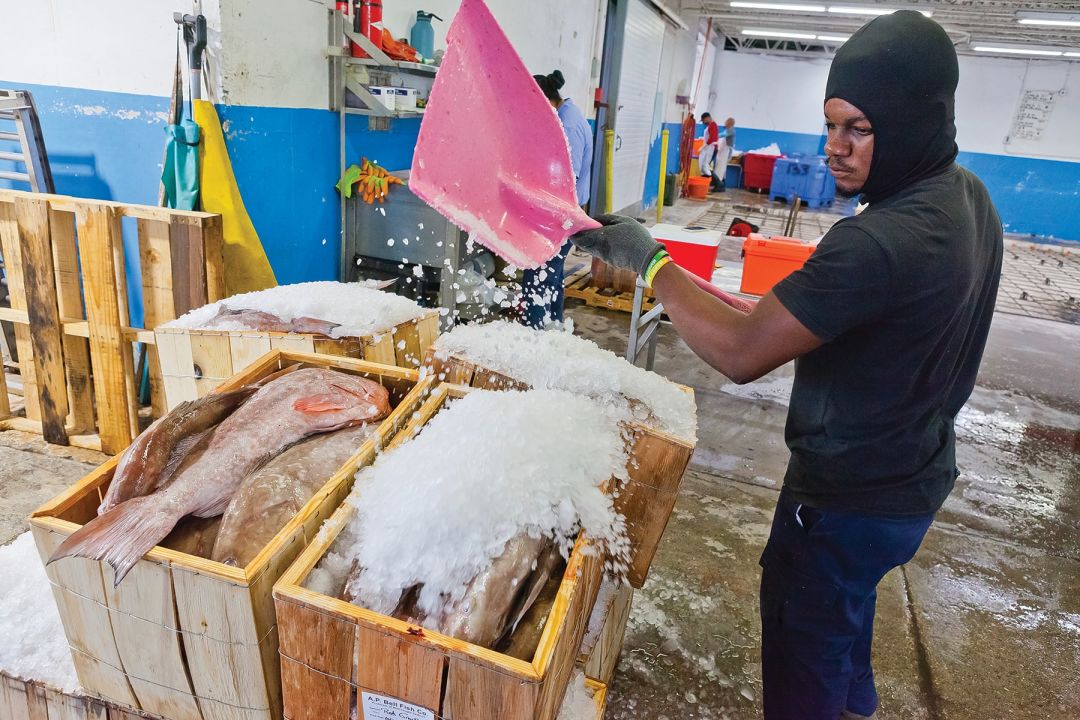
Image: Gene Pollux
Kaitlyn Sinclair, a Florida Fish and Wildlife Conservation (FWC) field biologist, picked random fish from another container at the end of the conveyor belt. She brought them to a table and used what looked like oversized nail clippers to pull something from the fish’s head. She explained that she was pulling the cheek bones out of the snapper to determine its age and overall health. “They’re like the ring of a tree,” she explains—a way to help determine the amount of permissible catch per year so the fish’s population remains sustainable.
A.P. Bell also offers chefs the opportunity to pick fresh fish by hand and do their own quality control. Instead of ordering seafood from big commercial factories that ship pre-fileted products, a handful of local restaurants make the trip to handpick their fare and select prize catch.
Adams picked up a snapper from the ice. I ask him what he looks for in a fish.
First, he smells it. Fish shouldn’t smell fishy. “You know that smell when you pull a fish straight out of the water, as opposed to when you go to a store and buy a fish that’s even two days old?” he asks. “Fresh fish should smell a little briny without being fishy.” He compares it to picking a tomato fresh off the vine. “Fish should smell like the ocean,” he says. “That’s the best way I can explain it.”
Next, he looks at the gills and eyes. You want red or pinkish gills. This means the fish have been caught and handled recently. Brownish, gray or slimy gills mean the catch might be spoiled—something that might happen, for example, if a fishing boat gets caught in an ocean storm and delays its return. Adams also says you want to look for clear, bulging eyes. Cloudy, sunken eyes are not a good sign.
Finally, he looks at the skin to make sure the fish has gone through rigor mortis. That might make you think of a crime scene, but this stage means that the fish’s tissue, deprived of oxygen, begins to tense up, giving the flesh a firm texture. Eventually, after 24 to 48 hours in a cooler, the fish’s tissue begins to relax again. You want the fish to go through this natural tenderizing process, Adams says.
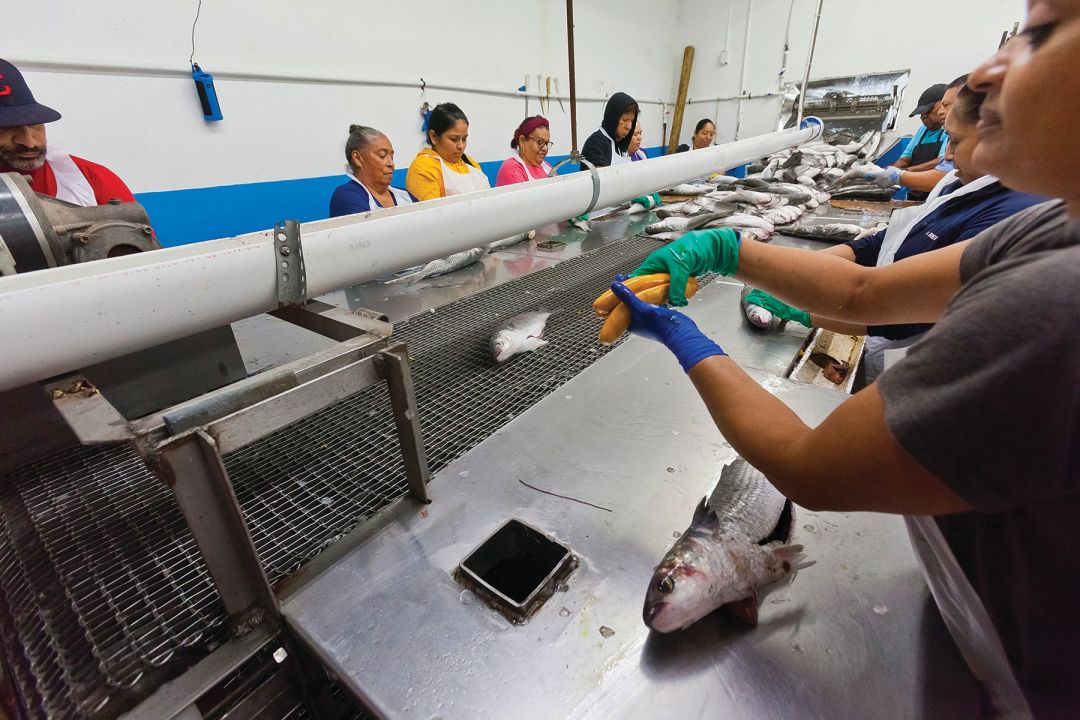
Image: Gene Pollux
At the other end of the building were a dozen or so workers standing shoulder to shoulder on either side of another conveyer belt. They each grabbed a mullet as it passed by and placed it down a shoot streaming with clean water. It looked like an old Ford assembly line, but in this case, it would be more appropriate to call it a disassembly line. The workers gutted the fish, pulling out their mango-colored mullet roe, and then packed them in clear plastic bags.
Watching all this fresh catch rolling by—right from our own Gulf waters—I wondered why we can’t get more people to dine on our local seafood.
For chefs like Adams, it comes down to customer demand: Does he cook what he wants to eat? Or cook what his customers want? People think the Gulf is nothing but grouper and snapper territory. “Lots of people here look down on the other kinds of fish,” he says. “They see them as ‘trash’ fish, but they’re anything but. Porgy, sand perch, permit, red fish—I’d take any of those fish over snapper or grouper any day. So unless it’s some cool restaurant that’s willing to branch out, or—and I hate the word ‘foodie’— someone who wants to try new and different things, that’s the only time you can get them to choose a different kind of fish.”
Outside of the building was a semi-truck trailer filled with boxes of all different kinds of locally caught fish: lady fish, pompano, tuna, mackerel. Customers started showing up and buying the fish from out of the trailer. Two of them, Nitin Thomas and his wife Elizabeth, drove down from Tampa that morning. “It’s the closest wholesale market around,” Nitin Thomas says of A.P. Bell. “The prices are really good, so it’s more than worth the trip.” He bought several pounds of mackerel. He said his plan was to make a curry. When Adams saw the couple’s purchase, he got excited. He offered them his favorite mackerel recipe.
“Here’s what you do,” Adams says. “You cut it off the bone, lightly pickle it, dry it and then smoke it at a low, low temperature, just to get some smoke under it, maybe about 100 degrees. Then sear it down until it gets a little crispy, and you have this medium rare mackerel. It’s just the best thing.”
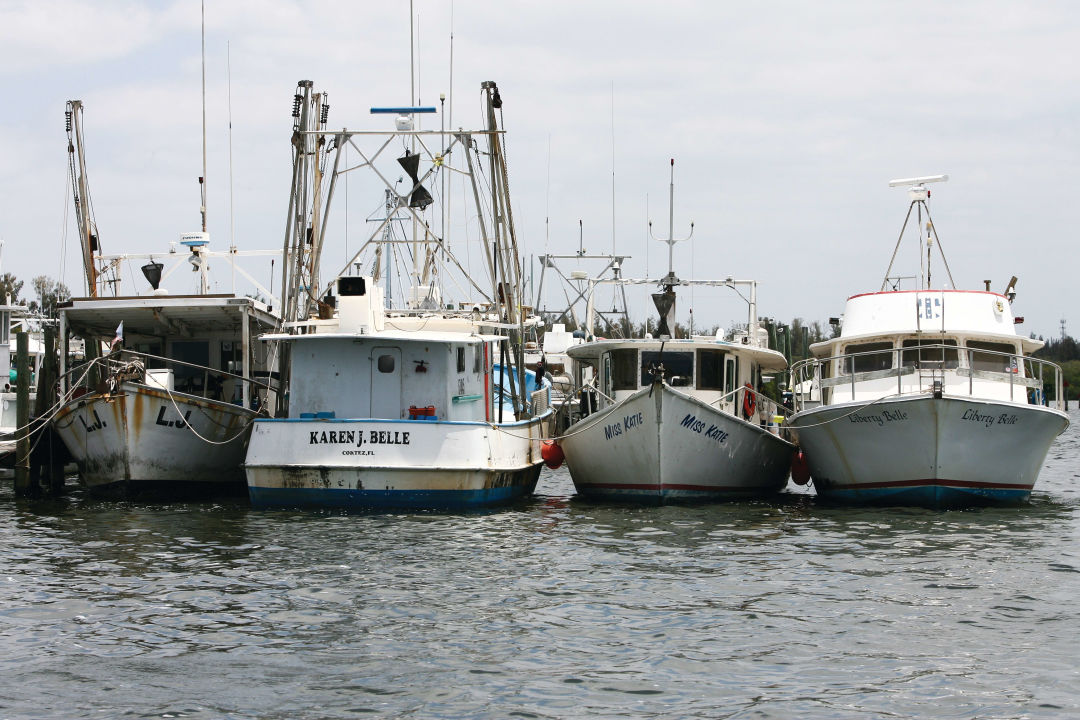
Image: Chad Spencer
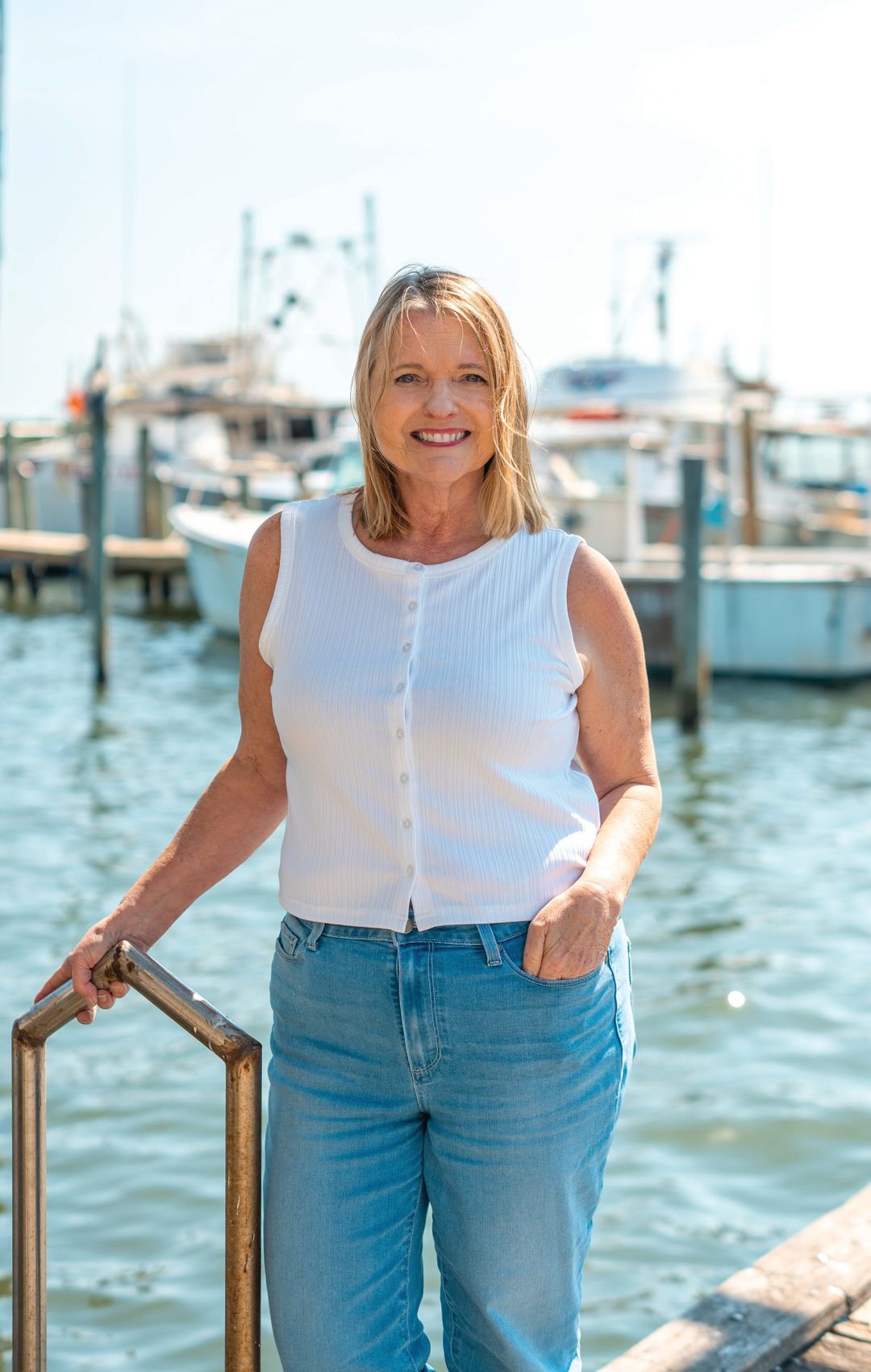
Image: Nicole Moriarity
Adams took me to meet Karen Bell, the ringmaster of the entire operation. I waited outside her office while she chewed out some captains. (A.P. Bell owns all its boats and contracts with captains and their crews to go out into the waters and harvest fish.) There’s a sticker outside her office door that says “BOSS LADY,” so you know she runs a tight ship. Inside was a century of local history hung along the walls and all over her desk. She had antique fishing poles and a large, wooden abacus that was once used at the Cortez schoolhouse. “I’m not a hoarder, I swear,” Bell says. Hung up behind her, I noticed a colorful Christmas card from the late Paul Reubens (Pee Wee Herman). “He used to come here and buy herring for his mother to feed the herons that visited her back yard,” Bell says. “He was very friendly.”
It was Bell’s grandfather, Aaron Parx Bell, that started this business. The family came down from Carteret County, North Carolina, in the late 1800s after a big hurricane wrecked the Carolinas' Outer Banks. After receiving a marketing degree from Florida Atlantic University, Bell went to work for IBM for a while, but by 1986, she missed her friends and family in Cortez and decided she preferred a life with fish instead of hanging out with executives and wearing a suit.
“There are some local restaurants that buy from us,” she says. “Michael’s On East gets our stone crabs, but sadly, it’s not as many as you would assume.” She says there are a few other establishments that purchase local fish—Swordfish Grill and Tiki Bar, Blue Marlin Seafood, Gulf Coast Crab and Seafood, CW Prime and, of course, A.P. Bell’s Star Fish Company—but most places don’t bother because of the skill it takes to filet their own fish. They’d rather have pre-portioned, pre-cut fish.
“[Fileting] is really an art, and if you don’t get a good yield, it can be expensive,” she says, explaining that the yield is the quality of the cut, so no fish flesh goes to waste. “That’s why most places buy from places like US Foods.”
Distributors like US Foods source their fish from all over. A restaurant that says you are eating “local” Gulf grouper is being liberal with the word. Technically, it’s not lying when it says the fish is from the Gulf, but it could be from farms from Texas or Mexico. “What’s so funny about that is I couldn’t tell you how many times I’ve seen an article that claims some restaurant buys a fish from A.P. Bell on the local news,” Bell says. “No, they don’t. That’s a lie. I don’t go up running and screaming or anything. But that is false advertising. I guess people just want to tell that story to their customers.”
But Bell isn’t bitter about it. Business is good, and she understands that it’s a lot of work for restaurants. “Drew [Adams] is a big customer of mine,” she says. “But that’s because he would take the time to come down here, since we don’t deliver locally. Most of our fish gets sent out in larger orders elsewhere.” In fact, 60 percent of her sales are national and international.
Bell agrees with Adams that part of the issue is customer preference. She thinks that a lot of people here don’t like inshore fish like mullet, sheepshead and trout because they have a stronger, oilier flavor. “They just don’t hold it in the same regard as reef fish” like grouper, snapper and amberjack, she says.
Her favorite fish is mullet. “I remember every Friday my grandmother would fry mullet,” Bell says. “True Southerners like the taste. They know what it is because they grew up on it. We would never call it a trash fish.” She believes that we should be proud of the mullet and wants people to give it a chance. “I think if people were more aware of the health benefits, they’d be more keen on trying it,” she says. “It’s got all the same good oils as salmon and sardines, those Omega-3s, but instead of being $15 dollars per pound like salmon, mullet is just a couple bucks.”
Mullet is also a very sustainable fish. Bell has never been worried about the mullet population. The only time it’s an issue is when there’s a bad red tide. “The mullet go further north or south,” she says. “We had that terrible red tide in 2018, but then a year or two later was one of our best harvests for mullet during mullet season.” A.P. Bell also uses every part of the mullet. What’s not sold for human consumption is used for bait. “The crabbers love mullet,” she says. “We don’t throw anything away.”
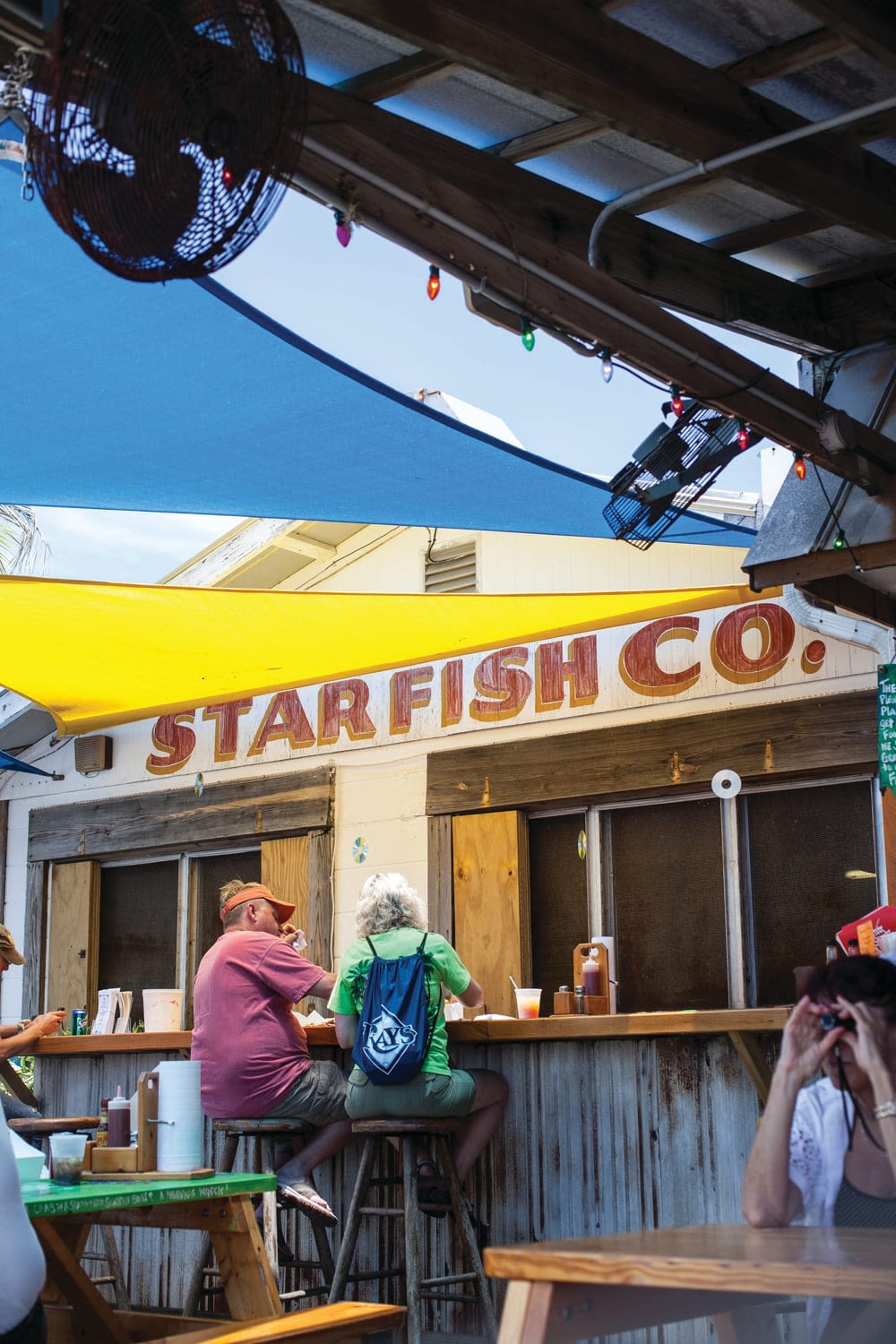
Image: Chip Litherland
After all this talk about fish, I was hungry. I went next door to Star Fish Company. It’s incredible to me that this place exists and hasn’t been sliced up and filled with towering condos. There was a long line in the back of the restaurant. Most people come here for a quick bite in a waterfront setting and are totally unaware they can also buy fresh catch to prepare at home just steps away.
I asked a group of people waiting in line, who were visiting from Ohio, if they knew they could get fresh-caught sand perch and porgy next door. They looked at me, puzzled. “Why would we do that?” they asked. Then they ordered fried grouper sandwiches with Cokes. I smiled and ordered the smoked mullet.