



'Echoes of Sarasota' Exhibit Connects Us to Our Past

Image: Courtesy City of Sarasota
With the June debut of its Cultural Heritage exhibit, Echoes of Sarasota, the City of Sarasota is creating an opportunity to “connect local heritage with a national moment of reflection,” says city public art administrator Ciera Coleman, referring to America’s 250th anniversary.
Echoes of Sarasota contains 19 paintings—16 hanging at City Hall and three at the Van Wezel Performing Arts Hall—including large-scale pieces by Regan Dunnick and Frank Hopper, plus selected works from artists William Hartman, Eugene White and more.
The exhibit explores the history of Sarasota, from its swampy beginnings as a farming community to an emerging city of arts and tourism, offering residents a look into how far the city has come.
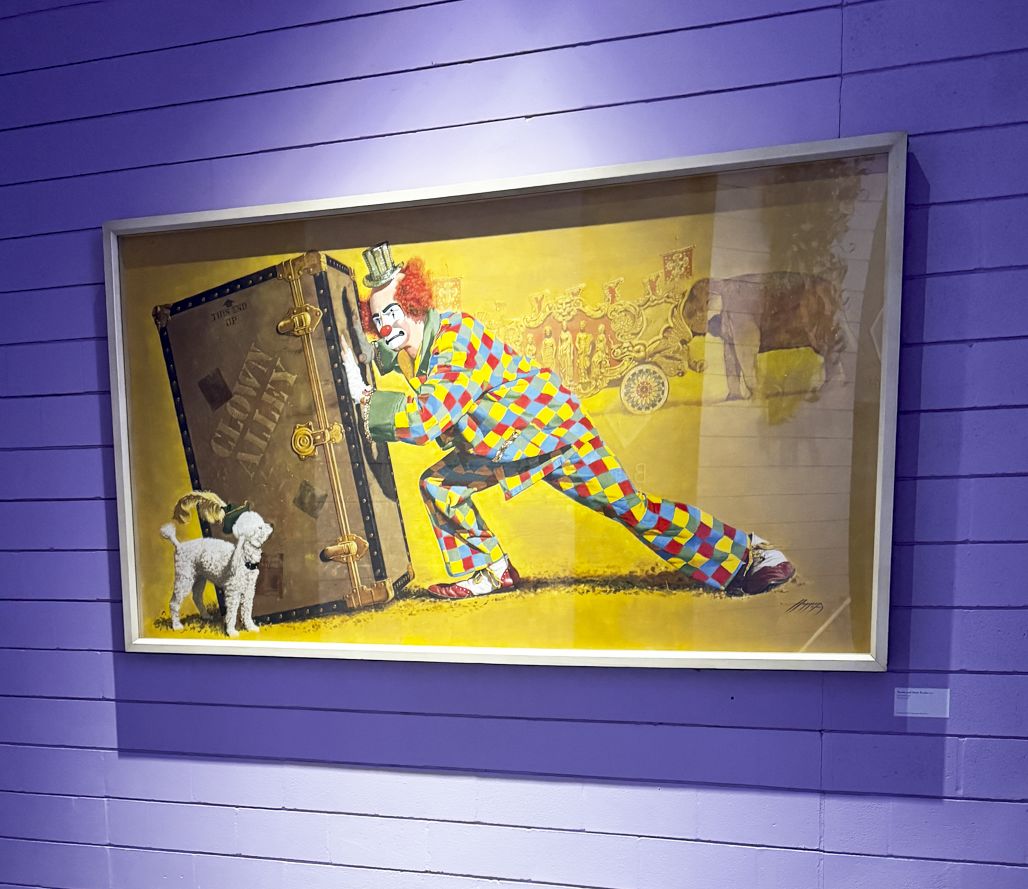
Image: Courtesy City of Sarasota
The inspiration for the exhibit came all the way back in 2004 from Colin Thomsen of Thomsen Fine Art. Dunnick and Hopper had been commissioned in the 1980s to create mural-sized artwork for Sarasota Bradenton International Airport’s main terminal. But as the airport began updating its architecture in mid-2021, their pieces were gradually moved into storage before Thomsen bought them.
“After acquiring the collection, Thomsen approached the city because it was important to him that these historically significant artworks be returned to public view in a civic setting,” says Coleman.
Dunnick, an award-winning illustrator whose works are part of the Library of Congress, is a Ringling College of Art and Design graduate, now faculty member, who was also a longtime Sarasota Magazine contributor. Hopper’s contribution to the Sarasota arts community began in the 1970s, after he moved to the area and was hired to design the wagon wheel medallion used for the Circus Ring of Fame plaques at St. Armands Circle. He continued to make art until his passing in 2022 at age 98.

Image: Courtesy City of Sarasota

Image: Courtesy City of Sarasota
Some of the other artists included in the exhibit are Wilfred Berg, whose Converted depicts a post-WWII area of town that would later become SRQ Airport, and Loran Wilford, whose Land’s End shows the natural bayfront land that existed before the construction of the Van Wezel Performing Arts Hall.

Image: Courtesy City of Sarasota
Part of the exhibit’s story also includes a discussion around Indigenous people who inhabited the area. Hopper’s Centennial Celebration shows an Indigenous man standing next to clowns, cowboys, children and a family looking at a golden horizon—a painting meant to represent all the people who have inhabited the region and make it what it is today.

Image: Courtesy City of Sarasota
In Myakka River, one of the first pieces Dunnick made for SRQ Airport, he depicts two Indigenous people next to drawings of Fort Armistead, Gen. Zachary Taylor and Isaac Alderman Redd, one of Sarasota’s earliest pioneers. The painting is meant to represent the Seminole Wars that took place from the mid-19th century to the early 20th century.
Other pieces, such as a digital America 250 collage flag quilt, made by students from Sarasota School of Arts + Sciences, are also on display temporarily at City Hall.
The exhibit will be open through May 2027 and the city plans to expand its free docent-led tours and is considering creating an additional display with a partner facility.

Image: Courtesy City of Sarasota
For now, Coleman hopes that visitors to City Hall and the Van Wezel learn something new about Sarasota’s expansive history.
“Even longtime residents may encounter topics, people or places they have not seen depicted before,” she says.
For more information, click here.