






It’s Peak Birding Season Look for These Migrating 'Lifer' Birds Making a Stop in Sarasota
Every day of the year, if you listen carefully, you’ll hear the chirp of a bird in a tree or the flap of feathers overhead. Florida is on a migratory route, which means many species of birds pass over our region. Some stop to rest and replenish on their way elsewhere, while others stay all winter. (You could call them snowbirds.)
In Sarasota, at the Celery Fields and in woodland areas like Pinecraft Park, you’ll spot numerous kinds of birds, from jaw-droppingly colorful painted buntings to chicken-like soras and flashy scarlet tanagers. Avid birders keep what they call “life lists,” and checking off birds they haven’t seen before—a.k.a. “lifers”—is akin to crossing out an item on a bucket list.
Here's a list of 14 “lifers,” compiled by the team at the Sarasota Audubon Society, that you might see locally this fall.

Blue Gray Gnatcatcher
Where: Pinecraft Park, Celery Fields and woodland areas
Flight Path: 1,000-1,100 miles, starting in the northern U.S., from late June to early July through November
This cute little gray bird, pictured at top, is constantly in motion in the trees and plants where it resides, looking for bugs to eat.

Image: SHUTTERSTOCK/BRIAN WOOLMAN
Swamp Sparrow
Where: Celery Fields
Flight Path: 800-1,200 miles, starting in Canada and the northern U.S., from late August and early September through mid-October and early November
Look for the swamp sparrow’s gray collar and rust-colored wings among the reeds in the swamps at the Celery Fields.

Image: Jim Mann
Northern Harrier
Where: Celery Fields
Flight Path: 1,300-1,800 miles, starting in Alaska, Canada and the northern U.S., from mid-August to late November
A bird of prey that’s part of the raptor family, you can see them skimming the edges of marshes, looking for small mammals to eat. You’ll know it’s a harrier by its broad, white rump.

Palm Warbler
Where: Celery Fields
Flight Path: 2,300-3,300 miles, starting in Canada, the Midwest and eastern U.S., from mid- to late August through late September and October
Look for palm warblers constantly pumping their tails in the trees and on the ground.

Image: Jim Mann
Painted Bunting
Where: Celery Fields
Flight Path: 500 miles, starting in North Carolina, from late July through mid-October
The male painted bunting’s shy, skittish demeanor is in direct opposition to its technicolor red, yellow, blue and green plumage. (Females are bright green.) You’ll often see them around the feeders at the Sarasota Audubon Nature Center.
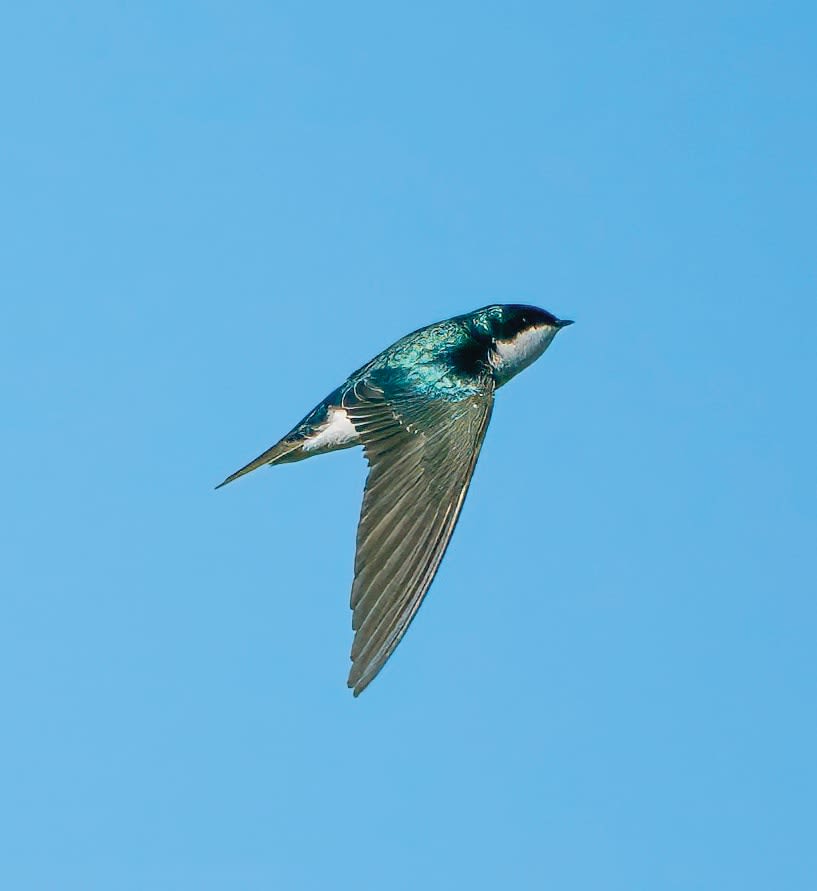
Image: Merry Houghtaling
Tree Swallow
Where: Celery Fields
Flight Path: 1,300-2,000 miles, starting in Alaska, Canada and the northern U.S., from July and August through late September and early October
These aerial feeders , with their iridescent blue-green backs, are often found in flocks.

Scarlet Tanager
Where: Pinecraft Park, Celery Fields and woodland areas
Flight Path: 2,500-3,300 miles, starting in the eastern U.S., from late August to early September through mid-October
Another bird with a serious “wow” factor, male painted buntings have cherry-red feathers and distinctive black wings. Female tanagers have green feathers to help them blend into foliage. They love munching on caterpillars.
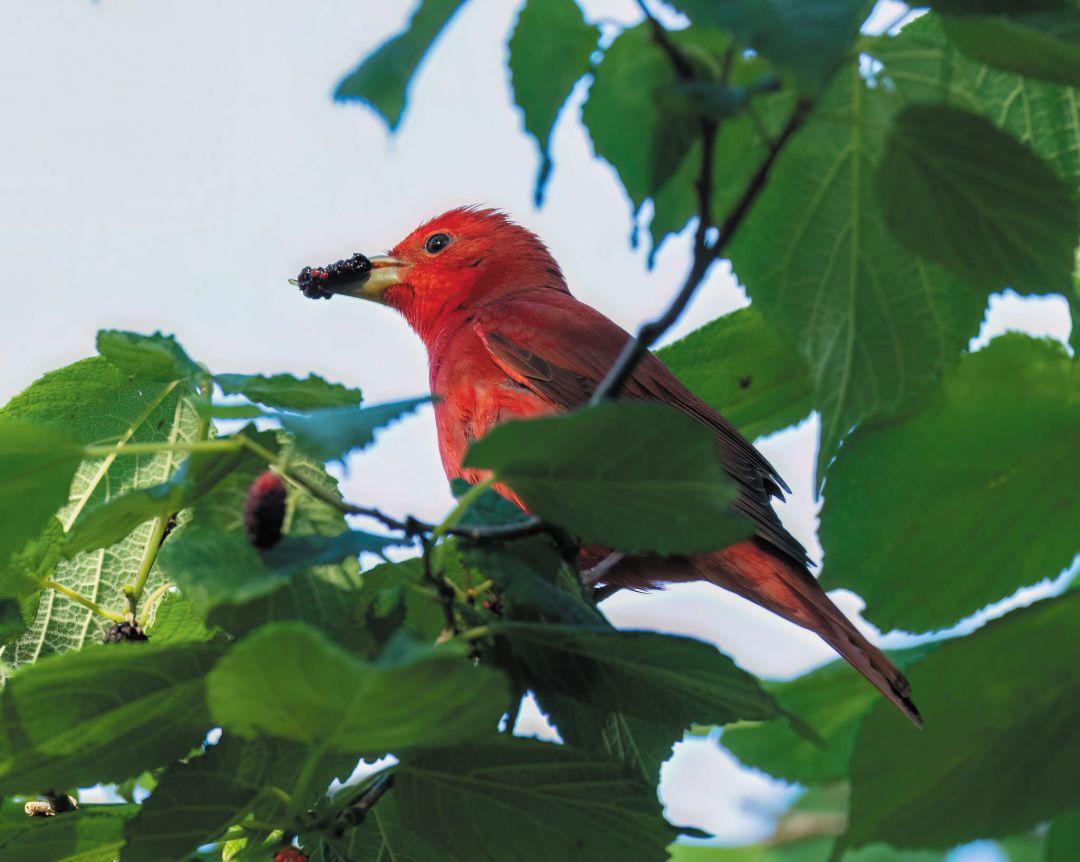
Image: Jim Mann
Summer Tanager
Where: Pinecraft Park, Celery Fields and woodland areas
Flight Path: 1,200-3,400 miles, starting in the Southwest, Midwest and eastern U.S., from August through September
Male summer tanagers are brick red and not quite as brilliantly colored as scarlet tanagers; females are a mustard-yellow color.
Magnolia Warbler
Where: Pinecraft Park, Celery Fields and woodland areas
Flight Path: 1,800-2,100 miles, starting in Canada and the northern U.S., from late July through November
Unlike other types of warblers, magnolia warblers have a distinctive black band at the underside of their tails.
Rose-Breasted Grosbeak
Where: Pinecraft Park, Celery Fields and woodland areas
Flight Path: 2,700-3,500 miles, starting in the northwestern U.S. and Canada, from mid-August through mid-October
Male rose-breasted grosbeaks are black-and-white with, yes, a rose-colored breast. Their large bills are perfect for seeds and berries, their preferred foods, and you can often find them in mulberry trees.
Sora
Where: Celery Fields
Flight Path: 1,500-2,700 miles, starting in the Great Lakes and along the Atlantic coast, from late August to November
You’ll spy these secretive, chicken-like swamp birds foraging in the mud and rushes during the winter months.
Black-and-White Warbler
Where: Pinecraft Park, Celery Fields and woodland areas
Flight Path: 1,900-2,600 miles, starting in Canada and the northern U.S., from late August through October
These little birds have beautiful black-and-white striped plumage and creep up and down tree trunks looking for insects to eat.
Yellow-Throated Warbler
Where: Pinecraft Park, Celery Fields and woodland areas
Flight Path: 600-900 miles, starting in the mid-Atlantic and midwestern U.S., from mid-August through September
Insect-eating yellow-throated warblers can be found—like many Floridians—around palm trees. Look for their egg-yolk yellow throats and gray backs.
American Redstart
Where: Pinecraft Park, Celery Fields and woodland areas
Flight Path: 1,700-2,500 miles, starting in the northern U.S. and Canada, from late July and August through early October
Another busy bird that flits from tree to tree looking for insects. Keep an eye out for its fanned tail.
Into the Woods
The Sarasota Audubon Society offers guided walks where you can see all kinds of birds, both at the Celery Fields and in local woodland areas.
Birding 101: Audubon Society Nature Center
Dec. 16, Jan. 20, Feb. 17, March 10
Learn the basics of your new hobby, including learning how to identify different birds, use binoculars and more. Registration is required; sign up at sarasotaaudubon.org.
Birding 101: Celery Fields
Nov. 16 at 8 a.m.
Meet at the Raymond Road boardwalk.
December 17 at 9 a.m.
Meet at the Sarasota Audubon Nature Center.
Dec. 21 at 8 a.m.
Meet at the Raymond Road boardwalk.
Birding 101: Woodlands (Myakka River State Park)
Dec. 3 at 8 a.m.
Meet at the parking lot on the right after the main entrance.
Birding 101: Woodlands (Lakeview Park)
Jan. 7 at 8:30 a.m.
Meet in the Lakeview Park parking lot.
Christmas Bird Count
Dec. 27, 2025
For the past 124 years, birdwatchers, ornithologists and scientists have conducted an annual Christmas Bird Count. Sponsored by National Audubon Society, more than 2,000 “circles”—areas 15 miles in diamater—are counted in the U.S., Canada, and in some countries in Latin and South America.
Sarasota County has three circles: one in Sarasota, one at Myakka River State Park and one in Venice. The count takes place over a 24-hour period, and the results are used to track decreasing or increasing species, as well as by wildlife managers.
For more information and to sign up to participate, email Aaron Virgin at [email protected].

Image: Courtesy Photo
Bird Brains
If you can’t make it to a bird walk or class, technology can help you identify the birds in your own back yard by simply recording their songs.
Merlin Bird ID
A great option for beginners, Merlin Bird ID was developed by the Cornell Lab of Ornithology. The user-friendly app allows users to ID birds based on photos, sounds or descriptions. merlin.allaboutbirds.org
eBird
More data-driven than Merlin Bird ID, eBird allows users to record the location, date, time and type of bird they saw or heard at any given time. It’s used for tracking bird populations, understanding migratory patterns and contributing to research. ebird.org
Birdfy Smart Feeder
Love watching birds flutter around your feeder while you sip your morning coffee? Upgrade your practice with a smart feeder. Birdfy’s smart feeder has a built-in AI camera that can recognize more than 6,000 species of birds via an app, and sends shareable videos and images to your phone when new feathery friends appear at the feeder. $149.99, birdfy.com