




One of Sarasota County’s Newest Programs, the Farm, Teaches Agricultural Skills and Life Lessons

Image: Nicole Moriarity
It’s 6 p.m. on a winter Monday, and the nearly 40-acre property behind McIntosh Middle School called The Farm is shadowed in the cool dusk. A cow calls an inviting moo and chickens cluck in the distance. Crickets have begun their nighttime chorus. Plenty of students are still on campus in the waning light, some tending to the animals they’re raising for the Sarasota County Fair auction, some waiting for a 6:30 p.m. 4-H meeting, and some just hanging out, kids being kids.
The Farm is a Sarasota County Schools initiative, launched last year, to increase agricultural literacy among today’s students. Kate Traugott, often called “Farmer Kate” by students and faculty alike, is the farm’s manager, overseeing the $8 million, 39-acre agricultural complex, which includes livestock barns, greenhouses, a teaching kitchen, pasture land and dozens of acres of wild oak and pine hammock.
Traugott earned her farmer title while running a community supported agriculture (CSA) enterprise from her five-acre homestead in Myakka Valley Ranches called Season of Sun. (A CSA is a farming model in which community members pay for a share of a farm’s harvest.) She was also the farm-to-school coordinator for Sarasota County Schools before taking her new role as the farm manager. Notably, she trained with Alice Waters, the famous Berkeley, California, chef who launched the farm-to-table movement in the 1970s, as well as the Edible Schoolyard Project, which has been teaching students how to harvest and grow food for more than 30 years and is now in 5,800 school kitchen-and-garden programs nationwide.
With nightfall approaching, Traugott rushes to show off the back pasture and its adjoining woods. “The point is to not develop all of the land,” she says, pointing to the treeline. “Part of learning about agriculture is learning about conservation and teaching ecological values. We can use the wild spaces to teach about interdependence and the impacts of humans on the environment.”
Both Traugott’s and The Farm’s entire philosophy comes back to using agriculture as a holistic teaching tool. There are obvious lessons like how to raise livestock, how to grow a cucumber and how to bake a loaf of bread, but the teaching scope has infinite potential. “Every Sarasota County teacher can use The Farm in their toolkit and bring students here to give them a tactile way to make lessons memorable,” Traugott says. “A school’s objective is to expose students to future career paths that they could pursue.”
She shares an example about how a group of Sarasota High School students working in the greenhouse needed an irrigation system, so they coordinated with other students in a plumbing program. “The agriculture students had to learn how to communicate with the plumbing students about what they actually needed for their plants to grow successfully so that the plumbing students could figure out what and how to build it,” she says. “The agriculture students learned about the plumbers’ challenges; the plumbers learned customer service skills; and everyone had to learn to problem-solve to get water all the way from the well out to the plants. This is all about learning that no one really does anything by themselves.”
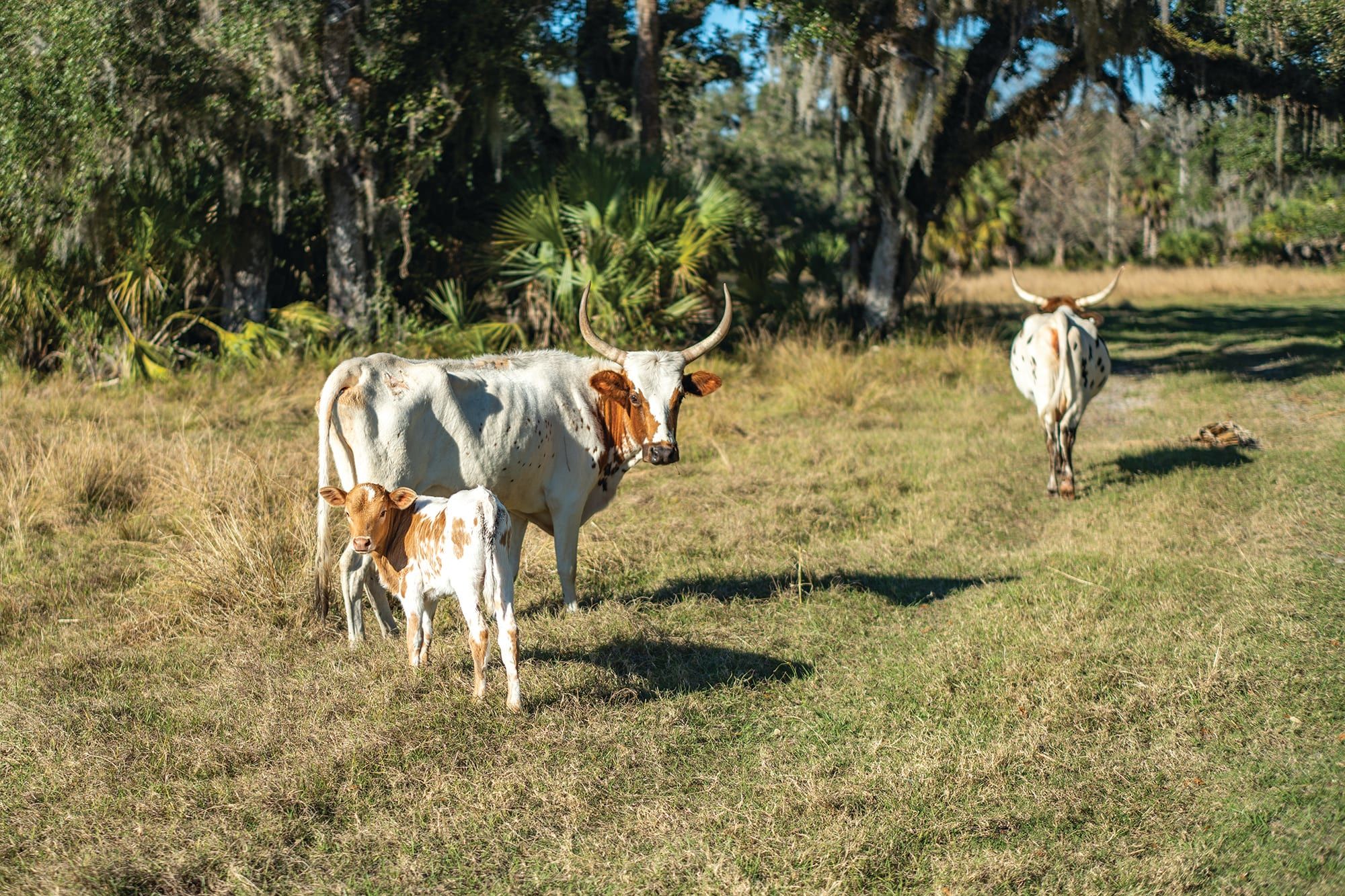
For many, the two livestock barns are the main draw. One barn is dedicated to smaller livestock such as hogs, sheep and goats, and the other is for dairy cows and cattle being raised for beef production. Students can use 50 animal pens between the two barns at no cost. They do, however, have to source the animal—whether they own it outright or lease it from a farmer—and provide its food and care.

Image: Nicole Moriarity
Some of The Farm’s hardest lessons are learned in these livestock pens. A black Brangus breed steer named Munchkin is the culmination of a three-year project for 12-year-old McIntosh Middle School student Rebecca Sounders. Sounders owns the heifer that birthed Munchkin, so the middle schooler was integral in the birthing process. Tonight, inside the barn, Munchkin ambles toward the pen’s gate for a quick sniff and a lick that tickles. Munchkin is set to be sold for beef at the 2026 Sarasota County Fair auction. This reality is a lesson in commitment, care and responsibility for Sounders and other students who raise livestock.
“Look,” Traugott says, trying to soften the news, “we eat meat, and raising those animals right is important. Part of that is caring deeply and being heartbroken sometimes. If it changes how you eat meat and how often you eat meat, it means you’re taking everything into consideration.”
Learning animal management and the science behind it is valuable for these students—many of whom may be our future farmers—not only from a training perspective in terms of feeding and care, but also as a life lesson about our roles as stewards of the earth and what it means to care for something beyond ourselves. It’s also a lesson in interdependence. “Farming doesn’t happen successfully because you’re out there doing it by yourself,” Traugott says. “It happens successfully because you’re doing it in a community.”