




Attorney Janella Leibovitz Gives Foster Kids a Voice in Court
This article is part of the series In Their Own Words, proudly presented by Gulf Coast Community Foundation.

Image: Barbara Banks
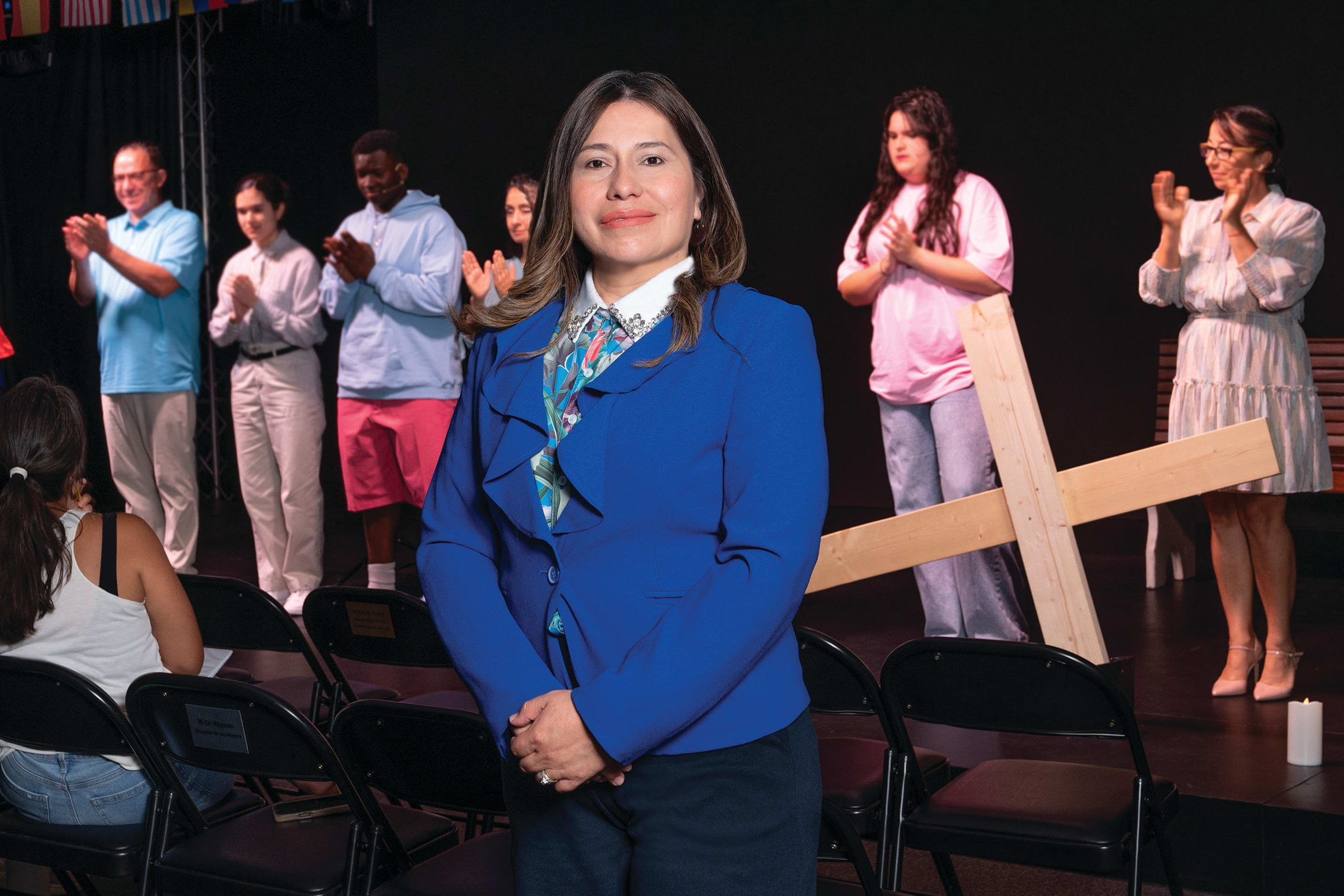
It was only a matter of time before attorney Janella Leibovitz turned her passion for advocating for children in foster care into a career. Growing up in Miami, Leibovitz volunteered at a shelter for abused, neglected and abandoned teens when she was in high school. “When I walked into the bathroom of the shelter, the walls were black with mildew,” she says. “The next time I visited, I brought my Ajax and bleach, and I cleaned the walls. I’m no messiah or anything; I’m just a regular person who wants to see a better world for everybody.”
It’s an ethos she’s carried with her through college—where she was the first teaching fellow in the University of Florida’s Gator TeamChild Juvenile Law Clinic—and into her career, first as an attorney in the private sector and now as the supervising senior staff attorney at Legal Aid of Manasota, where she oversees the nonprofit’s Legal Lifeline for Youth program. Legal Aid of Manasota is the only legal aid organization providing comprehensive legal representation to kids in Sarasota and Manatee counties. The program, which was founded in 2019, provides free legal help for foster youth for issues like dependency, social security, injunctions for protection, name changes, guardianship, adoptions, child neglect cases and more.
What made you want to study law?
“I wanted to be a marine biologist—but I have an unreasonable fear of sharks.
“I was always good at arguing, and I was absolutely committed to high school debate. I also did reporting for the blind. So I developed a [loud] court voice. Usually, I steal the room!
“I worked in the private sector in Sarasota for seven years, at a silk-stocking law firm where I wore pantyhose and heels every day. I handled divorces, and we only took cases where the parties had assets of $1 million or more—excluding their home and retirement. But I always kept my hand in the game of children’s law and advocating for kids, because that was my passion. I’d meet the judges [assigned to those cases]. Everybody kind of figured out who I was, and I’d get calls from a judge at, like, 6 a.m. saying, ‘I need you to be an attorney ad litem for this kid.’”
How many foster kids does Legal Aid of Manasota currently serve?
“We currently have 122 cases open, and we’ve represented 167 kids since the inception of the program. We never [take a kid off our case list] unless they want us to. I’ve worked with one youth since 2019, and we’ve had several with us since 2020 and 2021. Occasionally, we get babies—judges will appoint us if a child is disabled.
“We have youth in traditional foster homes, court-ordered specialized therapeutic group homes, residential treatment centers, and a new type of group home called a behavior qualified residential therapeutic placement.”
What are the big issues you see Sarasota kids in foster care dealing with?
“For a lot of our youth, their parents’ rights have been terminated, or their parents’ behavior has not improved substantially enough for [their kids] to be safe at home. Those are our ‘lockout kids.’ We have a lot of them. And those lockout kids are, more often than not, runners.
“I recently spoke at a conference about child sex trafficking. We’re close to Tampa, Miami and Orlando—the epicenters of sports and leisure. It is very easy for our youth who are on the run to be enticed to have that lifestyle and be groomed [for trafficking]. There’s a market for it.”
That will probably sound shocking to people who think of our region as mostly sunshine, blue skies and white-sand beaches.
“There’s that veneer. But underneath, there are kids on the run, there’s access to drugs. We just had a youth recovered in a sting operation, and we all suspected that there was trafficking going on. This youth had the same tattoo that another youth in [foster] care has, because often the people who are trafficking them make them get what’s called a ‘loyalty tattoo,’ to show commitment to their trafficker. But in [the youth’s] mind, they don’t see it as transactional or exploitation. They see it as care and maybe as ‘love’ and ‘support’—I say this in quotes—that they weren’t getting.
“There’s often a trauma bond with the trafficker. It’s just like a trauma bond with a parent. I’ve never met a kid in foster care who didn’t consider going back to their parent, who wasn’t thinking about their parent, who wasn’t asking about their parent, even if their parent did things that we would consider absolutely out of control.”
How do you create a sense of trust with the kids you work with?
“I have a fun vibe. I wear a Taylor Swift T-shirt and jeans. I’m at their level, to meet them where they are at—and that includes our kids who struggle developmentally. I have a room full of makeup and Taylor Swift stuff to prove that.”
How do you separate yourself from your work? It’s so emotional.
“Disengaging is really hard. But you have to have boundaries. Your clients respect you a whole lot more if you have them.
“We work with a lot of kids who are dually served—that means that they are in the dependency system, so they are abused, neglected or abandoned, and the delinquency system, so they have [criminal] charges. We have to reinforce that they can’t pick up more charges and what the law means for them. They understand it better when you’re not trying to be their friend.”
What do you wish people knew about the work that you do?
“More advocacy for kids having attorneys—having that confidential attorney-client relationship—is critical.
“Also, Legal Aid of Manasota is not funded by the state of Florida. We are purely funded by grants and donations. So more money means more attorneys and more attorneys means more kids we can serve.”
What keeps you going?
“In the Manatee County detention center, there’s always a sign posted about hope, or one that says, ‘Everybody is struggling with something you know nothing about.’ That resonates with me. I care about our community and care about the people who come to Legal Aid of Manasota for help, and these kids are part of our community.”
What is Legal Aid? Legal aid provides free civil legal assistance to people who cannot afford a lawyer, from families facing eviction to veterans trying to access medical benefits, seniors recovering from hurricanes and youth in foster care. Legal Aid of Manasota was founded by local lawyers in 1991 and celebrates its 35th anniversary this year.

This article is part of the series In Their Own Words, proudly presented by Gulf Coast Community Foundation.