




Sarasota Commissioners Reject Controversial Palm Avenue Tower Again

Image: Courtesy Photo
Sarasota city commissioners have again blocked one of the most contested luxury condominium towers proposed for downtown, voting 4-1 on Monday, May 4, to reject a mediated settlement agreement that would have allowed the 1260 N. Palm Residences mixed-use project to move forward. Commissioner Liz Alpert was the dissenting vote.
The vote was the second defeat in less than a year for the 18-story, 327-foot, mixed-use tower planned for eight parcels along North Palm Avenue. The project, formerly known as Obsidian, calls for 14 luxury residences on a .28-acre site now occupied by a row of street-level businesses near Bay Plaza, the 100-unit condominium complex whose residents have led the opposition.
Still, the vote may not be the final word. After the city rejected the project last year, the property owner, 1260 Palm Properties LLC, used a state land-use dispute process to challenge that decision. That process led to mediation and a proposed settlement, which special magistrate Mark S. Bentley recommended the city approve. Bentley wrote that the revised plan addressed earlier concerns and that the owner had “a strong likelihood of prevailing on the merits.” Because commissioners rejected the settlement, the dispute can continue before the special magistrate and could eventually move to court. Commissioners were not persuaded.
The settlement agreement did not lower the tower. Instead, it proposed changes at the street level: a 10-foot-by-26-foot loading area on Palm Avenue, revised sidewalks, preservation and replanting of historic palm trees, a two-story green wall, modifications to the first two stories, and a demolition and construction staging plan for the first 90 days of work.
Bay Plaza’s presentation argued that the redesign left “height and lot size” unaddressed. During the hearing, project representatives compared 1260 N. Palm with other downtown towers, noting that the recently approved Mira Mar project down the street was expected to rise to 301 feet, 6 inches. That would make 1260 N. Palm about 25 feet taller than Mira Mar, even though both projects fall within the city’s 18-story downtown framework.
The hearing stretched for more than three hours and drew roughly two dozen public speakers. Opponents argued that those changes did not address the reasons commissioners denied the project last year: compatibility, scale, pedestrian experience, retail frontage, loading, the cumulative effect of requested code adjustments and the tower’s proximity to Bay Plaza. Commissioner Jen Ahearn-Koch, who made the motion to reject the settlement, said the project still failed the compatibility test.
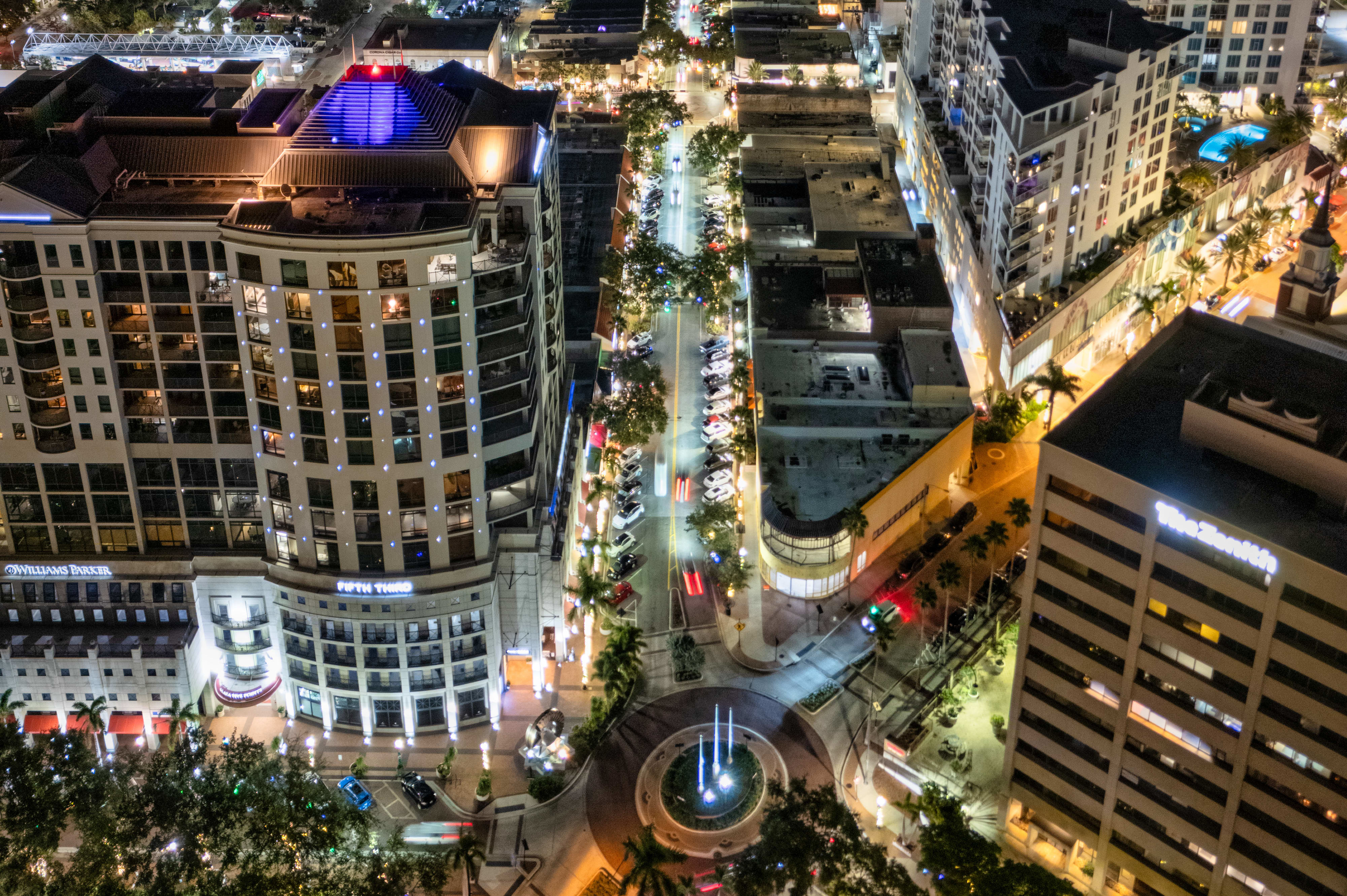
The project has tested Sarasota’s rules for downtown development and sharpened an older debate over what Palm Avenue is supposed to be: a compact retail street with a pedestrian scale, or a high-rise corridor in a downtown where land values and building heights keep rising.
The site is zoned Downtown Bayfront, a district that allows 18 stories and measures height by stories rather than feet. That point became central to Alpert’s dissent. The tower’s height may have alarmed opponents, she argued, but it was not outside the zoning framework the city had adopted. Alpert, who also dissented when the commission rejected the project last year, said the zoning criteria were on the applicant’s side.
Bay Plaza’s presentation to commissioners argued that the redesigned project did not address several earlier concerns, including compatibility related to height and lot size, the ability to maintain the outside of the building, the cumulative effect of adjustments and reduced retail space. The presentation said the proposed retail space had decreased from 3,644 square feet to 3,603 square feet.
To opponents, those adjustments were evidence that the building was being forced onto a site too small to hold it.
Paul Hess, a Bay Plaza resident and retired lawyer, said the settlement offered “minor changes” that did not answer the commission’s earlier concerns.
“The cumulative effect of the requested city code adjustments and other settlement agreement changes don’t address why you rejected his plan last year,” Hess said. “It remains incompatible with the provisions of Sarasota’s Comprehensive Plan, the zoning code and sections governing development compatibility, building, scale and design. Simply put, the project is incompatible, out of scale.”
David Lowe, another public speaker, made the same argument in simpler terms.
“When the legal arguments are set aside, it still comes down to scale and adjustments,” Lowe said. “The fundamental issue remains: the developer is trying to put 10 lb. of sugar in a 5 lb. bag.”
Ron Shapiro, president of the Bay Plaza Condominium Association, urged commissioners not to approve the project because of the threat of continued litigation.
“It would also set a dangerous precedent for the city of Sarasota,” Shapiro said. “It would encourage other developers to beat the city through the threat of litigation, to ignore the building and zoning codes, to do whatever they want.”
Anthony Joseph, a Bay Plaza resident, focused on what the project would do to the street itself. He said the existing businesses—including a barbershop, beauty salon, art gallery, restaurants with outdoor seating and a clothing store — already match the city’s vision for Palm Avenue as an active, walkable corridor. The proposed building, he argued, would replace a row of smaller storefronts with a single ground-floor retail space and street-level elements that do little to engage pedestrians.

Image: Hannah Phillips
Supporters framed the proposal as the kind of high-end, architecturally ambitious project Sarasota should expect in its downtown core.
Jonathan Abrams, a Sarasota resident who said he had worked with MK Equity on earlier projects, including Sansara and The Collection, called the project an “iconic addition” to Sarasota’s skyline. He said it would bring 14 new residences downtown, increase the property’s tax value, and support architects, engineers, attorneys, inspectors, construction workers, surveyors, real estate professionals, city staff and others tied to the development industry.
Brian Loebker, a real estate agent with Michael Saunders & Company, said he supported the project without being reflexively pro-development. He said Sarasota should not become Miami or Fort Lauderdale, but argued that downtown is where density belongs.
“Our skyline is going to go up, maybe not today, maybe not tomorrow, but the secret’s out,” Loker said. “Our little town has been well known, and we cannot put it back in the bag.”
He also urged commissioners to see the project as a chance to work with a local developer, not an outside investment group. “This is not Wall Street money,” Loker said. “This is a gentleman who lives in our town, gentleman who’s built two other projects in our town.”
As the hearing stretched on, commissioners explored whether additional conditions could make the settlement more acceptable. Commissioner Kyle Battie raised concerns about the existing tenants, including a barbershop whose owner, he said, is a minority business owner from Newtown who took a chance opening on Palm Avenue. “Now he’s being displaced,” Battie said.
The applicant’s team later offered additional conditions, including monthly construction meetings with Palm Avenue residents and businesses, quarterly updates on the construction staging plan and a first right of refusal for existing tenants to lease new commercial space at 20 percent below market rate. Those offers did not move enough commissioners.
Because commissioners rejected the settlement, the dispute can continue before the special magistrate. Depending on the outcome of that process, the developer could later challenge the city’s denial in the 12th Judicial Circuit Court or, potentially, federal court.


