




Asolo Rep Presents 'Fiddler on the Roof' for the First Time

Image: Adrian Van Stee
If anyone should happen to think they’ve seen the musical Fiddler on the Roof often enough and can skip it this time around in its Asolo Rep production: No, you can’t.
Sure, some of us can probably recite many of the lines and lyrics from this classic, which first landed on Broadway in 1964 and was a hit then and for decades to come. Songwriters Jerry Bock (music) and Sheldon Harnick (lyrics), as well as book writer Joseph Stein, concocted a nearly perfect adaptation of the Tevye stories by Sholem Aleichem, one that’s withstood myriad performances in community and school theaters as well as professional venues.
But, amazingly enough, Asolo Rep has never presented Fiddler before. Thankfully though, now, the time is right. With a guiding vision by director Peter Rothstein that includes nearly everyone onstage playing an instrument of some sort, this Fiddler resonates in more ways than one.
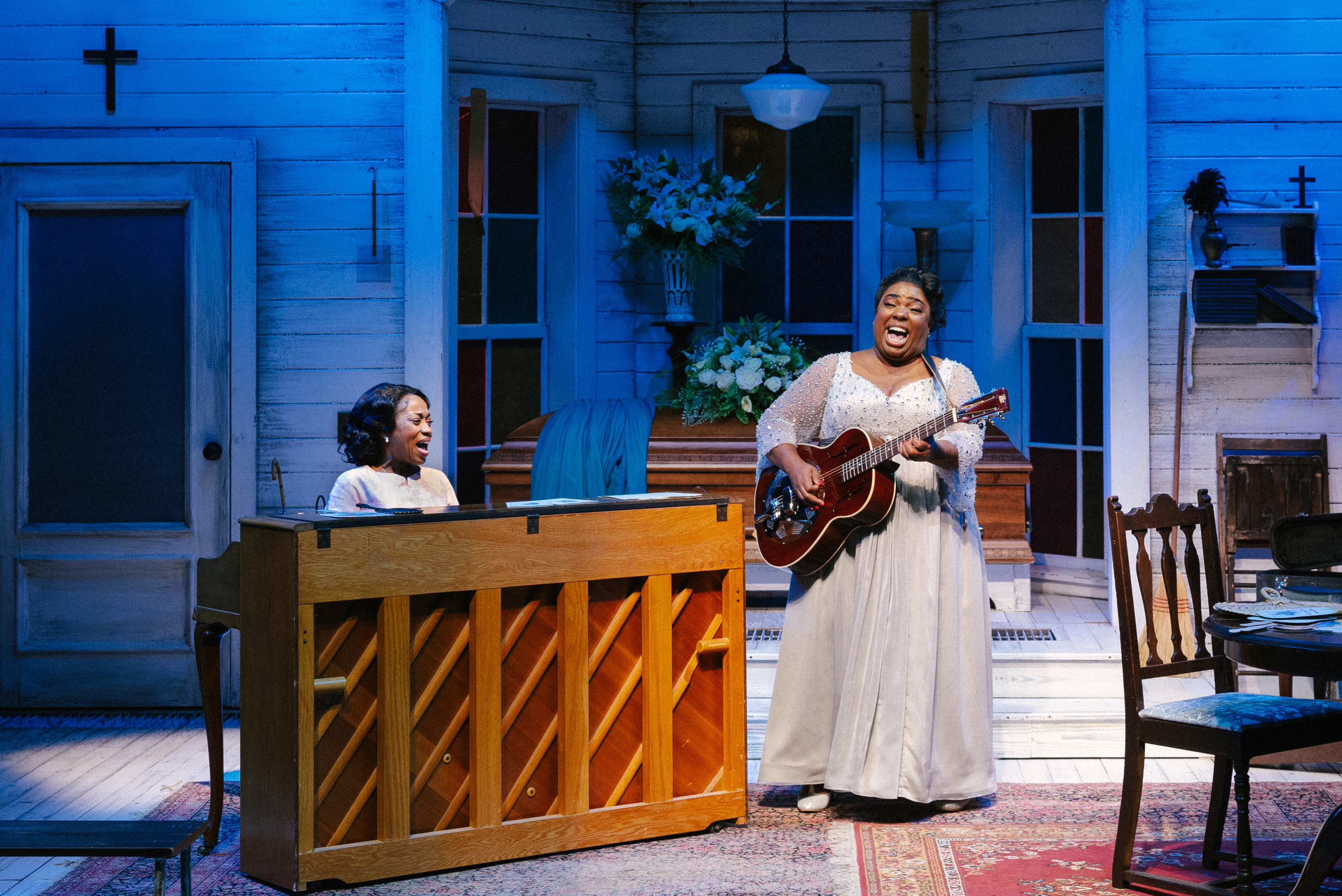
The idea of having the actors—already delivering powerfully with song and dance as well—double as the orchestra might seem like a gimmick before the show starts. But when we see the cast gathered together, each holding their instrument as the curtain rises and “Tradition” rings out, it’s a thrill, and one that compounds the sense that these people belong to a community.
The storyline is (or should be) so familiar by now I’ll keep a synopsis very brief. Tevye (Jeremy Radin), a hard-working dairyman in Tsarist Russia, has big problems. He has five daughters to marry off, a nagging wife, Golde (Lauren Molina), an injured horse, and the looming fear of what the Tsar’s regime will mean for Jews, especially in his little village of Anatevka. Still, he has faith, in his God, his fellow villagers, and for a better future. Those faiths will be sorely tested.

Image: Adrian Van Stee
Given the success of Fiddler as we’ve all come to know it, it could be tempting to fall into beats and patterns that have worked for years, whether onstage or in the 1971 film version. For the most part, Fiddler doesn’t do that here. The actors render their dialogue (monologues as well, in the case of Tevye) as if they are just coming to mind. Sometimes, even a surefire laugh line is more or less tossed off, landing perhaps a second later than you’d expect, or with less impact.
But that’s OK, because Rothstein and his actors are not about hitting all the punch lines. They are working to bring to life these people, in this time and place, while also succeeding in making us think, as they are forced to leave their homes, of the centuries-old history of immigrants seeking new lives.
Given the logistics of finding actors who can do all they are doing here, making the appearance of instruments onstage when needed seamless, and conveying both the drama and the comedy of the show, it’s impressive that we in the audience never feel the effort. We’re too caught up in the story and the characters.
Radin doesn’t ham it up too much as Tevye (something the show’s original star, Zero Mostel, was sometimes accused of). He’s seldom boisterous, often quiet, even when frustrated. And, of course, he’s a crowd pleaser with “If I Were a Rich Man” and his monologues. Molina is a convincing Golde, a perpetual worrier, and it’s fun to watch her just about jump in shock when Tevye asks if she loves him. It’s not something she’s thought about over the past 25 years.
Rachel Gubow as Tzeitel, Noa Luz Barenblat as Hodel and Linda Bard as Chava all sing with spirit and make their impressions singly as well as on the trio “Matchmaker, Matchmaker.” Ditto with their respective lovers: David Darrow as Motel, Trent Dahlin as Perchik, and Maxim Chlumecky as Fyedka. Tina Stafford’s Yente is entertaining and strong, and Jason Pintar makes for a likable Lazar Wolf.
There’s a lot more to say about this big show—that the set design by Kate Sutton Johnson, anchored by a large tree that roots us firmly in the village, is a character of its own; that Philip Rosenberg’s lighting design is often magical; that Howard Tsvi Kaplan’s costumes are simple when they should be and complex when they should be (as in the sequence of "Tevye’s Dream," for which he also created the masks worn). That the music direction by Matthew R. Meckes, however complicated it might be with the actor-musicians, is accomplished. That the choreography, by Daniel Pelzig, seems to spring organically from whatever the characters are feeling and need to express.
Overall, the choices the director makes at every turn (one I especially found intriguing—the Gentiles here speak with accents, but the Jews do not) succeed in eliciting not only all the emotions we expect to feel, but more. Kudos to all.
Fiddler on the Roof continues through May 24. For tickets, call (941) 366-9000 or visit asolorep.org.