


A European-Style Music Salon Takes Root in South Sarasota
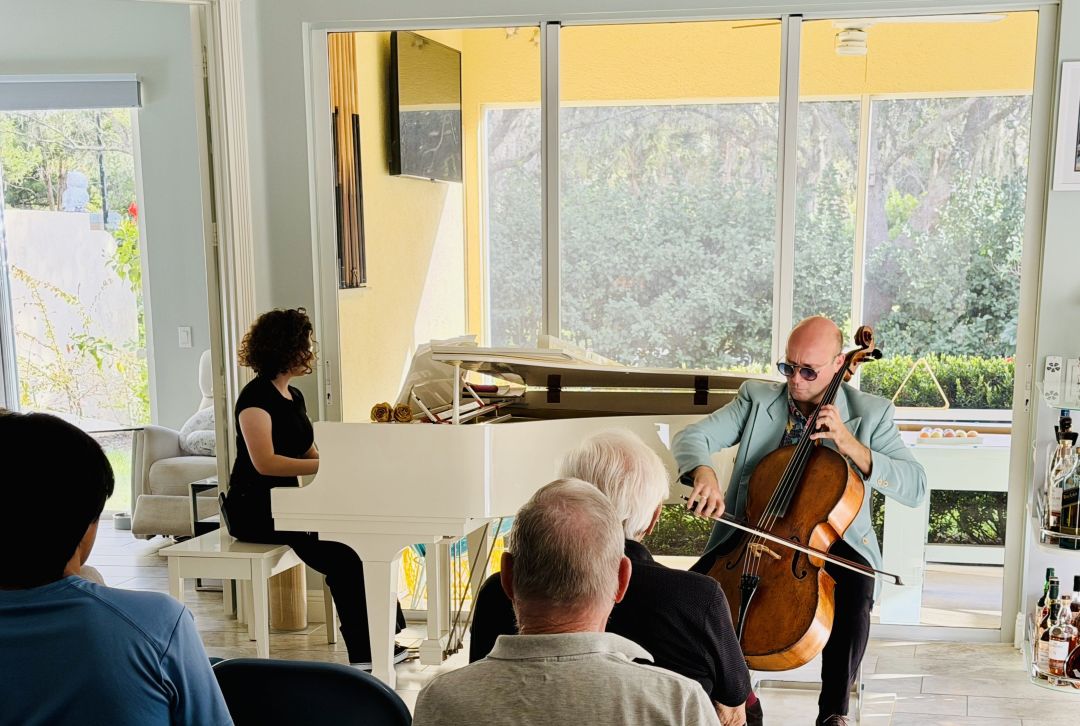
Image: Anna Kramer
The entrance to VillageWalk in South Sarasota is marked by palms, a guardhouse and the kind of manicured stillness that suggests firm adherence to quiet hours. The streets curve past identical roofs and clipped hedges. It doesn't hint at the possibility that, on the first Sunday of each month, at 3 p.m., a cello will begin to warm up inside one of the houses.
Yet that's what happens once a month, when the Music Salon of Sarasota convenes in the VillageWalk living room of cellist Steve Kramer. Folding chairs are arranged in rows. The lanai doors open. At 2:45 p.m., guests begin to arrive with wine, fruit or something homemade to snack on at intermission. Then the music begins.
The salon launched on April 7, 2024. Its first “Artist of Honor” was the legendary jazz pianist Dick Hyman, who attended in person with his wife, the sculptor Julia Hyman. Kramer spoke about Hyman’s life and work; Hyman sat among the audience. The scale was domestic. The distance between artist and listener, close to none.
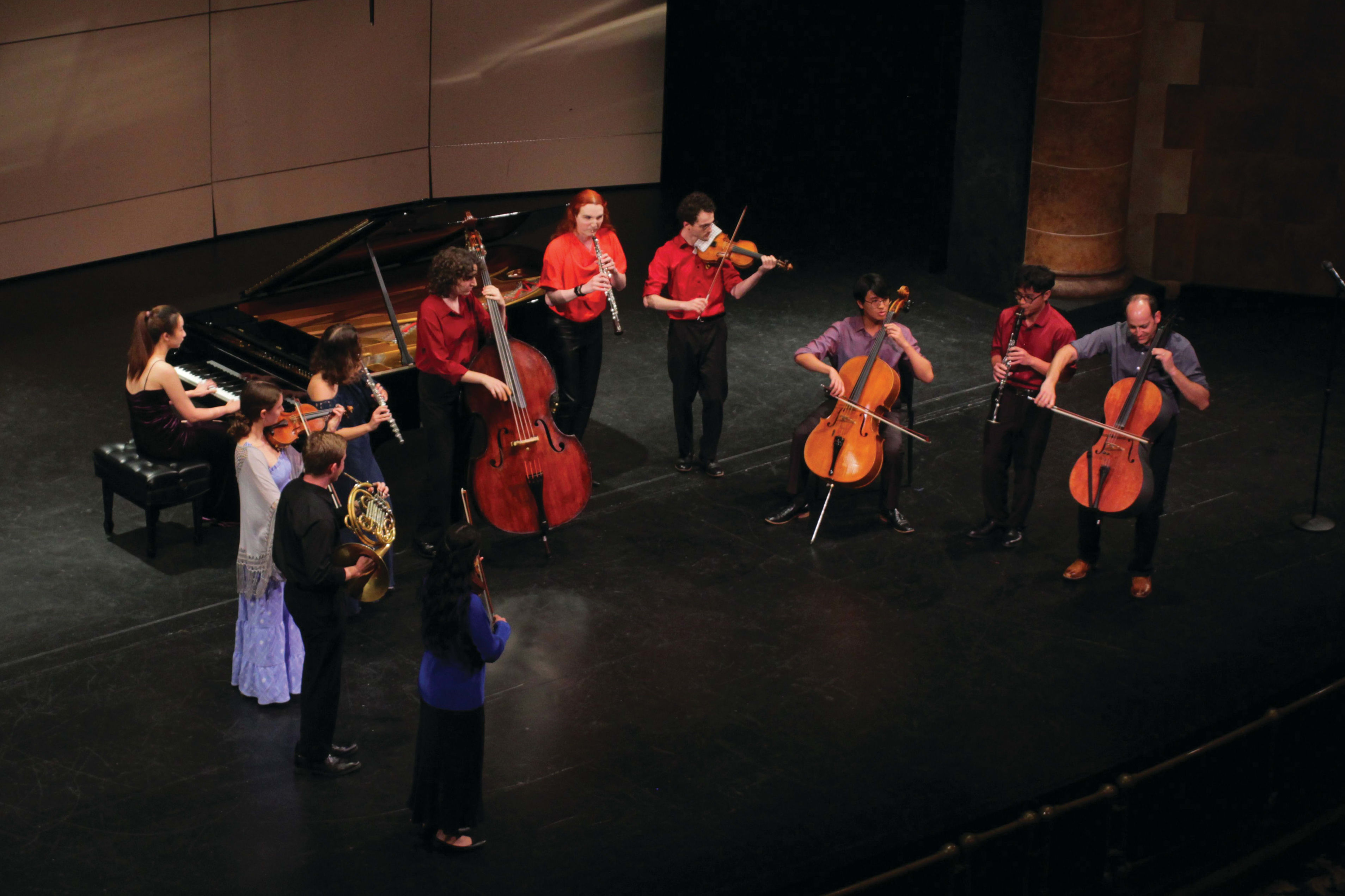
The structure is deliberate but fluid. The first half often leans classical; the second may drift toward jazz or song. Musicians, authors, poets, painters and photographers are invited to perform or exhibit their work. A donation is required; it goes directly to the guest performers as an honorarium. Children attend for free. The atmosphere is neither concert hall nor cocktail party, but something older: a salon. Recital as gathering.
The word “salon” carries weight. In 17th-century Italy and later in France, Austria and Germany, salons were convened in private homes as rooms of exchange. They were scaled for conversation rather than spectacle, where composers, writers and political thinkers gathered to test ideas and introduce new work. During the Enlightenment and the French Revolution, they became sites of debate. Women often presided over them, shaping artistic life in drawing rooms instead of institutions. The music written for those rooms—by composers such as Haydn, Mozart, Beethoven and Chopin—was intimate, suited to chamber acoustics and close listening. What began as elite gatherings broadened, helping reshape how art was supported and shared.
In Sarasota, the scale remains the same: a room, a handful of chairs, dialogue and storytelling.
Kramer was born in Copenhagen, Denmark, after his family emigrated from the Soviet Union in the 1970s. He describes himself as a generational musician. His grandfather, Vladimir Issaivich Novak, was a violinist associated with the Kiev Philharmonic and a respected pedagogue in Kyiv and, later Copenhagen. At age 3, Kramer began violin under his grandfather’s guidance. At 5, after hearing a cellist in concert, he shifted instruments. The cello’s range, he says, is closest to the human voice; its low and high registers mirror speech and breath.
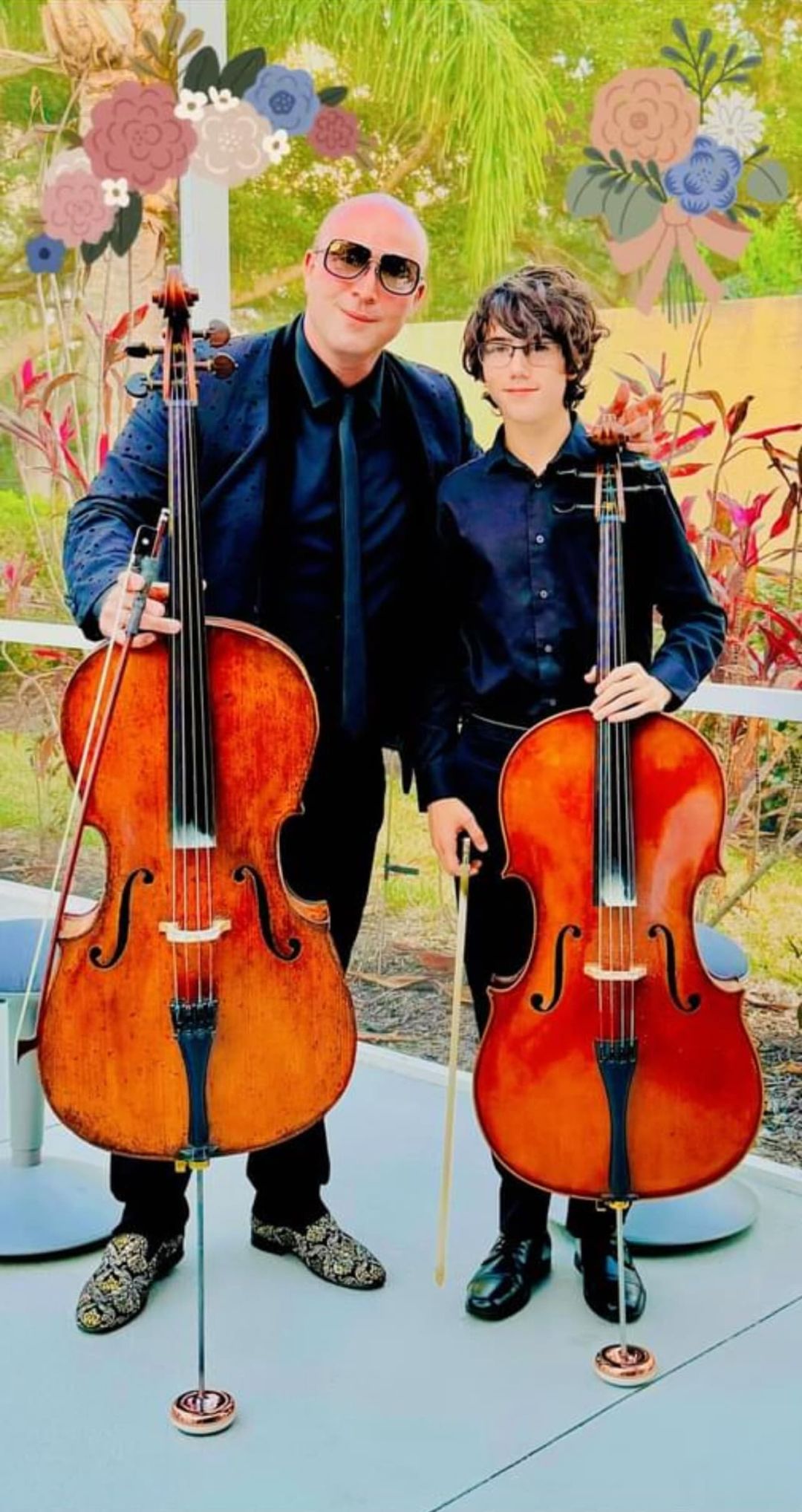
Image: Anna Kramer
Kramer's early musical education carried him across Europe. He studied with Erling Bløndal Bengtsson, a cellist in the lineage of Gregor Piatigorsky. He attended the Yehudi Menuhin School in England and later at the Hochschule für Musik Detmold in Germany. The institutions are formidable, but Kramer speaks less about prestige than about inheritance—stories, phrasing and standards passed down through teachers who themselves carried traditions across borders.
In 2010, he relocated to the U.S. Concert halls and international travel followed. But when he speaks about his greatest passion, Kramer doesn't talk about stages. He speaks about bringing live music to the elderly and infirm—facilities and residences where people can no longer bring themselves to concert halls. He has done this nationwide. The work, he says, is essential. Music belongs in close proximity.
The salon extends that ethic. In a room small enough to see the bow hair tremble, the act of playing becomes conversational.
Ginny Kutikoff, 75, and her husband Steve, 80, live nearby. They first heard Kramer perform before the pandemic, when he and his daughter Emilia Gazman played at a community center. “We were blown away,” Ginny recalls. The salon was mentioned but then delayed by Covid. When it finally opened—on April 7, which happened to be Ginny's birthday—they attended.
The couple regularly attends performances at larger venues in town, including the Sarasota Orchestra and Asolo Rep. The salon offers something different. “It’s the intimacy,” Ginny says. “You really get to watch.” There is conversation between pieces. Guests introduce themselves. You learn where someone moved from, what instrument they once played, what songs they still remember. They bring food. They linger on the porch. The whole family is there, plus the dog.
Attendance ranges from 15 to 50 people. Word of mouth carries most of it. Kramer prefers the direct exchange of an email RSVP. The scale is intentional.

Image: Anna Kramer
One recent musical guest was Enrique Casados, a guitarist who has performed in Sarasota for 15 years. He plays Latin fusion, bossa nova, blues and flamenco on a nylon-string guitar. A mutual acquaintance passed his name along to Kramer.
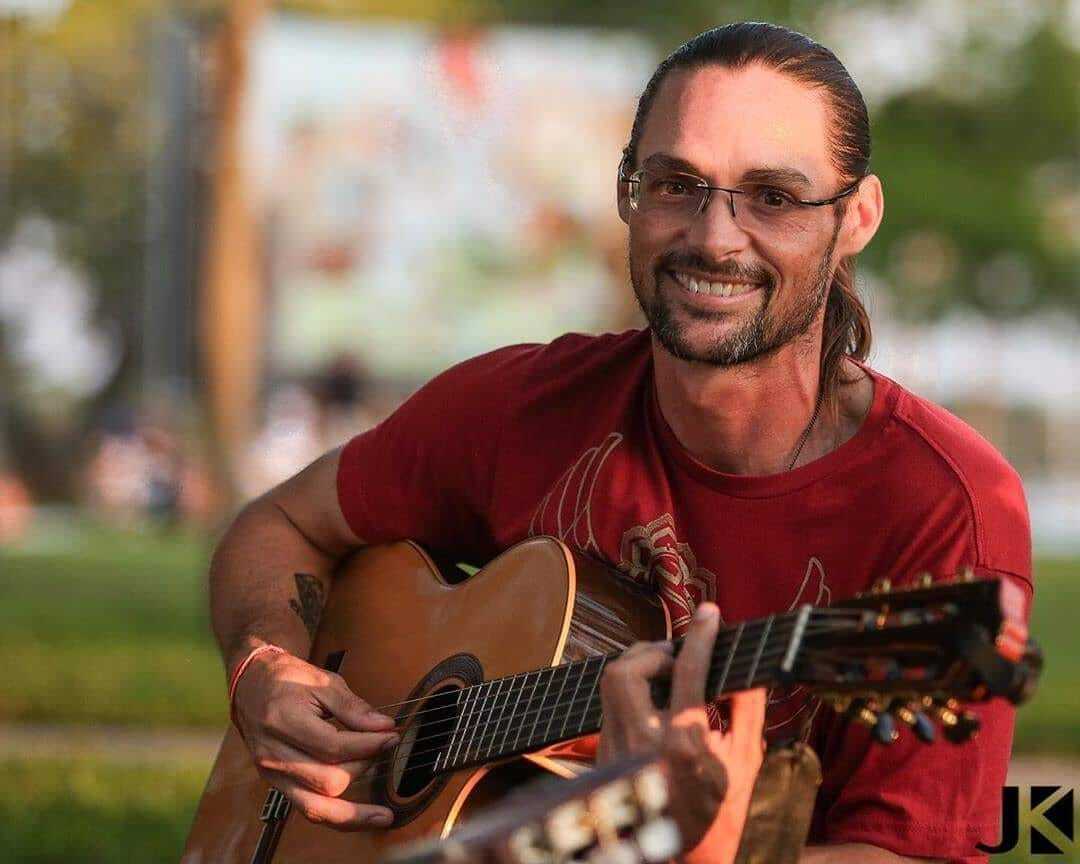
Image: Courtesy Photo
At the salon, Casados played four or five songs. Kramer asked him about his technique and background. The format, Casados says, felt partly like “show and tell,” but organic. His father was a guitarist and multi-instrumentalist; his grandfather played as well. “It was a house of music,” he says. At the salon, that inheritance became part of the program, not just the sound.
Kramer returns often to Johann Sebastian Bach. From there, he moves freely through other periods, genres and styles. Lately he has been recording with jazz pianist Tom Lawton, honoring the “golden melodies” of 20th-century America. Here, Bach and Gershwin coexist.
Kramer's daughter Emilia began playing piano at age 4 and studied intensively through her teens, moving into technically demanding repertoire, including Chopin’s etudes. Now a motorsport photographer and videographer, she credits her musical training with shaping her sense of rhythm and pacing as a visual artist. She performs regularly at the salon.
His son Victor, 15, also plays cello and has appeared at multiple salons. Like his father, Victor has participated in bringing music to elderly and infirm audiences. The family’s youngest child, baby Samuel, is part of the household rhythm. The salon is not an extracurricular hobby; it's woven into domestic life.
After the final piece, chairs scrape lightly against tile as people begin to stand. Conversation resumes. Outside, the streets are calm. Inside, for a few hours each month, the room holds something older than the development around it: a tradition passed down through generations, now offered behind a gate that opens for everyone.
Interested? Email [email protected] to attend. Musicians and artists interested in performing are required to submit a letter of interest, a biography, a professional photo with instrument(s), and ensemble info. The salon is every first Sunday of the month at 3 p.m.