

Public Media Host Dalia Colón Is Always Hungry for Stories
This article is part of the series In Their Own Words, proudly presented by Gulf Coast Community Foundation.
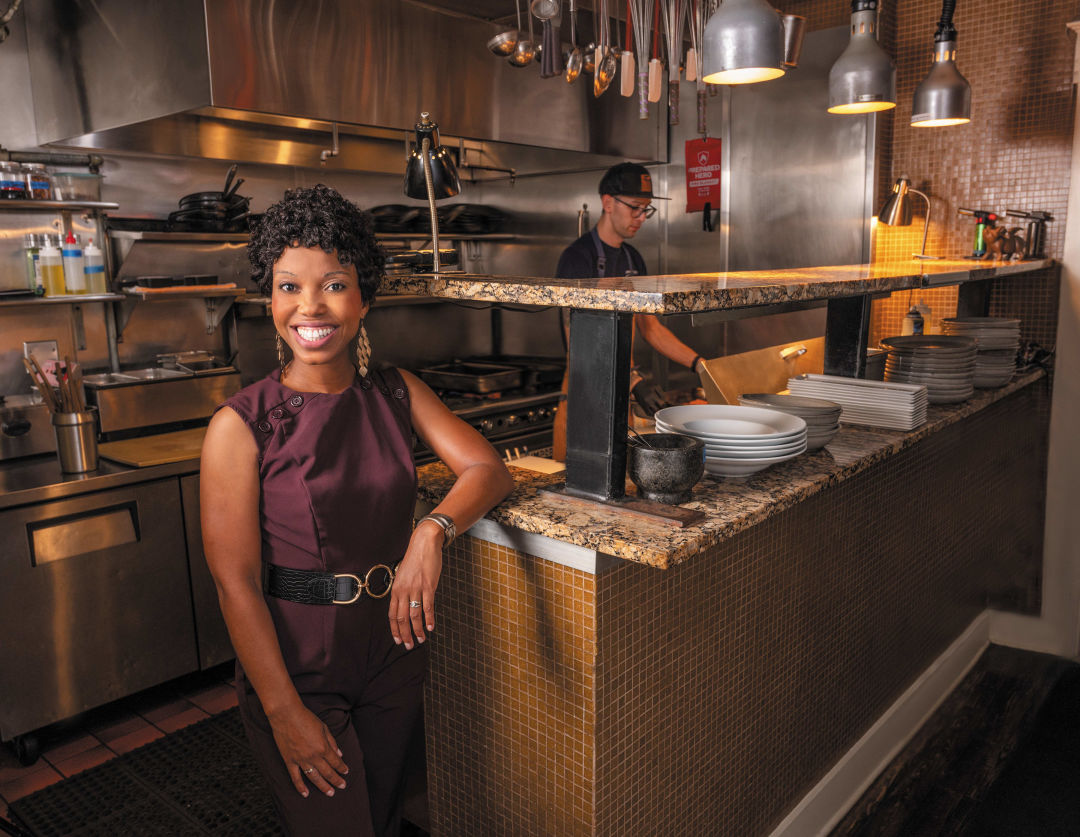
Image: Barbara Banks
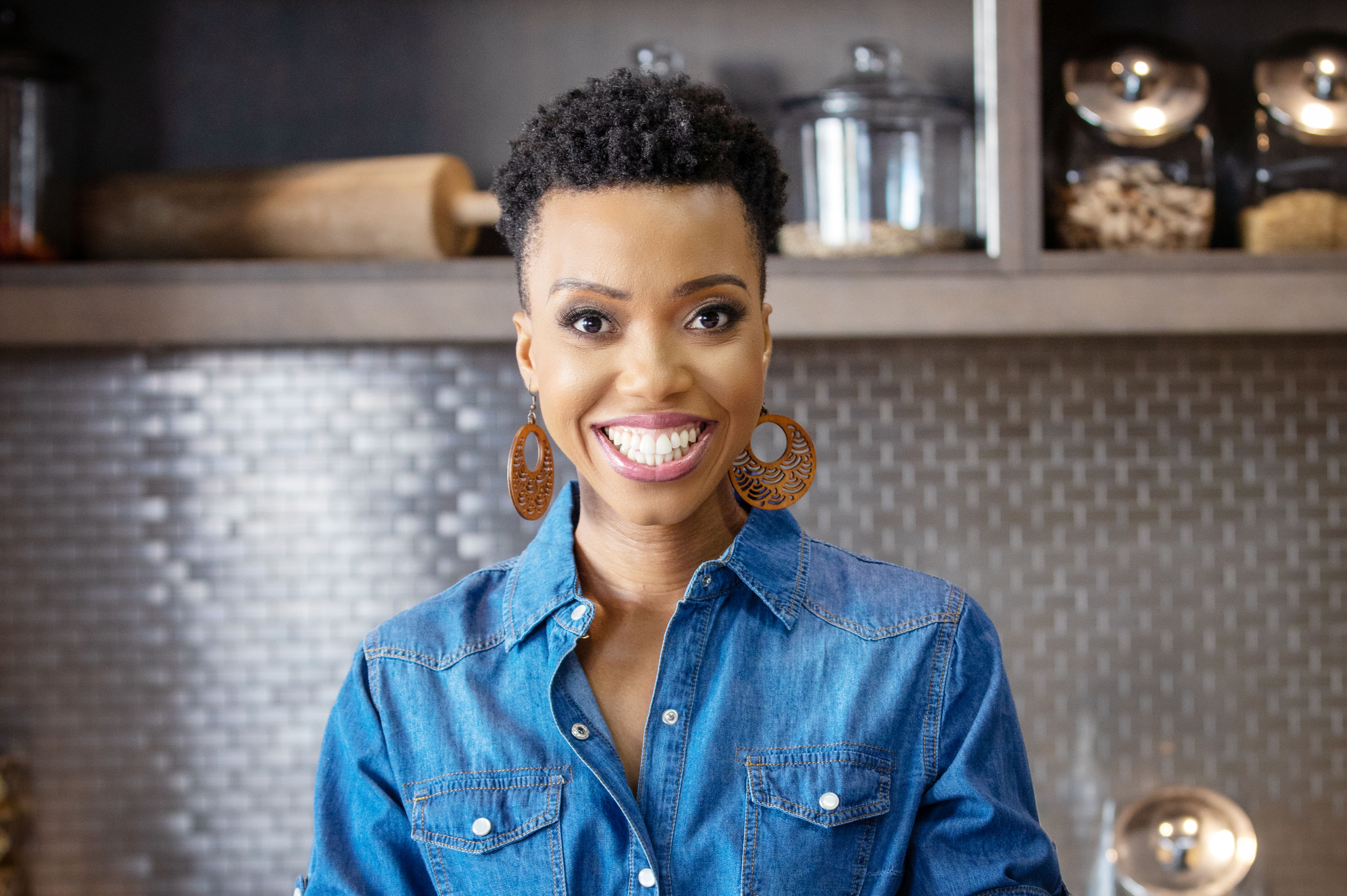
Media personality Dalia Colón got her start in public media almost 20 years ago after writing about a female beatboxer—a hip-hop musician who uses her voice to mimic a drum beat. At the time, she was working for the Tampa Bay Times, but she realized this was a story where the subject’s voice needed to be heard.
Colón reached out to local public radio station WUSF, and the station taught her how to record, edit and produce her story. She soon became a reporter, host and producer for WUSF’s and WEDU’s (the local PBS member TV station)
collaborative broadcast program, Smart Health, which covered health and wellness, and, in 2011, won a local Emmy Award for her work.
As she explored healthier living, she learned more about nutrition by interviewing food industry experts, and her curiosity about food began to grow. Today, Colón, 43, hosts a popular weekly food podcast for WUSF called The Zest, which highlights individuals advancing food trends, sustainability and agriculture in Southwest Florida. She’s also the author of The Florida Vegetarian Cookbook. In addition, she co-hosts an arts and culture television program on WEDU called Arts Plus, telling stories about local artists and cultural institutions. She spoke with us about her career and why public media matters. This interview has been edited for clarity.
The Zest and Arts Plus cover different topics, but both showcase food and art from different communities and people of color. Was that intentional, or did it evolve naturally?
“I grew up in a predominantly white neighborhood. On television, there’s always the sitcom with the Black best friend—that was me. I want you to have more than one Black friend. I want you to have Muslim friends and Indigenous friends. A tenet of public media is celebrating diversity, and diversity doesn’t mean we’re all the same.
“Representation matters. Race, ethnicity, gender, sexuality, ability, religion and socioeconomic status matter. I’ve heard it said that it’s hard to hate up close, and we have an opportunity to introduce our fellow community members to people they might not meet in real life in a way that’s intimate.
“We all know Sesame Street, and that was founded on a principle of diversity. I want to live on that street. They’re every color, every race, they’re all there in a little utopia.”
What has been one of your most memorable interviews?
“Francis Lam is a food writer who also hosts NPR’s The Splendid Table. He came to the Tampa Performing Arts Center for a live taping of his show
and accepted my invitation to be on The Zest. He was brilliant. I was fan-girling, but I think I kept my cool.
“While in town, he and I rounded up some of my favorite food industry people and went to some local gas station restaurants that serve unexpectedly good food. We gathered up whatever we wanted and ate it out of the back of a friend’s pickup truck. That night was one of the top five food experiences of my life.”
You’re based out of Tampa, but you cover Sarasota. Is Sarasota different from the Tampa market?
“What I love about Sarasota is that you guys are your own little universe. You don’t care if Tampa people know about the cool restaurants that you have or the fact that there’s a world-class chef or culinary royalty right here in Sarasota—probably because you want to be able to get a reservation at your favorite places. I get it!
“WEDU covers 16 counties, and it’s hard to stay out of Sarasota for Arts Plus with the art college, the museums and the art scene that you have. We have to restrain ourselves from only covering Sarasota. Recently, I even had an Arts Plus and The Zest crossover because of Sarasota. I interviewed an artist named Chris Friday. She’s based in Miami but had a food-themed exhibition at the Sarasota Art Museum. Sometimes all roads lead to Sarasota.”
What about your job is the most gratifying for you?
“My favorite part is going out into the community and meeting people. These are our neighbors. There could be an artist living next door to you who has some amazing mural happening in the back yard, or a chef who is changing the way people may think about food.
“I think of each episode as a field trip, like when we were kids. I get to travel to meet new people and learn about their pursuits on-site, and then I get to come back and distill it into the best parts and share those parts with the public.
“While I love to read fiction, I think the truth is even more compelling. Every single thing I present to you, whether it’s on the podcast, whether it’s on the television show, is true. It’s so nice to live in a world where all of this exists. This job fills me with a lot of hope and inspiration.”
What do the recent $1.1 billion federal funding cuts to public media mean for stations like WUSF and WEDU? Combined with state cuts, Tampa’s WEDU will lose about $2.8 million and WUSF, $800,000.
“These funding cuts mean the public’s support is more important now than ever. Public media has always relied on a mixture of Corporation for Public Broadcasting (CPB) funding and individual donations. So we’re counting on the community to help close the gap to protect the programs and services we all rely on. It’s been encouraging to see the outpouring of support for public media, and we need to find a way to keep that going. My hope is that people will be willing to give whatever they think is fair.
“Public media is one of those things that we take for granted, and I consider it part of our infrastructure in the same way that we all have access to roads. Public media offers a similar support system for all of us that I think we’ve taken for granted.”
What do you like to watch and listen to?
“Public media is an educational source, not unlike a library. It’s a source of inspiration and civility, and I hear from people that WEDU is the only station they watch. I’m the same way. I’ve always kept my television on PBS all day long, and my radio tuned to NPR.”
This article is part of the series In Their Own Words, proudly presented by Gulf Coast Community Foundation.