





The Passionflower, Sarasota’s Most Striking Plant, Is More Than Just a Pretty Face
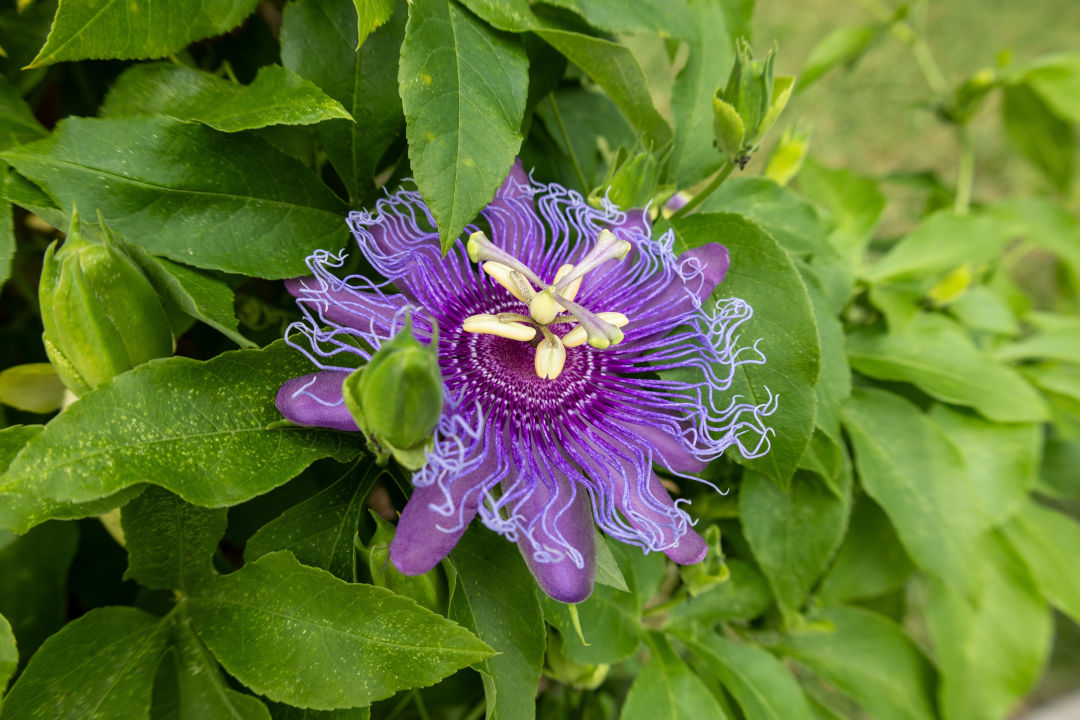
Image: Macer/Shutterstock.com
It’s only after you’ve walked past it a thousand times that you take note of the passionflower vine—if you do at all. In its vegetative state, it’s easy to miss amidst the green noise of spring, with its tendrils curling out from fences and weaving into the fabric of foliage. But sometime between the first real heat of spring and the dog days of summer, the passionflower begins to stop passersby in their tracks—not because they recognize it, but because the vine feels improbable; like it belongs somewhere else entirely. Despite its beauty and abundance in the local ecosystem, those who delight in the blossom often never learn its name and utility. Fewer still realize that the flower is just the vine’s opening act.
Florida is home to approximately seven native passionflower species (the exact number remains up for debate), with the maypop passionvine, Passiflora incarnata, by far the most striking and prevalent. Its 10 pearly petals radiate from a ring of purple and white filaments that appear to float untethered to the flower itself. Its center is so geometrically complex that early Christian missionaries saw religious meaning in its sophistication, associating its morphology with Jesus’ crucifixion. They weren’t alone in their come-to-God moment: Across the world, Indians saw their own theology reflected in the flower, reading elements of Hindu cosmology into its form and naming it the Krishna Kamal.
These theatrical, diurnal blooms give way to an equally remarkable fruit—a tough-skinned orb filled with fragrant, seed-packed pulp prized far beyond Florida’s borders. This bizarre, jelly-like liquid balances sweetness with a mouth-puckering tang that finds its way into everything from cheesecakes and cocktails to salsas and sorbets. The fruit’s sugar content increases as the skin wrinkles, typically peaking just after it falls from the vine. Step on one by accident—perhaps while trying to capture its glamour for Instagram—and it will “pop,” hence its common name.

Image: New Africa/Shutterstock.com
For those with green thumbs (or ambitions of developing them), passionflower is best known not for its delicacy, but for its determination. “If you want to add something to your landscape that’s not just beautiful, but hardy and ecologically important, you’ll find no better than the Passiflora genus,” says Sean Patton, native plant aficionado and owner of Stocking Savvy Environmental Consulting. Given enough sun and a few hearty rains, the perennial grows quickly and unapologetically, sending coiling tendrils in every direction. It climbs fences, trellises, and neighboring plants with equal zeal—a gift for enthusiasts and a nuisance to those who value more polished, traditional landscapes. “It makes a stunning living wall,” says Patton, who regularly incorporates it into his landscape designs. While the average maypop stretches to around 20 feet, it can grow far larger, even scaling oak canopies. Drought-tolerant, moderately salt-tolerant, and well-suited to Florida’s sandy soils, it thrives where fussier plants falter.
That vigor serves a purpose beyond ornamental ambition or culinary enjoyment. The maypop is a critical host plant for a range of butterflies, including the Gulf fritillary, zebra longwing (Florida’s state butterfly), variegated fritillary, crimson-patched longwing, Julia heliconian, banded hairstreak and red-banded hairstreak. Females lay their eggs exclusively on the passionflower, and the emerging caterpillars depend on its leaves for survival. Sun exposure shapes the cast of visitors. Vines grown in full sun tend to attract Gulf fritillaries, whose quick, erratic flight animates open spaces. Shadier plantings, by contrast, are favored by zebra longwings, whose slow, drifting movements lend an almost meditative stillness to the garden. “Just be sure to mix it with another vine, like Carolina jessamine or coral honeysuckle, to hide bare spots when the caterpillars arrive,” Patton says. “Our local pollinators are hungry!”
As spring settles in, an observant morning walk might be all it takes to spot the passionflower, or you can visit one of Sarasota’s local nurseries to make the plant your own. Either way, the passionflower offers a reminder that sometimes remarkable things are growing right under your nose.


