



How to Create Beautiful Wedding Portraits With Simple Lighting and Background Choices

Most wedding venues are built for ceremonies, dinners, and dancing. Very few are built for portraits. A ballroom can look beautiful at eye level and still put an exit sign directly behind the couple. A garden that photographs well in the morning can be flat overhead sun by the time family formals start. By the time a photographer has fifteen minutes to work, the conditions are usually some mix of harsh sunlight, mixed indoor lighting, a busy background, guests moving through the frame, and less space than anyone expected.
Strong wedding portraits usually come from controlling the light, simplifying the background, and choosing the right space, rather than from building an elaborate setup.
Start With the Light, Not the Background
It's easy to spot an attractive corner of a venue and start shooting without checking where the light is coming from. A more useful habit is to walk the space, watch the light first, then decide whether the background behind it holds up.
Outdoors, direct midday sun is the hardest light to work with. It puts hard shadows under the eyes and makes people squint. Open shade on the north side of a building, a tree line, or a covered porch gives more even light. Watch for dappled light coming through leaves, which looks pleasant in person and messy across a face. In bright Florida light, a shaded courtyard is often more useful than the prettiest patch of lawn.

Indoors, window light is usually the most predictable source in the building. Turn the couple toward the window and set them back a few feet so the light falls across the face instead of hitting it flat. A window on an overcast day is soft; the same window with direct sun coming through needs a sheer curtain.
Receptions are harder, because ambient light, uplighting, and overhead fixtures rarely match in color. Pick one source to work with and keep the others off the faces, or add your own light and let it dominate. Turning a couple forty-five degrees, or moving them a few feet from a colored uplight, often fixes more than another light would.
Simplify the Background Before Adding More Decor
Look at what is actually behind the couple before deciding a spot is good. Exit signs, stacked chairs, propped-open doors, catering stations, half-cleared table settings, and guests holding phones all end up in the frame, and they read louder in a photo than they do in person.
Color matters too. A background that competes with the dress, the suits, or the florals pulls attention away from faces. Deeper or more muted tones tend to hold up better behind a white dress than a bright, saturated wall.
When a venue gives you something clean, use it. Plain architecture, a run of curtains, a brick wall, a hedge, or open sky can all carry a portrait with no extra setup. When it doesn't, look for a simpler surface elsewhere: a side wall, a quiet hallway with decent light, a window bay off the main room.
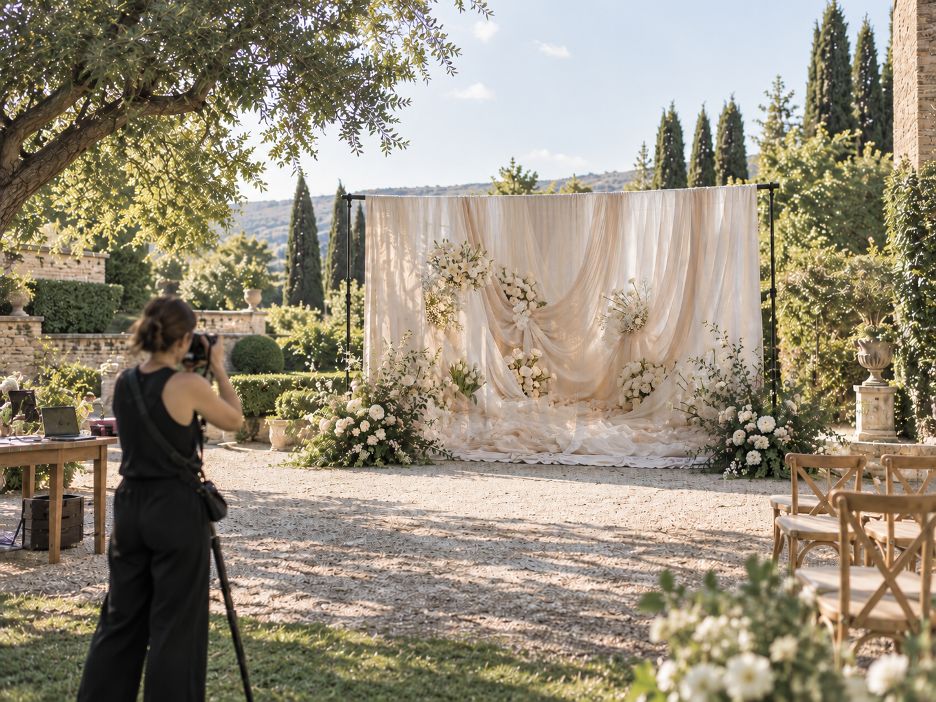
Photographers who regularly work in changing locations may also keep simple background options available when a venue doesn't provide a clean portrait setting. Brands such as Kate Backdrop offer photography backgrounds and support equipment that can be worked into temporary portrait setups.
Create a Simple Portrait Area at the Venue
Couple portraits, family formals, wedding party portraits, and quick guest portraits usually have to happen in one short window. Rather than hunting for a new background with every group, plan one area and move everyone through it.
A few things worth sorting out when you choose the spot:
• Leave distance between the background and where people stand, so shadows don't land directly behind them.
• Size the area to the largest group you expect. A wedding party of twelve needs far more width than a couple does.
• Keep it out of heavy foot traffic, away from bar lines and service doors.
• Keep the background plain. It's there to stay out of the way.
• Use what the venue already has. A single chair, one floral arrangement, or existing decor is usually enough.
For larger portrait areas or setups that need to stay in place through several parts of the wedding day, a heavy-duty backdrop stand can provide a more substantial support framework for the background than a lightweight travel stand.
Keep Enough Distance Between the Couple and the Background
Pressing people against a wall or a backdrop creates three problems at once. Their shadows land right behind them, the background stays as sharp as their faces, and the frame flattens out.
Moving the couple forward changes all three. Shadows fall off behind them instead of printing on the surface, and you get more control over how much of the background stays visible through aperture and focal length. A longer lens from farther back will simplify a background more than a wide lens will. In a small room, where there's no space to move the camera back, bringing the subjects forward often accomplishes the same thing.
Group portraits also need more lateral space than single portraits. A row of people set too close to the background and shot too wide will show distortion at the edges and uneven light across the group. Exact distances depend on the venue and the lens, so test the spot with one person before a whole family is standing there waiting.
Make the Setup Flexible Throughout the Wedding Day
Ceremony light is not cocktail hour light, and the room that was empty at four is full by seven. A setup that works at one point in the day can be in the way an hour later.
• Don't block main walkways, fire exits, or service routes. Venues will ask you to move, usually at the worst moment.
• Keep the setup simple enough to adjust or break down in a few minutes.
• Confirm in advance what the venue will let you move. Some won't allow furniture to be rearranged at all.
• Adjust as light changes. Turning people to face a different direction is faster than rebuilding anything.
• Don't run every portrait against the same background. Environmental portraits around the venue and controlled portraits in a set area can live in the same gallery, and the contrast usually helps both.
Good wedding portraits come from reducing distractions, reading the light, and giving people enough structure to relax in front of the camera. Good light, a clean background, enough shooting space, and a simple, stable setup will carry most of the day. The rest is timing and paying attention to the people in the frame.