




How iGaming Development Is Changing in 2027
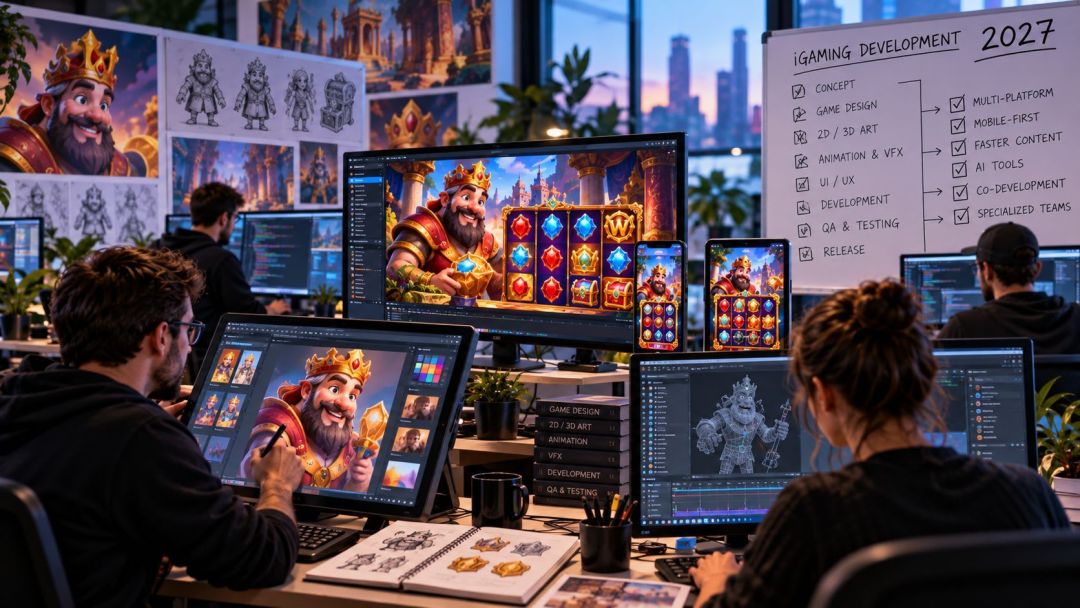
iGaming production is becoming more demanding from both a technical and creative perspective. Players move between desktop and mobile devices, operators need a steady supply of new content, and individual games compete for attention in libraries containing hundreds or even thousands of titles.
These pressures are already influencing how games are produced. Development pipelines have to accommodate multiple devices, increasingly sophisticated animation and interfaces, and integration with the platforms where games will eventually run. Heading into 2027, these requirements are likely to push studios further toward specialized teams, closer collaboration between disciplines, and more flexible production models.
Specialized Production Is Becoming More Important
The range of skills involved in producing an iGaming title has expanded considerably. Game design and programming remain central, but modern production can also involve concept artists, 2D and 3D artists, animators, VFX specialists, UI/UX designers, technical artists, QA engineers, and integration specialists.
Companies such as Inkration work within this increasingly specialized casino game development environment, where art, animation, game logic, UI, and technical implementation have to function as parts of the same product.
This specialization is likely to have an even greater influence on how development teams are structured in 2027. Rather than maintaining every discipline internally, more studios may combine their core teams with external specialists or co-development partners for particular stages of production.
The result can be a more modular pipeline. One team may define the game concept and mechanics while another handles art production, animation, or technical implementation. The challenge is making those contributions feel like a single product rather than work produced by several disconnected teams.
Visual Production Is Moving Closer to Development
Art has always been important in iGaming, but the boundary between visual production and engineering has been narrowing.
A character is no longer simply an illustration. It may require multiple animation states, effects, responsive UI elements, and interactions tied to events within the game. Backgrounds, symbols, transitions, and bonus sequences also have to perform correctly across different screen sizes and hardware.
This makes technical considerations relevant much earlier in the art pipeline. Artists need to understand how assets will be implemented, while developers need workflows that preserve visual quality without creating unnecessary performance problems.
Heading into 2027, technical artists and other specialists working between creative and engineering teams are likely to become increasingly valuable. For studios producing games at scale, reducing friction between those disciplines can be just as important as increasing the volume of assets produced.
Mobile Will Continue to Shape Production
Mobile compatibility is already a fundamental requirement for much of the iGaming market. For many products, the smaller screen is one of the primary environments in which the game will be played.
That affects decisions throughout production.
Interfaces need to remain readable without covering important game elements. Controls have to work comfortably with touch input. Animation and visual effects need to remain smooth across a broad range of devices rather than only on high-end smartphones.
Screen orientation can influence composition as well. Artwork that looks impressive on a large desktop display may become difficult to read when compressed onto a phone.
In 2027, mobile-first thinking is likely to become even more deeply integrated into game design and art direction rather than being treated mainly as a technical optimization task near the end of development.
Faster Content Cycles Will Put More Pressure on Pipelines
iGaming operates in a content-heavy market. Operators continually add games, while studios compete to keep new releases visible in increasingly crowded libraries.
That creates pressure on production schedules, but simply shortening development time is not necessarily the answer. Faster production without an efficient pipeline can result in inconsistent art, additional revisions, technical problems, or repetitive products.
Studios are therefore likely to focus more heavily on removing unnecessary delays between production stages.
Art production can move forward while engineers work on systems and integration. Reusable technical components can reduce repeated engineering work. Clear documentation and established asset requirements can limit unnecessary revisions.
External production and co-development may also become more useful when studios need additional capacity for a particular stage without permanently expanding their internal teams.
Cross-Platform Technology Will Remain a Priority
Browser-based delivery means cross-platform compatibility will continue to be a central technical consideration in 2027.
Games may need to work across different browsers, operating systems, screen sizes, and hardware configurations while maintaining consistent behavior. Performance optimization and testing therefore cannot be treated as final-stage tasks.
At the same time, visual presentation continues to become more sophisticated. Detailed animation and effects can strengthen a game's identity, but they also increase the work required to maintain reliable performance.
Development teams will have to continue balancing visual ambition with practical technical limits.
This is another area where closer collaboration between art and engineering is likely to matter. Decisions about animation, asset size, effects, and interface complexity can affect performance long before a game reaches QA.
AI Is Likely to Change Individual Workflows
Generative AI will almost certainly remain part of the iGaming technology discussion in 2027, but its most practical impact may come from changes to individual production tasks rather than the replacement of complete creative or development teams.
AI-assisted tools can already support areas such as early visual exploration, reference gathering, repetitive production work, documentation, testing, and parts of coding.
The next step is likely to be deeper integration of these tools into established workflows.
Consistency will remain a major consideration. A commercially released game needs assets that follow the same visual language, technical requirements, and production standards across the project. Human art direction, engineering decisions, review, and quality control therefore remain important even as individual tasks become more automated.
Co-Development Could Become More Common
As production becomes more specialized, expecting one internal team to cover every discipline can become increasingly difficult.
Co-development gives studios another way to add expertise without transferring an entire project to an external company. A partner might handle art production, animation, a technical feature, integration work, or a larger section of the game while the original studio maintains control over the product.
This model could become more common in 2027 as studios look for ways to adjust production capacity without continuously rebuilding their permanent teams.
Its effectiveness will still depend on integration. External teams need clear responsibilities, compatible tools, documentation, and regular communication with internal developers.
When those elements are in place, co-development can become a planned part of production rather than a solution used only when an internal team runs out of capacity.
iGaming Development Is Becoming More Multidisciplinary
There is unlikely to be one technology that defines iGaming development in 2027. The broader change is the increasing number of disciplines that have to work together efficiently.
Art, animation, UI, engineering, performance optimization, testing, and platform integration already overlap throughout development. Mobile requirements influence visual design, technical limitations affect animation, and production schedules shape how teams are organized.
Heading into 2027, studios are likely to put more emphasis on connecting those disciplines rather than treating them as separate production stages. The companies that adapt their pipelines to this increasingly multidisciplinary environment will have more flexibility to adopt new tools and production methods as the market continues to evolve.