





A Tale of Tradition on a Sea of Change
So indelible is the power of this beloved musical that it can transport an audience around the world with a single word. It conjures a simpler time in a close-knit, pastoral landscape. Simpler, not because there weren’t significant problems to deal with – how will I make a living, who will be my partner in life, what makes a place a home – but because the mechanism for solving those problems was simple: what have we always done? Tradition.
The word itself is comprised of two Latin roots “Tra,” a variant of “trans,” meaning across, and “dare,” meaning to give: so literally “to give across” or “to hand down.” It follows that tradition cannot stand if either the giver or the receiver aren’t participating; of course, this is where our story springs to life. Between debates with God and pulling the wagon his shoeless horse is unable to pull, Tevye attempts to install the value of continuity within his daughters, but they aren’t always willing recipients. Or perhaps more accurately, each finds a unique interpretation of the tradition, challenging not only the sacred role of Tevye as ‘household decider-in-chief’ but the very foundations of their way of life.
This internal revolution of culture runs parallel, and inevitably collides with, a much more physical revolution of human rights, religious freedom, and national sovereignty that we call the Russian Revolution of 1905.

Image: Courtesy Photo
Fiddler on the Roof itself represents a tradition in the American musical theater.
Based on a collection of short stories by Sholem Aleichem originally written in Yiddish with a title inspired by the paintings of Marc Chagall – a Russian Jew who took refuge in Paris at the turn of the century and later New York City when Hitler was on the march in France – the musical is a melting pot of mediums, people, and ideas from around the world. The magic of music that accompanies so many critical stages of our lives from the mundane commute to the wedding ceremony and funeral service, crystalizes and elevates these various influences.
In signature Asolo Rep style, this production deploys all the elements of theatrical storytelling to their best advantage. The well-loved costumes ground the characters in a community with a proud legacy. The subtly abstracted settings invite theatrical imagination to forge new connections. The instruments are placed in the hands of the performers themselves to highlight the centrality of music in these people’s lives; they play for one another just as they live for one another. Taken together, this is a ‘Fiddler’ that honors where it comes from but still lives very much in the present.
In the vein of Tzeitel, Hodel, and Chava then, we invite you into a non-traditional celebration of this unforgettable musical that reminds us all to consider our roots before planting new seeds.

Image: Courtesy Photo
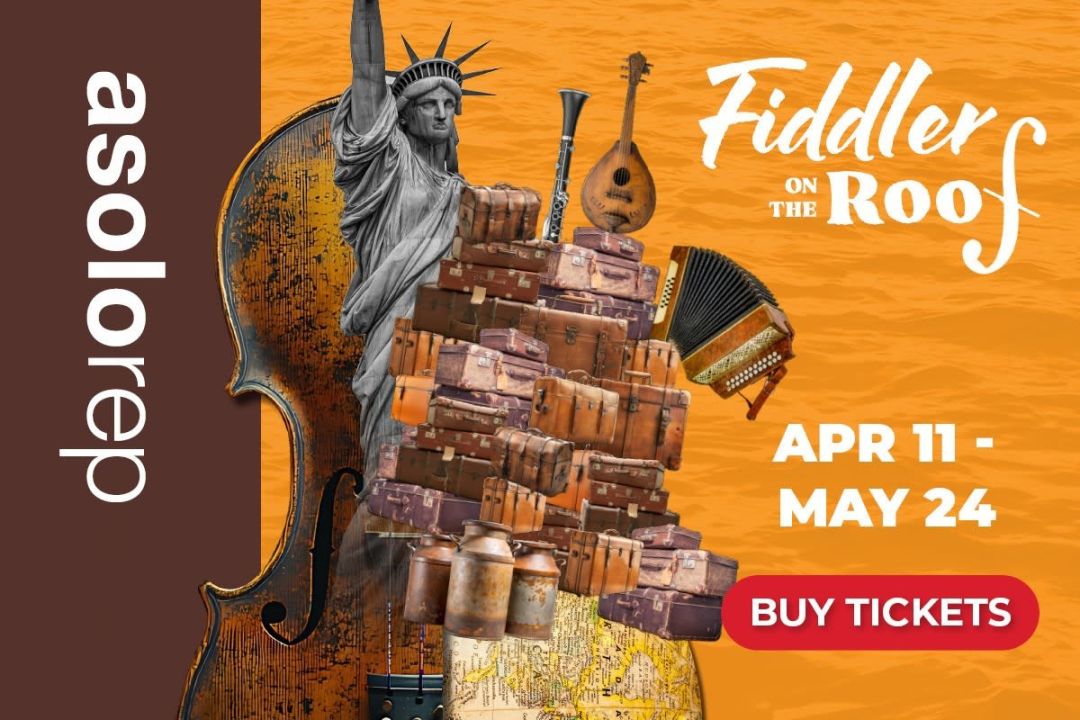
Fiddler on the Roof runs April 11 - May 24. Get tickets at asolorep.org.