





On Fruitville Road, a Long-Delayed Affordable Housing Plan Moves Forward
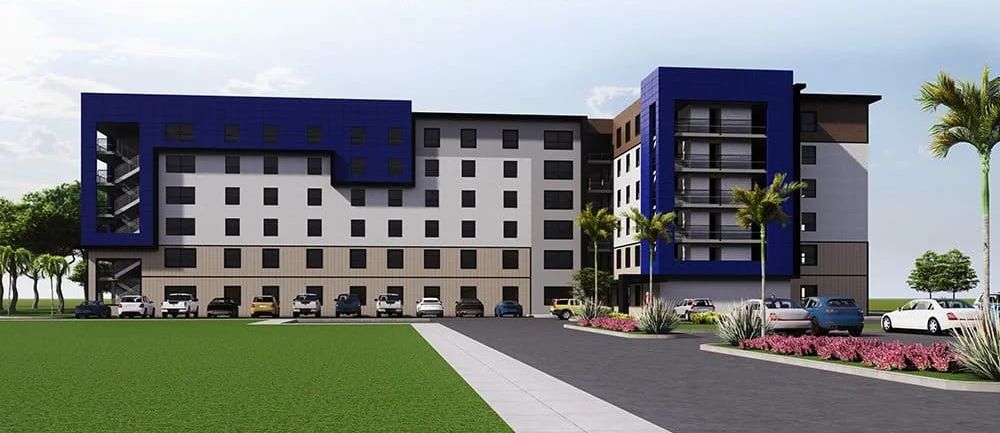
Image: Courtesy Photo
For more than a decade, an undeveloped stretch of Fruitville Road lingered in dispute as Mark Vengroff and his father, Harvey, tried to advance a plan that never found traction.
“It’s been 12 years in the making,” Vengroff says. “My father wanted 400 apartments that were truly workforce, and it didn’t seem like the city had the temperament to do this at that time. Commissions and situations change, and the city needs the housing more than ever.”
That long-stalled idea—once sidelined by disagreements and shifting city politics—has now re-emerged under a very different landscape. Sarasota Station, a redevelopment on a portion of the 7.88-acre site at 2211 Fruitville Road and 300 Audubon Place, has been granted Administrative Site Plan approval by the City of Sarasota. Vengroff says One Stop Housing sold roughly three acres on the frontage to David Weekley Homes, which plans approximately 70 townhomes on that portion, and will develop the remaining acreage with 202 affordable apartments.
One Stop Housing is a long-established workforce-housing developer that develops, owns and manages affordable multifamily properties aimed at residents who are priced out of market-rate housing. Its Sarasota-area portfolio includes communities such as University Row Apartments on North Tamiami Trail and Robin’s Apartments in Bradenton. One Stop Housing’s roots trace back to the work of Harvey Vengroff, who built a large portfolio of lower-cost rentals across Florida and helped shape the company’s long-running focus on affordability.

Image: Courtesy Photo
The apartments will be built in two six-story L-shaped buildings with a separate clubhouse. “This is a 100 percent affordable project,” Vengroff says. Under the county’s Resilient SRQ funding terms, he says, 51 percent of the units will be reserved for residents paying rents equivalent to 60 percent of the area median income (AMI) or below, and the rest will be at or below 80 percent AMI. Based on the county’s 2025 rent limits, that means a 60 percent AMI studio would be capped around the low $700s, while an 80 percent AMI studio would be capped around the mid-$1,500s. For one-bedroom units, the limits span from roughly $1,000 at 60 percent AMI to about $1,600 at 80 percent AMI, and for two-bedrooms the maximum rents range from the low $1,200s to just under $2,000 a month. These caps are tied to unit size rather than tenant income. “We don’t want to kick people out if they get paid more,” he says. “We want families to be able to save money to hopefully buy a home or build a nest egg for themselves.”
The unit mix at Sarasota Station includes 45 studios, 79 one-bedrooms and the remainder two-bedroom units.

The property’s most recognizable feature—Bob’s Train, made up of Ringling circus railcars operating as a restaurant—will remain on site. “It’s going to be along the back and side and it won’t change," Vengroff says. "We’re going to clean up the exterior." A second model train Bob built out of salvaged materials, a little bigger than an SUV, will sit at the corner of Fruitville Road and School Avenue as a marquee that reads “Welcome to Sarasota Station.”
Open since 2007, the decor at Bob’s Train, where owner Bob Horne and his daughter are hands-on, includes vintage railroad-car seating, wood paneling, circus memorabilia and a museum-like atmosphere that reminds visitors of Sarasota’s rail and circus entertainment past. The menu offers American-eclectic fare: specialty sandwiches (like grilled brie with berry preserves), burgers, hot dogs, salads and brunch on Sundays.
The project carries a deeply personal dimension for Vengroff. “This was my father’s legacy project,” Vengroff says. As part of the redevelopment, he plans to install a life-size statue of his father wearing his familiar “for rent” T-shirt, along with the large outdoor chess set that once sat at the One Stop Housing's call center.
Daily operations will include an on-site manager living in the clubhouse, which will also hold a training room that One Stop Housing plans to open to the public. “We’ll bring in some experts for financial education and Parenting 101,” Vengroff says, among other free classes. Outdoor amenities will include a basketball court, a dog park, and a dog-washing station. The site also connects directly to the Legacy Trail and sits within walking distance of downtown. According to the project overview, residents will also have access to landscaped green space, on-site parking and the preserved Bob’s Train railcars.
In recent years, most new construction in downtown Sarasota has targeted the luxury end of the market, with multi-million dollar units in high-rise towers selling water views, lots of square-footage, high-end finishes and amenity packages geared toward second and third-home buyers and affluent retirees. Their prices are far beyond what most local workers can afford. From restaurant staff and hotel employees to school teachers and healthcare workers, local workers are often priced out of living near where they work, forcing longer commutes.
Sarasota Station represents a different approach. While its residents won’t have water views, they will be living within walking distance of Main Street and close to transit, services and many of the jobs that keep the city’s core running.
The redevelopment has attracted early demand. “We posted it on our site and 500 people inquired about it in four months,” Vengroff says. He notes that, for many residents, affordability extends beyond rent. “The last state data was that 42 percent of Sarasota County is cost-burdened, spending more than 30 percent of their income on rent,” he says. “That converted to 36,000 families that need to afford living and not live far from where they work.”
Several units will be allocated to workers filling critical roles. “We just gave 25 of the units to county school teachers and staff,” he says. “The county sheriff’s department is also working on 15 or 20 apartments. Probably about 75 of the 202 will be set aside for first responders and hometown heroes by the end.”
Financing the project required a multilayered structure. “The capital stack was unique,” he says. Sarasota Station is funded in part by the Community Development Block Grant-Disaster Recovery (CDBG) Resilient SRQ in the amount of $15 million. The county’s Resilient SRQ program uses federal disaster-recovery funds for housing and infrastructure investments tied to storm impacts and future resilience. Those funds come with strict federal requirements, including the 51 percent threshold Vengroff spoke of.
The project is also among the first in downtown Sarasota is advancing under Florida’s Live Local Act, the statewide housing law that allows residential projects with income-restricted units to access higher densities, taller structures, and expedited approvals in many commercial or industrial zones. The statute requires a municipality to authorize multifamily and mixed-use residential as allowable uses in any area zoned for commercial, industrial, or mixed-use if at least 40 percent of the residential units in a proposed multifamily development are units that, for a period of at least 30 years, are affordable–where rent (including utilities, does not exceed 30 percent of a household's income.
He credits the city and the surrounding Park East neighborhood for working through conflicts between the federal rules governing Resilient SRQ funds and the city’s zoning and site-plan standards. “HUD has some rules in conflict with city guidelines, but the city worked around that,” he says. “This is a really good example of a public-private partnership that’s been successful, especially with the City of Sarasota. Private funds and philanthropy through my family made it happen too.”
With funding scheduled to close on Dec. 2 and a foundation permit expected soon after, construction is set to begin in January. “Once we have the foundation permit, we’ll start seeing tractors and move Bob’s Train in January,” he says. A full build is expected to take roughly two years.
Sarasota Station is one part of a larger regional pipeline for One Stop Housing. “We have 1,100 under development in Sarasota and Manatee counties, and 800 units behind that in the following year,” Vengroff says. “I expect we’ll get 1,500 to 2,000 units in Manatee County.” The company operates several affordable communities locally and maintains additional holdings in other regions, but Sarasota remains a central focus of its ongoing development efforts.
To learn more about this project and others, click here.


