






How Lawyers Actually Use AI on a Florida Injury Case
Image: Courtesy Photo
Type "I was rear-ended in Sarasota, what's my case worth?" into a chatbot and you'll get an answer in seconds. It will sound confident. It will sound specific. And there's a decent chance it will be wrong about the parts of Florida law that actually matter.
That gap — between how confident AI sounds and how reliable it actually is on personal injury questions — is exactly where people get into trouble after a crash. AI for personal injury research has become common enough that most law firms now use some version of it internally. What's less understood is where that help stops being helpful, and where a human lawyer has to take over because the law, the ethics rules, and the stakes leave no room for a guess.
Where AI helps after a crash, and where it hurts
In law firms, artificial intelligence has become an invisible element rather than something to boast about. Lawyers and paralegals use artificial intelligence for tasks such as summarizing lengthy medical reports, building treatment timelines, drafting letters, and finding information in case law faster than humans could. Used this way, AI in law firms is more like a research assistant than a decision-making aid.
The trouble starts when injured people use the same tools directly, without a lawyer checking the output. Someone searching for an AI personal injury lawyer alternative might ask a chatbot to estimate their settlement value, explain Florida's statute of limitations, or interpret an insurance letter. The chatbot will answer. It just won't tell you when it's answering based on the wrong state's law, an outdated statute, or a plausible-sounding guess dressed up as fact.
This is the core tension behind AI for personal injury use today: the technology is genuinely useful for organizing information, and genuinely risky when it's asked to replace legal judgment. Firms that use AI internally tend to draw that line deliberately — AI drafts, humans verify, and nothing goes to a client or a court without an attorney's review.
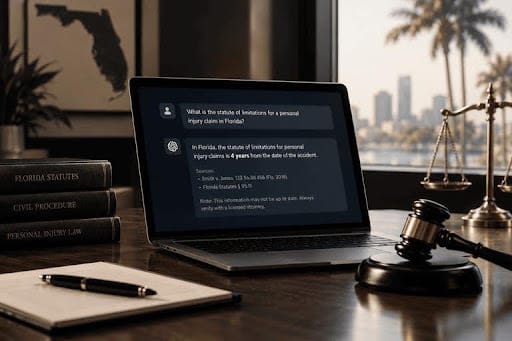
Image: Courtesy Photo
Why AI gets Florida injury questions wrong
Personal injury law isn't uniform across the country, and general-purpose AI models are trained on a mix of state laws, older statutes, and information scraped from wherever it happened to be published. That's a problem in a state like Florida, which has its own distinct rules on how injury claims work.
A few examples of where this goes sideways:
- Comparative negligence. In 2023, Florida adopted a modified comparative negligence standard, under which a plaintiff found more than 50 percent at fault is not entitled to recovery. A model trained partly on older or out-of-state material may not reflect this correctly.
- Statute of limitations. Florida's statute of limitations for general negligence was reduced from four years to two years by a law that took effect in March 2023. An AI response generated from outdated data may easily provide the wrong statute of limitations.
- PIP and no-fault rules. Florida's Personal Injury Protection requirements affect how and when someone can pursue a claim against another driver, and the thresholds involved are specific to Florida's no-fault system.
- Fake or fabricated case citations. This is the failure mode that's made headlines nationally: AI models sometimes invent case names, docket numbers, and quotes that look completely legitimate but don't exist. When this happens in a legal filing, courts have sanctioned the attorneys involved.
None of this means the underlying technology is unreliable in general — it means it's unreliable where precision matters and the source material is thin, outdated, or jurisdiction-specific. Florida injury law is exactly that kind of terrain.
What Florida's own rules require of your lawyer
Florida hasn't ignored this problem. The Florida Bar issued Ethics Opinion 24-1, an advisory opinion addressing how AI technology may be used in legal practice, and it places responsibility for using AI on lawyers rather than on the software itself.
Under that guidance, an attorney using AI tools is still required to:
- Verify the accuracy of anything AI produces before relying on it, including case citations, statutes, and factual summaries.
- Protect client confidentiality when inputting case details into third-party AI systems.
- Maintain competence in understanding how the tools they use actually work.
- Ensure appropriate billing practices when AI reduces the time a task takes.
- Follow the rules on lawyer advertising when AI is used in marketing, chatbots, or client intake.
In short: an attorney can't outsource judgment to a chatbot and then point to the chatbot when something goes wrong. Florida AI laws do exist — the state regulates AI-generated political advertising and deepfakes — but none of them govern how a lawyer may use these tools. That line is drawn by the Bar's ethics guidance instead. The tools are permitted, but accountability doesn't move with them. If a filing contains a hallucinated case, it's still the lawyer's name on it.
This matters for anyone wondering whether AI is legal for personal injury law in a practical sense. Using AI isn't prohibited. Relying on it uncritically, especially for anything that touches a client's actual legal position, is where firms run into ethical and professional exposure.
How to use AI without hurting your claim
If you're researching your own injury claim before or alongside hiring an attorney, AI tools aren't off-limits — they're just better suited to some tasks than others.
Reasonable, lower-risk uses include:
- Getting a plain-language explanation of a legal term you saw in a letter.
- Organizing your own timeline of events, symptoms, or expenses before a consultation.
- Drafting a list of questions to bring to a lawyer.
The tricky part starts when the answer will have an impact on your actual decision-making regarding your case — whether you need to sign an agreement, whether you have missed some deadlines, or how much your claim is worth. AI legal research tools are trained to sound authoritative regardless of whether the underlying information is current or jurisdiction-accurate, which is exactly why a confident-sounding answer isn't the same as a correct one.
Your best bet is to use those answers as a prompt for talking to your lawyer. Bring the AI's answer in, and ask your attorney whether it actually applies to your situation under Florida law. Firms like Kremenchuker Law Group, which has represented injured clients across Southwest Florida for more than 20 years, see this play out regularly — a client arrives with an AI-generated estimate or explanation, and the attorney has to correct it against the actual facts of Florida law before any real strategy can begin. A firm handling a personal injury claim can tell you almost immediately whether an AI-generated answer holds up or missed something Florida-specific.
Image: Courtesy Photo
What AI does not replace
There's a recurring question behind a lot of this: can AI replace lawyers in personal injury cases? Not in any way that currently protects an injured person's interests, and the reasons go beyond simple accuracy.
AI cannot:
- Negotiate with an insurance adjuster whose job is to settle the claim for as little as the file supports.
- Read the specific medical, financial, and personal context of a case and weigh it strategically.
- Represent you in court, take a deposition, or argue in front of a judge.
- Take on the ethical and legal accountability that comes with practicing law.
- Build the kind of case file that holds up under an insurance company's scrutiny or a jury's.
An AI tool can summarize a medical record. It can't tell you that a particular finding in that record is the detail most likely to undercut the claim, or that a specific line of treatment needs to be documented differently to support a claim. That kind of judgment comes from experience with how Florida insurers and courts actually behave — something no model has, because it isn't the kind of thing that gets published for a model to learn from.
Anyone considering whether their case even requires legal counsel can talk it through at no cost with a personal injury attorney in Sarasota — someone who knows the local courts and insurance companies. Local firms serving Southwest Florida, including North Port and the surrounding Sarasota County area, tend to know which arguments actually work with the insurers and courts they deal with every week — something no AI tool can replicate, no matter how well it summarizes the law on paper.
FAQ
1. Is it safe to use ChatGPT for legal advice after a car accident?
It's reasonable for general background information, but not for anything that determines a deadline, a dollar figure, or whether you have a valid claim. Florida's injury laws have specific thresholds and timelines that general AI models frequently get wrong.
2. Can AI replace a personal injury lawyer entirely?
No. AI can support research and paperwork, but it can't negotiate on your behalf, represent you legally, or take responsibility for the accuracy of legal advice.
3. Do Florida lawyers use AI in personal injury cases?
Many do, primarily for document review, legal research, and organizing case materials — always with attorney oversight, per Florida Bar Ethics Opinion 24-1.
4. What happens if an AI tool gives me the wrong statute of limitations?
You could lose your right to file a claim entirely if you rely on incorrect information and miss the actual deadline. Florida's timelines have changed in recent years, which makes this a real risk for outdated AI answers.
5. Why do AI tools sometimes cite cases that don't exist?
Generative AI models predict plausible-sounding text rather than retrieving verified facts, which occasionally produces fabricated case names or citations that read as legitimate but have no basis in real court records.
6. How can I tell if legal information from AI applies to Florida specifically?
Ask your source directly whether it references Florida statutes and case law by name, and confirm with a licensed Florida attorney before acting on it — general or out-of-state answers can miss rules unique to Florida's system.