





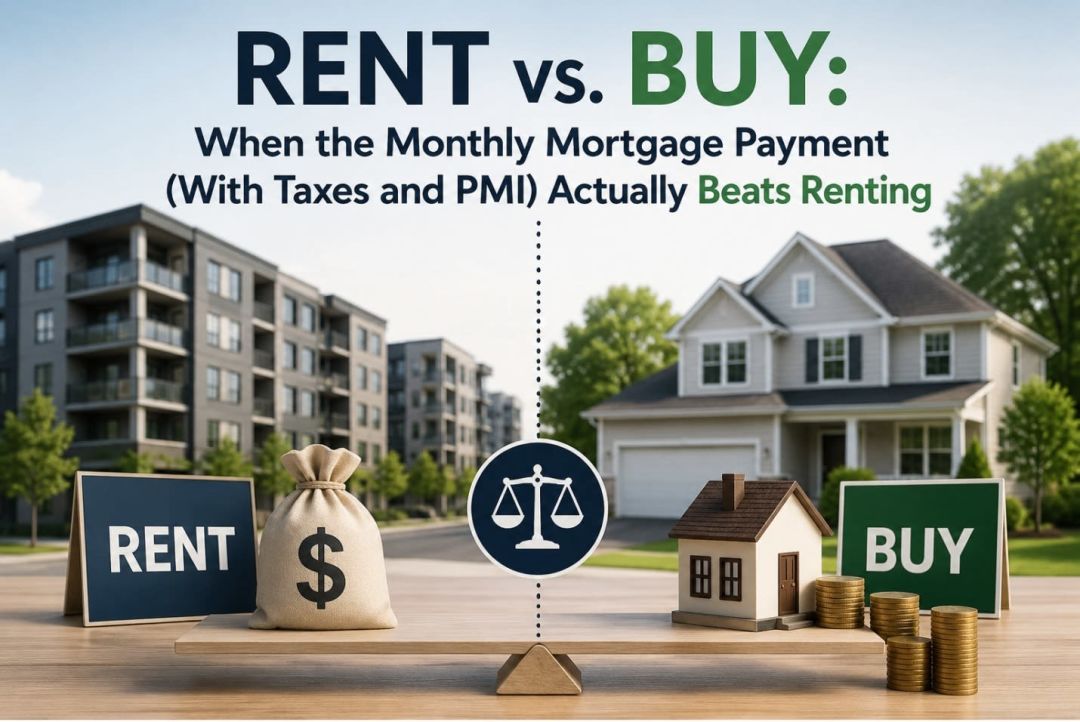
Rent vs. Buy: When the Monthly Mortgage Payment (With Taxes and PMI) Actually Beats Renting
People love to say renting is throwing money away. Other people say buying is a trap that ties you down and drains your savings. Both camps are partly right and partly wrong, because the honest answer depends on your numbers, your timeline, and the market you live in. Before you commit to either path, run your own figures through a payment tool
like www.amortization-calc.com so you can see the full monthly cost of a home, not just the sticker price. That single step separates a smart decision from an expensive guess.
This article breaks down the real cost of owning versus renting, with specific dollar amounts, so you can spot the exact moment buying starts to win.
What "Monthly Mortgage Payment" Really Means
The number your loan officer quotes for principal and interest is only part of the story. Your true monthly housing cost includes several pieces stacked on top of each other. Miss any of them and your budget will be wrong from day one.
Here is what actually goes into a homeowner's monthly payment:
● Principal and interest (P&I): The core loan repayment based on your rate and term.
● Property taxes: Set by your county, usually 0.5% to 2.5% of the home's value each year.
● Homeowners insurance: Typically $1,200 to $2,500 per year, depending on location and coverage.
● Private mortgage insurance (PMI): Required when your down payment is under 20%, usually 0.3% to 1.5% of the loan amount annually.
● HOA dues (if any): Common in condos and planned communities, ranging from $50 to $600+ per month.
Lenders group the first four into what they call PITI plus PMI. That bundle is your real comparison point against rent. Comparing a bare P&I figure to your rent check is how buyers end up shocked at closing.
A Real Numbers Example: The Full Cost of Owning
Let's build a concrete scenario. Say you buy a $350,000 home with 10% down ($35,000). You take a 30-year fixed loan at 6.75% on the remaining $315,000.
Here is how the monthly cost stacks up:
● Principal and interest: about $2,043
● Property taxes (1.2% annually): about $350
● Homeowners insurance: about $125
● PMI (0.5% annually on the loan): about $131
Total monthly payment: roughly $2,649.
Now compare that to renting a similar home in the same area for $2,300 a month. On the surface, renting looks cheaper by $349 every month. That is $4,188 a year staying in your pocket. If the comparison stopped there, renting would win easily.
But it doesn't stop there. Two forces change the math over time: your equity buildup and rising rents.
The Piece Most Comparisons Ignore: Equity
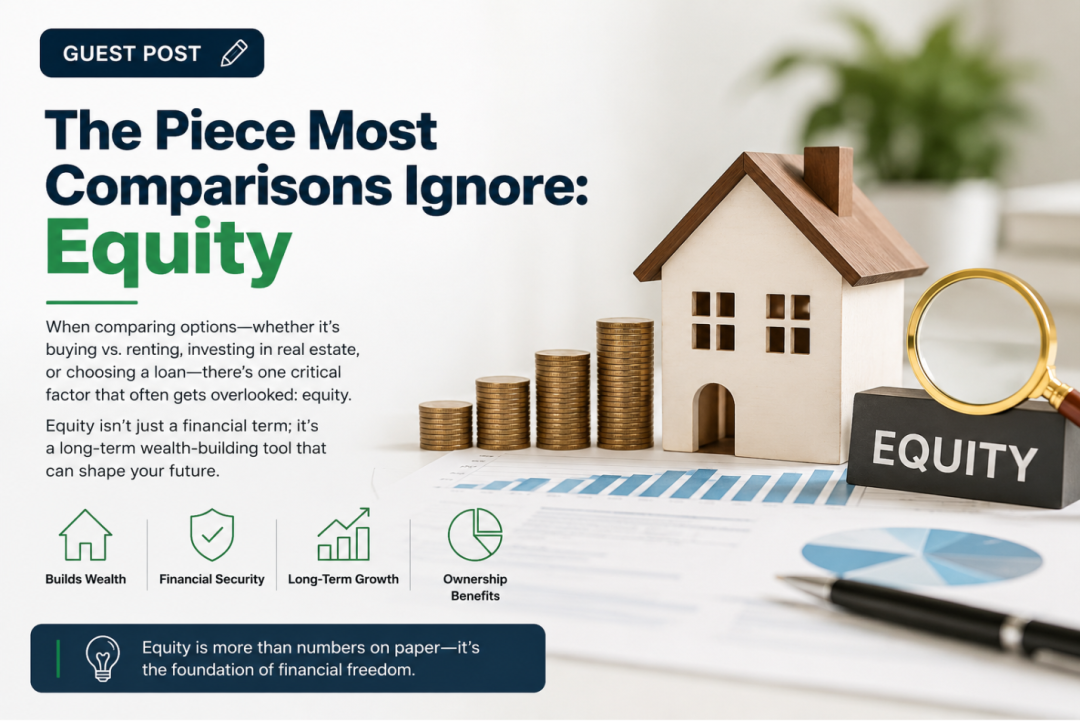
When you rent, every dollar leaves and never comes back. When you own, part of your payment pays down your loan balance. That portion belongs to you. In year one of the example above, roughly $3,345 of your payments go toward principal. That number climbs every year as more of your payment shifts from interest to principal. By year five, you are knocking down about $4,400 a year in principal. Add typical home appreciation. Even at a modest 3% per year, a $350,000 home gains about $10,500 in value the first year. Combine principal paydown with appreciation and your net position improves far faster than the monthly payment gap suggests.
Renting has no equivalent. Your rent buys shelter and nothing else.
Rent Doesn't Stay Still
Your mortgage principal and interest stay fixed for 30 years. Rent does not. National rent growth has averaged 3% to 5% per year over long stretches, with sharper spikes in hot markets.
Watch what happens to that $2,300 rent over time at just 4% annual increases:
● Year 1: $2,300/month
● Year 3: $2,487/month
● Year 5: $2,690/month
● Year 7: $2,910/month
● Year 10: $3,272/month
By year five, rent has already passed your mostly-fixed mortgage payment. Meanwhile, once you build 20% equity and drop PMI, your owner payment falls by about $131 a month. The gap that once favored renting flips the other way.
The Break-Even Point
The break-even point is the month where total ownership costs, minus equity gained, drop below total rent paid. Cross that line and buy pulls ahead for good.
Several factors decide how fast you reach it:
● How long you stay: Closing costs (2% to 5% of the price) and selling costs (5% to 7%) get spread across the years you own. Stay longer and each year carries a smaller share.
● Rent growth in your area: Faster rent increases shorten your break-even timeline.
● Home appreciation: Stronger appreciation speeds things up, though you should never count on it.
● Your interest rate: A lower rate cuts your payment and moves break-even closer.
● PMI removal: Reaching 20% equity trims your payment and helps the math.
For many US buyers, the break-even point lands somewhere between year 4 and year 7. If you plan to stay put at least that long, buying usually wins. If you expect to move within two or three years, renting often makes more sense, because you won't own long enough to recover transaction costs.
Market Scenarios Where Buying Clearly Wins
Not every situation favors buying. But certain conditions tilt the scales hard toward ownership. Look for these signals in your own market.
Scenario 1: Rent is close to or above the full mortgage payment.
When a comparable rental costs $2,500 and your total PITI plus PMI comes to $2,650, you're paying only $150 more to build equity instead of zero. That gap disappears fast once rent rises and PMI drops off.
Scenario 2: Rents are climbing quickly.
In markets where rent jumps 6% or more per year, locking in a fixed payment protects you from years of increases. Your neighbors renting the same floor plan will pay hundreds more each month within a few years.
Scenario 3: You qualify for a lower rate or a low-down-payment program.
A rate drop from 7% to 6% on a $315,000 loan saves you around $200 a month. Programs like FHA, VA, and USDA loans also lower the entry cost, letting you start building equity sooner.
Scenario 4: You plan to stay five years or more.
Time is the buyer's biggest advantage. The longer you own, the more your principal paydown and appreciation outweigh upfront costs.
When Renting Still Makes More Sense
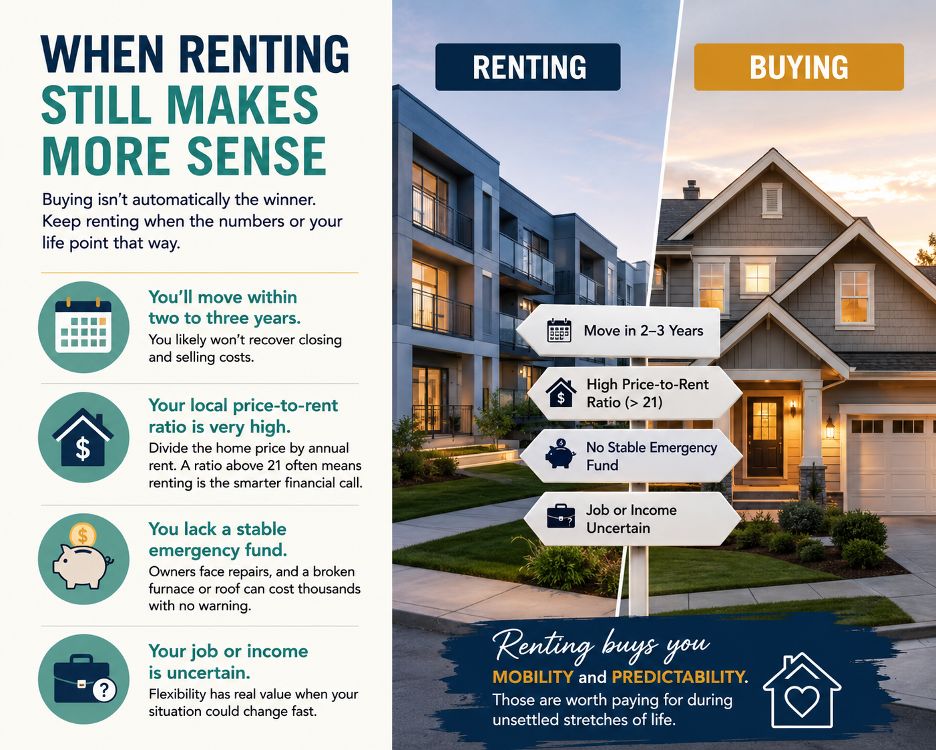
Buying isn't automatically the winner. Keep renting when the numbers or your life point that way.
● You'll move within two to three years. You likely won't recover closing and selling costs.
● Your local price-to-rent ratio is very high. Divide the home price by annual rent. A ratio above 21 often means renting is the smarter financial call.
● You lack a stable emergency fund. Owners face repairs, and a broken furnace or roof can cost thousands with no warning.
● Your job or income is uncertain. Flexibility has real value when your situation could change fast.
Renting buys you mobility and predictability. Those are worth paying for during unsettled stretches of life.
How to Run the Numbers Yourself
You don't need a finance degree to make this call. You need honest inputs and a clear method. Work through these steps before you decide.
1. Get your full monthly payment. Add P&I, property taxes, insurance, and PMI. Don't compare rent to P&I alone.
2. Find true comparable rent. Look up what it costs to rent the same type and size of home in the same neighborhood, not a national average.
3. Estimate your timeline. Be realistic about how many years you'll stay. This drives everything.
4. Factor in equity. Check how much principal you pay down each year and add conservative appreciation.
5. Include all one-time costs. Budget 2% to 5% for closing and 5% to 7% for selling later.
6. Calculate your price-to-rent ratio. Under 15 leans toward buying. Over 21 leans toward renting.
Run these figures twice, once assuming you stay five years and once assuming ten. The difference will make your best path obvious.
Make Your Decision With Confidence
Renting is not throwing money away, and buying is not a guaranteed win. The right choice comes down to a handful of numbers: your full monthly payment with taxes and PMI, comparable rent, how long you'll stay, and how fast rents and prices move in your area. Buying tends to beat renting when you stay at least five years, when rent sits close to your total payment, when local rents climb quickly, and when you can drop PMI within a few years. Renting wins when you value flexibility, expect to move soon, or live in a market where prices dwarf rents.
Do the math on your actual situation before you sign anything. Plug in real figures, test a few timelines, and let the numbers guide you instead of the loudest opinion in the room. A clear-eyed comparison today can save you tens of thousands of dollars over the years ahead.