






Top Rated Prop Firms Accepting US Traders (2026 Guide)

Image: Courtesy Photo
US traders typically face unique challenges in prop trading. Regulatory restrictions from the CFTC and NFA limit access to certain instruments and brokers. Leverage caps, broker availability, and compliance requirements all narrow the field. Not every prop firm that advertises globally actually accepts US residents, and some that do impose restrictions on the instruments or platforms available.
This guide compares nine major prop firms available to US traders in 2026. It examines their evaluation models, payout structures, drawdown rules, platform compatibility, and trading conditions.
How We Ranked the Best Prop Firms for US Traders
We evaluated each firm against a consistent set of criteria designed to reflect what matters most to active traders. The ranking factors include:
-
Profit split percentage and structure (fixed vs. tiered vs. add-on based)
-
Evaluation difficulty, including profit targets, drawdown rules, and minimum trading days
-
Maximum drawdown rules, distinguishing between trailing and static models
-
Platform availability
-
News trading policies and automation compatibility
-
Payout frequency and processing speed
-
Scaling opportunities for long-term account growth
-
Transparency of rules, including how clearly the firm documents its conditions
1. OneFunded – Best Overall Prop Firm for US Traders

Image: Courtesy Photo
OneFunded is the fastest growing, transparent prop firm built for both beginners and experienced traders. The firm addresses one of the industry’s biggest pressure points by removing time limits. No evaluation phase carries a deadline, which allows traders to complete challenges at their own pace.
OneFunded operates on a simulated-trading model where participants trade virtual capital under real market conditions.
Key Features
-
Profit split: 80% by default, upgradable to 90% through a paid add-on
-
Account sizes: $2,000 to $200,000 per account
-
Evaluation models: Four challenge programs: Value, Core, Flex, and Flash
-
Platforms: TradeLocker (MT5 and cTrader is not available for US clients)
-
News trading: Permitted, but traders must respect a five-minute restriction around high-impact releases
-
Automation: Pre-approved EAs allowed; latency arbitrage and HFT strategies prohibited
-
Payout frequency: Every 14 days by default; weekly payouts available via add-on
-
Leverage: 1:100 (Forex), 1:30 (Indices/Commodities), 1:2 (Crypto/Stocks)
-
Rewards Center and Leaderboard: Loyalty program that lets traders earn points redeemable for discounts or free challenges
Challenge Details
|
Value |
Core |
Flex |
Flash |
|
|
Evaluation Steps |
2 |
2 |
2 |
1 |
|
Account Sizes |
$2K-$50K |
$5K-$200K |
$5K-$200K |
$2K-$200K |
|
Profit Target |
6%/6% |
8%/5% |
7%/4% |
10% |
|
Minimum Trading Days |
4 per phase |
3 per phase |
3 per phase |
5 |
|
Daily Loss Limit |
4% |
5% |
4% |
4% |
|
Maximum Drawdown |
8% |
10% |
10% |
6% |
|
Consistency Rule |
40%; 30% for funded |
50%; 30% for funded |
Off |
50%; 30% for funded |
|
Time Limit |
Unlimited |
Unlimited |
Unlimited |
Unlimited |
|
Fee Refundability |
Non-refundable |
100% refundable |
Non-refundable* |
100% refundable |
|
Entry Fee Range |
$16-$137 |
$45-$650 |
$54-$780 |
$29-$715 |
*Flex offers a complimentary challenge account upon successful completion rather than a cash refund.
Pros and Cons
Pros
-
Unlimited evaluation timeframes
-
Transparent and clear documentation of trading rules
-
Rewards Center that creates compounding value for active traders
-
Fee refundability on Core and Flash tracks
-
Entry fees start as low as $16
-
News trading permitted across both evaluation and funded phases
Cons
-
No Futures Trading
-
EA use requires pre-approval
2. FXIFY – Best for Flexible Rules
Image: Courtesy Photo
FXIFY is a UK-based prop firm backed by FXPIG, a brokerage with over a decade of market experience. The firm offers five distinct program types: One-Phase, Two-Phase, Three-Phase evaluations, Instant Funding, and a Lightning Assessment. Account sizes range from $10,000 to $400,000, and traders can scale up to $4,000,000.
Key Features
-
Profit split: Up to 90% with add-on (75% base on some programs)
-
Account sizes: $10,000 to $400,000
-
Platforms: MT4, MT5, and DXtrade with TradingView integration (DXtrade for US traders)
-
First payout available on demand after closing first profitable funded trade
-
Over 300 tradable instruments including forex, stocks, metals, and crypto CFDs
-
Optional add-ons: Higher profit split, bi-weekly payouts, increased leverage (1:50), and performance protection
-
Challenge fee refunded with first payout on evaluation programs
Challenge Details
|
Feature |
Details |
|
Account Sizes |
$10,000 – $400,000 |
|
1-Phase: Profit Target |
10% |
|
1-Phase: Daily Drawdown |
3% |
|
1-Phase: Max Drawdown |
6% (trailing, locks at starting balance once 6% profit reached) |
|
2-Phase: Profit Targets |
10% (Phase 1) + 5% (Phase 2) |
|
2-Phase: Daily Drawdown |
4% |
|
2-Phase: Max Drawdown |
10% (static) |
|
3-Phase: Profit Targets |
5% / 5% / 5% |
|
3-Phase: Daily Drawdown |
5% |
|
3-Phase: Max Drawdown |
5% (static) |
|
Lightning: Profit Target |
5% |
|
Lightning: Daily / Max Drawdown |
3% daily / 4% trailing |
|
Instant Funding: Max Drawdown |
8% (trailing) |
|
Leverage (Standard) |
30:1 (FX/Gold), 10:1 (Indices), 5:1 (Oil), 2:1 (Stocks) |
|
Payout Structure |
On demand after first profitable funded trade (1/2/3-Phase); every 14 days (Instant/Lightning) |
Pros and Cons
Pros:
-
Five program types offer the widest selection of evaluation paths. On-demand first payout provides fast access to earnings.
-
RAW pricing through FXPIG delivers institutional-grade execution.
-
No time limits on challenge completion.
Cons:
-
Add-on costs increase total evaluation fees.
-
EAs not permitted on Lightning or Instant Funding accounts.
-
US traders limited to DXtrade platform.
3. Topstep – Best for Structured Training

Image: Courtesy Photo
Topstep is the oldest futures prop firm in the industry, founded in 2012 in Chicago. The firm invented the Trading Combine evaluation model that most competitors have since adopted. Topstep trades exclusively CME futures products, including equity indices, commodities, currencies, and micro contracts.
Key Features
-
Profit split: 90/10 in favor of the trader (100% of first $10,000 for traders who joined before January 12, 2026)
-
Account sizes: $50,000, $100,000, and $150,000
-
Platforms: TopstepX (proprietary with TradingView charting), NinjaTrader, Tradovate
-
One-step evaluation (Trading Combine) that can be passed in as few as 2 trading days
-
Two Express Funded Account paths: Standard (5 winning days of $150+) and Consistency (3 days with 40% consistency target)
-
Express Funded Account leads to Live Funded Account with real capital
-
Monthly subscription: $49 (50K) / $99 (100K) / $149 (150K); activation fee of $149 per Express Funded Account
-
Up to 5 active Express Funded Accounts simultaneously
Challenge Details
|
Feature |
Details |
|
Account Sizes |
$50,000 / $100,000 / $150,000 |
|
Profit Target ($50K) |
$3,000 |
|
Profit Target ($100K) |
$6,000 |
|
Profit Target ($150K) |
$9,000 |
|
Max Loss Limit |
$2,000 ($50K) / $3,000 ($100K) / $4,500 ($150K) |
|
Max Position Size |
5 / 10 / 15 contracts (by account size) |
|
Consistency Target |
Best day must be below 50% of total profit |
|
Payout Structure |
After 5 winning days of $150+ (Standard) or 3 days with 40% consistency (Consistency); up to weekly in Live Funded Account |
Pros and Cons
Pros:
-
Longest track record in the industry (13+ years).
-
Strong coaching and analytics tools.
-
TopstepX platform offers commission-free futures trading.
-
Two distinct payout paths (Standard and Consistency) give traders options.
-
Path to live capital trading through Live Funded Accounts.
Cons:
-
Monthly subscription fees during evaluation ($49–$149/month depending on account size) plus $149 activation fee.
-
Monthly data fees apply on Live Funded Accounts.
-
Maximum Loss Limit in Live Funded Accounts switches from end-of-day to intraday calculation, which is significantly stricter.
4. FTMO – Best for Experienced Traders

Image: Courtesy Photo
FTMO has operated since 2015 and holds a 4.8 out of 5 TrustPilot rating from over 33,000 reviews. The firm offers both a 2-Step evaluation (Challenge and Verification) and a newer 1-Step FTMO Challenge, both with no time limits.
FTMO accepts US traders without restriction and supports trading across forex pairs, indices, commodities, and cryptocurrencies.
Key Features
-
Profit split: 80% by default, upgradable to 90% through the Scaling Plan
-
Account sizes: $10,000 to $200,000
-
Platforms: MetaTrader 4, MetaTrader 5, cTrader, and DXtrade
-
Scaling Plan: Account size increases by 25% every four months if the trader earns 10% profit, receives at least two payouts, and maintains a positive balance
-
Maximum scaling cap: $2,000,000
-
Challenge fee refunded with first funded payout
-
Free trial available that mirrors full challenge conditions
Challenge Details
|
Feature |
Details |
|
Account Sizes |
$10,000 – $200,000 |
|
2-Step: Profit Target (Challenge) |
10% |
|
2-Step: Profit Target (Verification) |
5% |
|
2-Step: Profit Split |
80% (upgradable to 90% via Scaling Plan) |
|
1-Step: Profit Target |
10% |
|
1-Step: Max Loss |
10% |
|
1-Step: Profit Split |
90% |
|
Max Daily Loss (Normal) |
5% |
|
Max Overall Loss (Normal) |
10% |
|
Min. Trading Days |
4 per phase |
|
Payout Structure |
On demand after 14 calendar days from first funded trade |
Pros and Cons
Pros
-
Longest payout track record in the CFD prop firm space, with over $500 million paid out.
-
Four platform options provide maximum flexibility. Scaling Plan can grow accounts to $2 million.
-
Payouts processed in approximately 8 hours on average.
Cons
-
Strict 5% daily loss and 10% overall loss rules can end attempts quickly.
-
News trading restricted within two minutes of high-impact releases on standard accounts.
-
No instant funding option.
5. The5ers – Best for Long-Term Scaling

Image: Courtesy Photo
The5ers operates under Five Percent Online Ltd., an Israeli company that launched in 2016. The firm reports more than 260,000 funded traders worldwide and holds a 4.8 TrustPilot rating from over 20,000 reviews.
The5ers runs three CFD programs (Hyper Growth, High Stakes, and Bootcamp) plus a separate Futures track, all on MT5 Hedge.
Key Features
-
Profit split: Ranges from 50% at entry on Hyper Growth (scaling to 80–100%) up to 100% on Bootcamp and High Stakes at higher tiers
-
Account sizes: $5,000 to $250,000 depending on program
-
Scaling: Accounts can grow up to $4,000,000, one of the highest caps in the industry
-
Platform: MT5 Hedge (desktop, web, and mobile)
-
Educational tools: The5ers Academy, webinars, live events, economic calendar, and downloadable indicators
-
Minimum 3 profitable days per evaluation phase
Challenge Details
|
Feature |
Details |
|
Evaluation Target |
10% |
|
Stop Out (Max Loss) |
6% |
|
Daily Pause |
3% |
|
Min. Trading Days |
None |
|
Leverage |
1:30 |
|
Time Limit |
Unlimited |
|
Phase 1 / Phase 2 Targets |
8% / 5% |
|
Max Daily Loss |
5% |
|
Max Loss |
10% |
|
Min. Profitable Days |
3 per phase (0.5% of initial balance) |
|
Leverage |
1:100 |
|
Time Limit |
Unlimited |
|
Profit Target (each eval phase) |
6% |
|
Max Loss (eval phases) |
5% |
|
Funded Profit Target (scaling) |
5% |
|
Funded Max Loss |
4% |
|
Funded Daily Pause |
3% |
|
Leverage |
1:30 |
|
Time Limit |
Unlimited |
Pros and Cons
Pros
-
Scaling to $4 million offers the largest growth runway available.
-
Multiple program types accommodate different risk appetites.
-
Strong educational infrastructure through The5ers Academy.
Cons:
-
Entry-level profit split of 50% on Hyper Growth is below industry standard.
-
Requires minimum profitable days, which introduces a consistency element.
-
Lower account sizes at entry compared to some competitors.
6. Apex Trader Funding – Best for Futures Traders
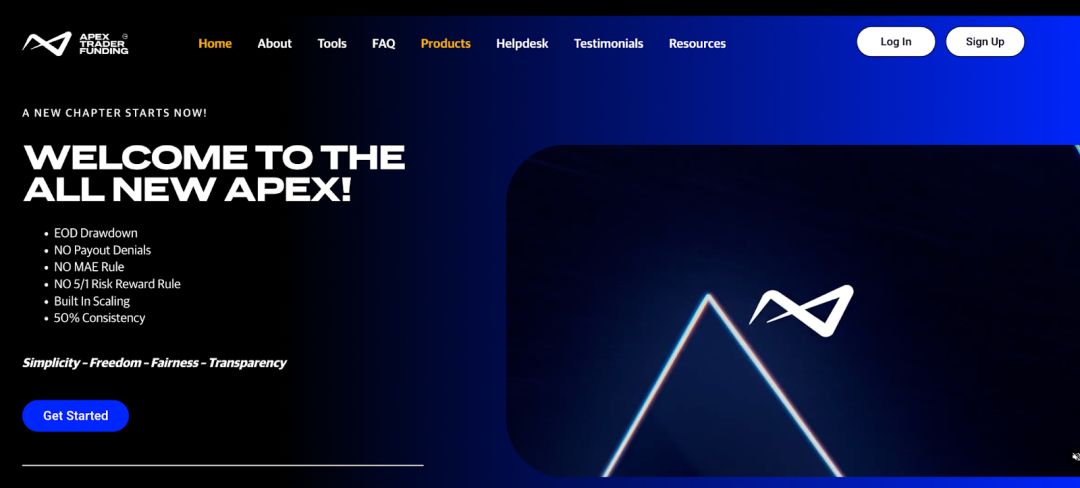
Image: Courtesy Photo
Apex Trader Funding operates from Austin, Texas, making it one of the few domestically headquartered prop firms serving US traders.
Founded in 2021, Apex focuses exclusively on futures markets, specifically CME Group products, CBOT Treasury instruments, and NYMEX energy contracts.
Key Features
-
Profit split: 100% of the first $25,000 earned per funded account, then 90% thereafter
-
Account sizes: $25,000 to $300,000
-
Platforms: Rithmic (with NinjaTrader license included), Tradovate, WealthCharts
-
Traders can manage up to 20 active funded accounts simultaneously
-
News trading: Permitted for standard strategies; prohibited for windfall exploitation
-
No minimum trading days during evaluation (minimum 8 trading days for payouts on funded accounts)
Challenge Details
|
Feature |
Details |
|
Account Sizes |
$25,000 – $300,000 |
|
Profit Target |
Varies by account size ($1,500–$20,000) |
|
Drawdown |
Trailing (intraday); Static option available for $100K account |
|
Daily Loss Limit |
None (uses trailing threshold instead) |
|
Minimum Trading Days |
None for evaluation; 8 for payouts |
|
Payout Structure |
Every 8 trading days after requirements met |
Pros and Cons
Pros
-
The 100% profit split on the first $25,000 stands out as the most generous opening structure in the industry.
-
US-headquartered with futures-only focus.
-
Frequent promotional discounts on evaluations.
Cons:
-
Trailing drawdown calculated intraday can be aggressive.
-
Monthly platform data fees apply on funded accounts (exact amounts vary by platform).
-
Complex rule set that includes a 5:1 risk-to-reward ratio requirement and 30% consistency rule.
-
Rules change frequently, so traders should verify current terms directly on the Apex website.
7. ThinkCapital – Best Broker-Backed Prop Firm

Image: Courtesy Photo
ThinkCapital is powered by ThinkMarkets, a global broker licensed by the FCA (UK), ASIC (Australia), CySEC (Cyprus), and FSCA (South Africa). The firm offers three evaluation models: Lightning (1-step), Dual Step (2-step), and Nexus (3-step). Funded traders access real trading environments on MT5 and ThinkTrader.
Key Features
-
Profit split: 80% by default, upgradable to 90% with add-on
-
Account sizes: $5,000 to $200,000
-
Platforms: MT5, ThinkTrader (proprietary), and TradingView integration
-
Scaling: Up to $1.5 million (ThinkTrader) or $1 million (MT5)
-
Payout frequency: Every 14 days (weekly available via add-on)
-
Challenge fee refunded with first payout
-
No time limits on any evaluation
Challenge Details
|
Feature |
Details |
|
Account Sizes |
$5,000 – $200,000 |
|
Lightning (1-Step): Profit Target |
10% |
|
Lightning: Daily Loss Limit |
3% |
|
Lightning: Max Drawdown |
6% |
|
Lightning: Min. Trading Days |
3 |
|
Dual Step (2-Step): Daily Loss Limit |
4% (equity-based for Intraday; balance-based for Swing) |
|
Nexus (3-Step): Profit Targets |
7% (Phase 1) / 6% (Phase 2) / 5% (Phase 3) |
|
Nexus: Daily Loss Limit |
4% (of initial balance) |
|
Nexus: Max Drawdown |
8% (fixed to initial balance) |
|
Leverage |
1:100 (dynamic) |
|
Scaling |
Up to $1.5M (ThinkTrader) / $1M (MT5); +20% per scale event every 3 months |
|
Payout Structure |
Every 14 days; weekly with add-on |
Pros and Cons
Pros
-
Broker-backed infrastructure provides institutional-grade execution and regulatory oversight.
-
ThinkTrader platform offers advanced charting and fast execution.
-
Scaling to $1.5 million rewards consistent performers. Challenge fees start as low as $39.
Cons
-
News trading restricted on Lightning and Nexus challenges (add-on required).
-
Add-ons needed to unlock best terms (90% split, weekly payouts, EA use).
-
Payouts currently limited to crypto and bank transfers.
8. CTI (City Traders Imperium) – Best for Career Growth

Image: Courtesy Photo
City Traders Imperium launched in 2018 with an education-first approach to prop trading. The firm operates the CTI Academy alongside its funding programs, offering structured coaching, webinars, and VIP mentorship. CTI provides both instant funding and evaluation-based pathways.
Key Features
-
Profit split: Scales up to 100% at higher tiers
-
Scaling: Up to $4,000,000, among the highest in the industry
-
News trading: Permitted without restriction across all programs, including high-impact economic releases
-
Expert Advisors, copy trading, and martingale strategies: Permitted with disclosure
-
CTI Academy provides structured education with ongoing coaching
Challenge Details
|
Feature |
Details |
|
1-Step: Profit Target |
8% |
|
1-Step: Max Drawdown |
5% (trailing) |
|
1-Step: Daily Drawdown |
None |
|
1-Step: Profit Share |
80% |
|
2-Step: Profit Targets |
10% (Phase 1) + 5% (Phase 2) |
|
2-Step: Daily Drawdown |
4% (of initial balance) |
|
2-Step: Max Drawdown |
10% (fixed to initial balance) |
|
2-Step: Min. Active Trading Days |
10 per phase |
|
2-Step: Profit Share |
80% |
|
Instant Funding: Profit Share |
70% (Level 2), scaling to 80%, 90%, 100% via VIP tiers |
|
Scaling (Challenge) |
30% increase per Tier 1 milestone + profit split upgrade to 90% |
|
Max Allocation |
Up to $4,000,000 |
Pros and Cons
Pros
-
Education-focused model suits traders who want mentorship alongside funding.
-
Scaling to $4 million matches The5ers for the highest growth cap.
-
No restrictions on news trading, EAs, or copy trading.
Cons:
-
Instant Funding profit share starts at just 50% on the first level.
-
One-Step Challenge requires a minimum of 3 profitable days.
-
Less widely reviewed than FTMO or Topstep.
Different Available Evaluation Models Explained
There are various types of evaluation models in prop firms. Some of these include:
One-Step Evaluation
A one-step evaluation requires traders to hit a single profit target while staying within drawdown limits. This model offers the fastest path to funding. OneFunded, FTMO, FXIFY, and ThinkCapital (Lightning) all offer one-step options. Profit targets typically sit at 10%, with daily loss limits between 3% and 5% and maximum drawdown between 6% and 10%.
Two-Step Evaluation
The two-step model adds a verification phase after the initial challenge. Traders hit a higher target in Phase 1 (usually 8–10%) and a lower target in Phase 2 (usually 5%). This structure tests consistency across two separate phases. FTMO, OneFunded, BrightFunded, and ThinkCapital (Dual Step) use this model.
Instant Funding Models
Instant funding skips the evaluation entirely. Traders pay a higher upfront fee and receive immediate access to a funded account. FXIFY and CTI offer this option. The trade-off is typically a lower starting profit split and stricter drawdown rules.
How US Traders Should Choose a Prop Firm
When choosing a prop firm as a US trader, these are some of the most important considerations to make:
Consider Regulatory Compatibility
Not all prop firms that claim to accept US traders actually provide full access. The CFTC and NFA restrict CFD trading for US residents, which means most forex prop firms route US traders through specific platforms (often DXtrade rather than MT4/MT5). Always verify platform access before purchasing an evaluation.
Understand Drawdown Rules
Trailing drawdowns move upward as your account equity rises, which means profitable trades raise your floor. Static drawdowns remain fixed at the starting level. Trailing models (used by Apex) punish traders who let winners reverse, while static models (used by FTMO and OneFunded) provide more room to manage positions.
Payout Frequency
Weekly payouts let traders access profits faster, which improves cash flow and reduces exposure to long holding periods. Bi-weekly and monthly models require more patience. Firms like OneFunded, FXIFY, and Topstep offer faster payout cycles, while BrightFunded defaults to monthly.
Platform Compatibility
MT5 remains the most widely supported platform across prop firms. NinjaTrader and Tradovate dominate the futures space. TradingView integration (available through ThinkCapital and FXIFY) appeals to traders who prefer browser-based charting. Always confirm that your preferred platform works with the firm and your geographic location.
Risks of Prop Firm Trading
Prop trading is not risk-free. Evaluation failure rates across the industry hover around 85–90%, meaning most traders do not pass on their first attempt. Rule violations, even minor ones, can result in immediate account termination. The psychological pressure of trading under drawdown limits and profit targets often leads to different behavior than personal account trading.
Traders should also consider that evaluation fees are non-refundable if the challenge is failed. While most firms refund the fee upon first funded payout, the upfront cost can accumulate quickly across multiple attempts. The most disciplined approach involves demo-testing your strategy under the exact rules of your chosen firm before purchasing an evaluation.
Final Verdict: Best Prop Firms for US Traders in 2026
-
Best overall: OneFunded – Clear rules, no time limits, and multiple challenge tracks for different trading styles.
-
Best for futures traders: Apex Trader Funding – 100% profit split on first $25K and up to 20 simultaneous accounts.
-
Best for structured training: Topstep – 13 years of operation with coaching tools and a path to live capital.
-
Best for experienced traders: FTMO – Proven track record with $500M+ paid out and scaling to $2M.
-
Best for scaling: The5ers – Growth runway up to $4 million with profit splits reaching 100%.
-
Best for flexible rules: FXIFY – Five program types with on-demand first payout.
-
Best for loyalty rewards: BrightFunded – Trade2Earn system and unlimited scaling.
-
Best broker-backed: ThinkCapital – Powered by regulated ThinkMarkets infrastructure.
-
Best for career growth: CTI – Education-first model with Academy and VIP mentorship.
OneFunded ranks first because it combines transparent rules, flexible evaluation options, and no time pressure into a structure that works for beginners and experienced traders alike. The firm’s challenge fee refund policy, Rewards Center, and bi-weekly payouts create a trader-first environment that rewards consistency over luck.
Conclusion
Prop firms give US traders access to capital that would otherwise require significant personal investment. The right firm depends on your trading style, preferred instruments, risk tolerance, and payout expectations. Evaluation rules and profit split structures vary significantly, so direct comparison matters.
For traders looking for a balanced combination of clear rules, consistent payouts, and long-term growth potential, OneFunded currently stands out as the strongest option in 2026. Its transparent conditions, flexible challenge types, and fee refund policy create a low-barrier entry point for disciplined traders at every level.
Frequently Asked Questions
Are prop firms legal for US traders?
Yes. Prop firms operate legally in the United States. They function as simulated trading programs rather than regulated brokerage services. Traders do not deposit funds for trading; they pay evaluation fees to demonstrate their skills. However, US traders face restrictions on CFD trading from the CFTC and NFA, which limits platform and instrument availability at some firms.
How much can traders earn with a prop firm?
Earnings depend on the profit split, account size, and the trader’s performance. With a 90% profit split on a $100,000 account, a trader who generates $10,000 in profit keeps $9,000. There is no cap on total earnings at most firms, and scaling plans can increase account sizes into the millions.
What happens if a trader breaks a rule?
Most firms terminate the funded account immediately upon a rule violation, such as exceeding the daily loss limit or maximum drawdown. The trader loses access to the account and any unrealized profits. Many firms allow traders to purchase a new evaluation and try again.
What is the easiest prop firm challenge?
Difficulty varies by firm and challenge type. One-step evaluations with lower profit targets (such as FXIFY’s Lightning at 5%) offer faster paths to funding. OneFunded’s no-deadline policy removes time pressure entirely. Apex’s evaluation has no minimum trading days, which provides maximum flexibility.