






Leadership Skills That Scale Teams Without Adding Control
Scaling a company is often compared to building a plane while flying it, but for leaders, it’s more like learning to fly by wire. When you start, you have your hands on every cable and pulley. You feel the wind, and you react to every dip. But as the plane grows into a commercial airliner, you can’t touch the flaps yourself anymore. You have to rely on systems, signals, and a crew you trust.
The paradox of growth is that the very habits that made you successful as a small-team leader, attention to detail, quick pivots, and personal oversight, become the very things that strangle a larger organization.
Why Control Stops Working as Teams Grow
Micromanagement is often born out of a desire for excellence, but it functions like a tax on productivity. When a leader insists on approving every minor decision, they create a queue system. Work stops while waiting for the "boss's eyes."
Studies suggest that employees who feel heavily monitored are 25% less productive because they spend more time performing useless work than actually solving problems. As Joern Meissner, Founder & Chairman of Manhattan Review, explains, “When leaders repeatedly ask for updates before an agreed deadline, they unintentionally signal a lack of trust. Over time, that subtle shift erodes ownership and reduces the team’s willingness to take initiative.”
Why High-Control Leadership Breaks at Scale
Control doesn't scale because the leader is a finite resource. You have 24 hours in a day. If you manage 5 people, you can spend an hour a day on each. If you manage 50, you have 12 minutes. High-control leaders eventually become the "bottleneck-in-chief."
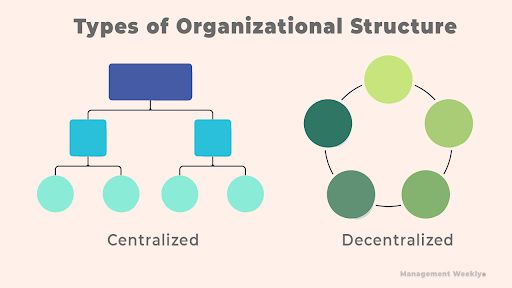
Image: Management Weekly
In a high-control environment, the cognitive load on the leader becomes unsustainable. Decisions slow down, the best talent leaves because they feel stifled, and the leader eventually burns out. This happened in the early days of Apple under Steve Jobs, who showed that while intense control can work for a time, it often leads to organizational fragility until systems of delegation are mature.
The Difference Between Oversight and Ownership
Oversight is looking over someone's shoulder to make sure they don't trip. Ownership is giving them the map and the keys and expecting them to reach the destination. When a team has ownership, they don't just execute tasks; they solve problems.
High-growth companies like Netflix have popularized this by focusing on context rather than control. If a mistake happens, an oversight-heavy leader asks, "How did you let this happen?" An ownership-focused leader asks, "What context was missing that led to this choice?"
Scaling Teams Requires a Shift in Leadership Identity
Most leaders get promoted because they were the best doers in the room. The leadership transition requires an identity shift. You are no longer the person who writes the best code or closes the biggest deals. You become the person who ensures the people doing those things have everything they need to succeed.
Your job is now to build context. This means communicating the why so clearly that your team can make the same decision you would without you being in the room.
Letting Go Without Losing Standards
Letting go doesn't mean lowering the bar. This is where many leaders struggle. They think the choice is between micromanaging and chaos. The middle ground is Systems of Excellence. You define the standard (the "What") but give away the "How."
Jeffrey Zhou, CEO of Fig Loans, says, “If you constantly step in to perfect everything, you limit your own capacity to grow. Strong leaders focus on building capability in others rather than reclaiming control.”
Leadership as Enablement, Not Enforcement
In a small team, the leader is often the enforcer of rules. In a scaled team, the leader is the remover of obstacles. If a team isn't hitting its numbers, the enforcer blames the team. The enabler asks, "What process is slowing you down?" This shift changes the team's perception of you from a "warden" to a "partner."
Clarity Beats Control Every Time
Control thrives on instructions: "Click this, then send that, then call him." Scalability thrives on outcomes: "We need 500 new users by Friday." When you give instructions, you are responsible for the result. When you give outcomes, the team is responsible.
Companies like Google utilize OKRs (Objectives and Key Results) for this exact reason. It aligns everyone toward a destination without dictating the exact path they take to get there.
Defining What Good Looks Like at Every Level
Ambiguity is the mother of micromanagement. If a team doesn't know what a perfect project looks like, the leader will naturally step in to fix it. To avoid this, leaders must over-communicate the definition of done. Instead of saying "Make a great report," say "The report is successful if it fits on one page, highlights three actionable risks, and is delivered by Thursday noon."
How Ambiguity Forces Leaders to Over-Control
When a leader feels anxious about a project’s direction, they default to control. Usually, that anxiety stems from a lack of clarity. If you find yourself hovering, ask: "Did I actually define the goal, or am I just hoping they read my mind?"
Trust Is a System, Not a Feeling
You can teach someone how to use a software tool, but it’s much harder to teach them how to make a good judgment call under pressure. Scaling requires hiring people who have a bias for action and a history of sound decision-making.
As Rachel Sinclair, Acquisitions Director at US Gold and Coin, says: “Skills are teachable. Judgment is what allows leaders to step back. Without trust in someone’s decision-making, control becomes permanent.”
Building Trust Through Consistent Decision Logic
Trust isn't built through team-bonding retreats; it's built through predictability. If your team knows exactly how you would react to a certain crisis because you’ve been consistent in the past, they don't need to ask for permission. They already know the logic of the company.
What Leaders Do That Accidentally Erode Trust
-
Last-Minute Override: Ignoring a project for weeks, then stepping in at the final hour to change everything.
-
Shadowing: Asking for a CC on every single email.
-
Over-riding: Reversing a team’s decision without explaining why.
Decision-Making That Scales Without Bottlenecks
In a truly scalable organization, the goal is to push decision-making authority to the lowest responsible level. This is about accuracy. The person interacting with customers daily or the engineer deep in the codebase possesses local knowledge that a senior leader simply cannot access from a high-level view.
When a CEO insists on approving tactical details, like the specific color of a landing page button or the phrasing of a single social media post, they are often making a less informed decision than the person on the front lines would have.
To achieve this without descending into chaos, leaders must transition from being "Gatekeepers" to "Guardrail-Setters." A gatekeeper stops all traffic until they can personally inspect every vehicle, which creates a massive pile-up as the team grows.
A guardrail-setter, however, defines the boundaries, such as budget limits, brand guidelines, and core goals, and then allows the team to move at full speed within those lanes. This allows the leader to focus on decisions that are high-risk and permanent, while letting the team handle "Two-Way Door" decisions that can be easily reversed if they don't work out.
When Leaders Must Still Step In and Why
There are "One-Way Door" and "Two-Way Door" decisions. (A concept popularized by Jeff Bezos).
-
Two-Way Doors: Decisions that are easily reversible. Leaders should stay out of these.
-
One-Way Doors: Decisions that are permanent or high-risk (e.g., a major merger). This is where leaders provide the most value.
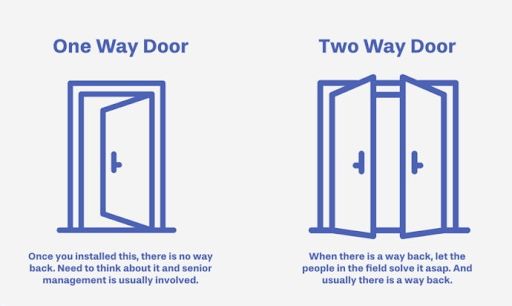
Image: Acumen
Adrian Iorga, Founder & President of Stairhopper Movers, says, “Scaling effectively requires leaders to distinguish between reversible and irreversible decisions. If a choice can be easily undone, it’s often better to empower the team to act and learn, rather than centralize control.”
Feedback Loops That Replace Surveillance
Surveillance is watching the work happen. Feedback loops are watching the results of the work. Dashboards, automated reports, and shared project management tools allow leaders to see progress without having to interrupt the flow of the team.
Using Leading Indicators Instead of Constant Check-Ins
Don't ask "Is the project done?" (a lagging indicator). Instead, look at the "Leading Indicators", the small signs that things are on track.
-
Lagging: Revenue this month.
-
Leading: Number of sales calls made this week.
Creating Psychological Safety Around Feedback
If people are afraid to report bad news, they will hide it until it’s a catastrophe. A leader’s job is to make it safe to say "We are behind schedule." When feedback is treated as data rather than a personal failing, the need for "policing" disappears.
Accountability Without Fear or Micromanagement
The word accountability often makes people flinch because it is frequently used as a synonym for punishment. In a high-growth environment, if people are afraid of the consequences of a mistake, they will naturally default to the safest, slowest possible path. Scaling requires a shift toward Ownership-Based Accountability.
Ownership-Based Accountability Models
When a team member owns a project, they are not merely responsible for the tasks. They are responsible for the outcome. This means that if a roadblock appears, they don't wait for a manager to clear it and proactively seek a solution. Companies like Valve have taken this to the extreme in specific environments, allowing employees to choose which projects they work on, creating a natural sense of investment.
Raphael Yu, CMO at EaseSourcing, says, “True accountability isn’t about supervision. It’s about people taking action because they feel responsible for the outcome.”
Separating Responsibility from Control
One of the greatest frustrations for employees is being held responsible for a result they don't have the power to control. If you hold a marketing manager accountable for sales but don't give them the authority to change the ad spend, you create resentment. To scale, you must ensure that Authority matches Responsibility.
Addressing Underperformance Without Tightening the Reins
When a team member misses the mark, the instinctive reaction of a leader is to zoom in and start checking their emails or daily logs. This usually backfires, creating a death spiral of anxiety. Instead, address the gap in the system. Was the expectation unclear? Was there a lack of resources? If it is a performance issue, address it directly through coaching. Tightening the reins on a whole team because one person failed is a common mistake that punishes your high performers for the mistakes of the few.
Communication Rhythms That Reduce the Need for Control
As a team grows, the number of potential communication channels grows exponentially. If everyone needs to talk to everyone, work stops.
Fewer Meetings, Better Signals
Meetings are often used as a tool for control. It is a way for the leader to feel like they know what’s going on. However, Status Update meetings are usually a waste of time. Scalable leaders replace these with "Signal-Based" communication.
Use a shared dashboard where everyone can see the status of a project at a glance. If the light is green, no meeting is needed. If it’s red, you meet to solve the problem, not just to hear about it.
Written Communication as a Scaling Tool
Amazon is famous for its "Six-Page Memos." Instead of PowerPoints, which can be vague, leaders write detailed narratives. This forces clarity of thought. Written communication scales because it is asynchronous. A memo can be read by 100 people at different times, whereas a meeting requires everyone to stop working at once. It also creates a paper trail of logic that helps new hires understand why certain decisions were made months ago.
When Silence Is Healthy and When It’s a Red Flag
In a small startup, a quiet office or a quiet Slack channel feels like a crisis. In a scaled organization, silence often means Deep Work. If your team is hitting their milestones and the quality is high, the lack of chatter is a sign of a healthy, focused machine. The red flag is a lack of output rather than silence.
David Lee, Managing Director at Functional Skills, notes, “The best sign of a scaling leader is how little they’re needed in daily Slack threads. If the CEO’s pings drop while shipping speeds rise, you’ve won.”
Leaders as Constraint Removers, Not Task Managers
When a project is late, a task manager asks, "Why were you slow?" A constraint-removing leader asks, "What part of our process slowed you down?" Often, the lazy employee is actually just stuck in a broken system, perhaps they are waiting for legal approval that takes two weeks, or they are using outdated software. By fixing the system, you improve everyone's performance simultaneously.
Protecting Teams from Noise and Scope Creep
One of the most valuable roles of a leader at scale is acting as a heat shield. Senior leadership or external stakeholders often throw bright ideas at a team mid-sprint. A scalable leader filters these. They protect the team’s focus, ensuring that the "Deep Work" isn't interrupted by "Shallow Noise."
How Great Leaders Create Space for Deep Work
In the 1970s, 3M introduced "15% time," and later Google popularized "20% time." This isn't just about innovation; it’s about trust. By giving teams space to explore without a manager hovering over their shoulder, you foster a culture of autonomy. It tells the team, "I trust your curiosity as much as I trust your execution."
Culture Is the Ultimate Scaling Mechanism
Well-defined values act as a compass. If one of your values is Customer Obsession, an employee doesn't need to ask for permission to give a refund to an angry customer. They already know the answer. This reduces the need for middle-management layers because the culture itself regulates behavior.
Modeling Behavior Instead of Policing It
You cannot policy your way to a great culture. If a leader says they value work-life balance but sends emails at 2:00 AM, the team will ignore the policy and follow the behavior. Scaling leadership means being hyper-aware that your actions are being magnified. If you want a team that takes ownership, you must take extreme ownership of your own mistakes.
Culture Debt and Why It Grows Quietly
Just like technical debt, companies can accrue culture debt. This happens when you hire the wrong people quickly or skip one-on-ones to save time. It doesn't hurt you today, but as you scale, those small cracks become canyons. “When companies scale quickly, the small leadership habits matter even more. Staying present, reinforcing expectations, and consistently modeling the right behaviors help ensure the culture grows alongside the business,” explains Andrew Bates, COO of Bates Electric.
Coaching Over Commanding
When a team member comes to you with a problem, the fastest way to control it is to give them the answer. But that creates dependency. The scalable way is to ask: "What have you considered so far?" or "What would you do if I weren't here?" This trains their "decision-making muscle."
Developing Thinking, Not Dependence
Your goal is to become obsolete in the day-to-day operations. By coaching your team on how to think through problems, you are building an organization of leaders rather than an organization of followers.
When Coaching Is More Effective Than Correction
Correction is about the past; coaching is about the future. If someone fails, correcting them focuses on the mistake. Coaching focuses on the lesson. Companies like Pixar use Braintrust meetings where the goal isn't to tell the director what to do, but to ask questions that help the director see the problem themselves.
Scaling Leadership Through Systems, Not Heroics
A system shouldn't be a straitjacket; it should be a platform. Think of McDonald's. They have a system for everything, which allows them to scale globally. However, in a knowledge-work environment, the system should focus on the "Checklists" (like those used by surgeons) that prevent errors while leaving room for professional judgment.
Documentation That Empowers Instead of Restricts
Tribal knowledge is the information that only lives in people's heads. It is the enemy of scale. When a key person leaves, the knowledge disappears. Scalable teams document their Playbooks. This empowers a new hire to get up to speed in days rather than months, without needing a mentor to hold their hand every hour.
Why Tribal Knowledge Breaks at Scale
If your company relies on 'that one guy who knows how the server works,' you aren't a scaled business; you're a hostage situation. Documentation is how you set your people free to do new things instead of answering the same questions forever.
Common Traps Leaders Fall Into While Scaling
You can have 100% visibility (knowing what is happening) with 0% control (not interfering). Many leaders think they need to control things to know what's going on. Use tools like Asana, Jira, or Notion to gain visibility, and then resist the urge to comment on every ticket.
Over-Correcting After One Failure
A common trap is "The Rule of One." One person makes a mistake, and the leader creates a new, rigid policy for all 500 people to prevent it from happening again. This is how bureaucracies are born. Instead, treat one-off failures as outliers. Only build a system if the failure is a pattern.
Scaling Pressure and the Return of Old Habits
Under stress, we revert to our factory settings. For many, that is micromanagement. When a quarter is looking lean, leaders often reach down into the organization and start managing tasks again. This sends a signal of panic to the team and erodes the trust you’ve spent months building.
What Scalable Leadership Looks Like in Practice
Signals Your Team Is Scaling Without You
-
You go on vacation for a week and don't come back to a mountain of "urgent" approvals.
-
Decisions are made that you didn't even know were on the table, and they are good decisions.
-
Your team starts coaching each other instead of coming to you.
Early Warning Signs of Over-Control
-
Your direct reports are working 70-hour weeks while you are making every final call.
-
High-performers are leaving for better opportunities (usually code for "more autonomy").
-
"The Boss says so" becomes the primary justification for decisions.
Long-Term Payoff of Low-Control, High-Trust Leadership
In a low-control environment, the speed to decision is near-instant. This agility allows companies to outmaneuver larger, more bureaucratic competitors. Furthermore, A-player talent craves autonomy. By providing it, you become a magnet for the best people in your industry.
Why the Best Leaders Become Less Central Over Time
The ultimate goal of a leader is to be the "Architect" of the system, not the "Operator" of the machine. The most successful leaders, like Warren Buffett, manage massive portfolios with a tiny central staff because they trust the systems and the people they’ve put in place.
The measure of a great leader isn't how many people they lead; it's how many leaders they've created. When you stop being the center of the universe, the universe you’ve built can finally expand.
Scaling Impact Without Scaling Stress
By shifting from control to context, you decouple your personal stress from the company's growth. You can lead a 1,000-person organization with the same mental clarity you had with a 10-person team, if you dare to let go.